Psyllium Husk
Overview
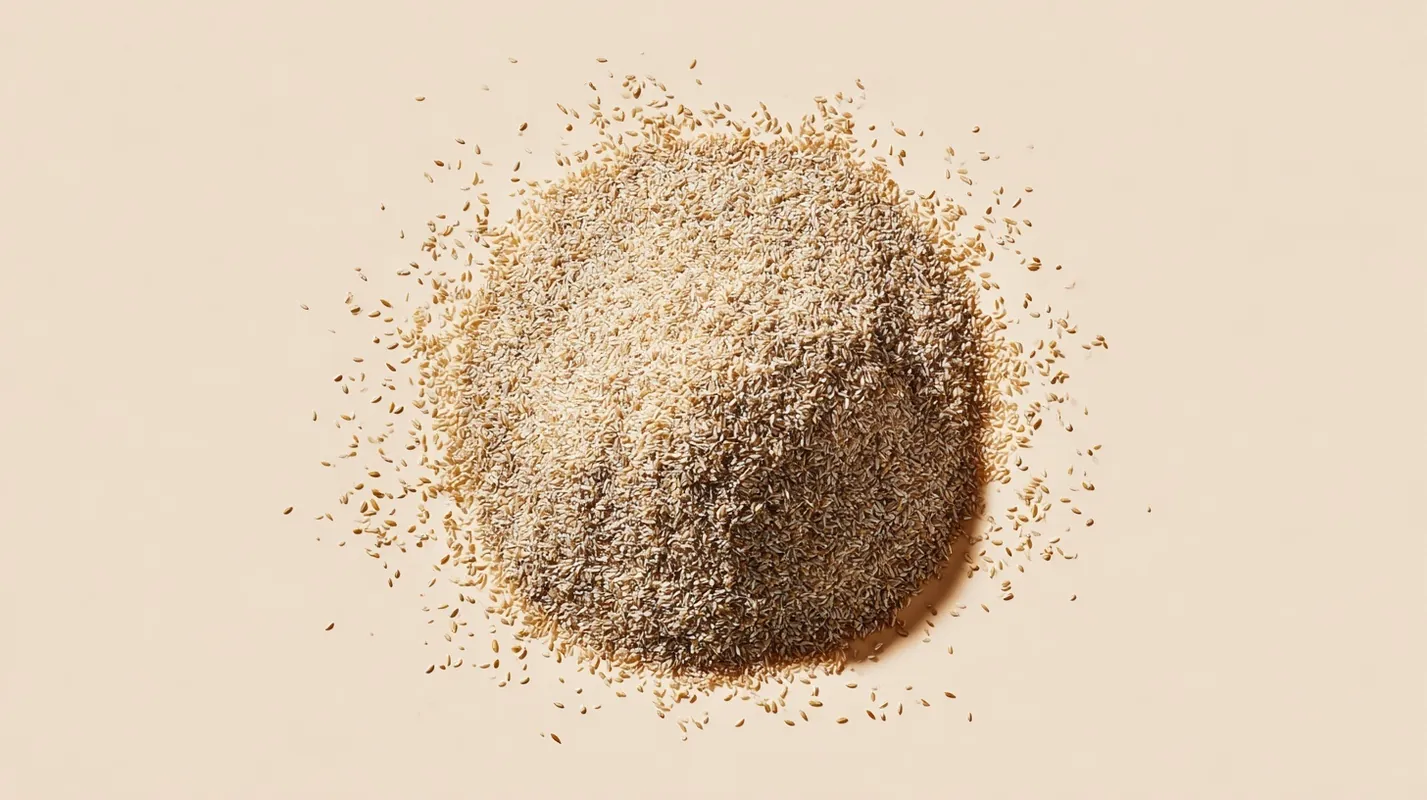
Psyllium husk is a concentrated, fibre-dominant food ingredient derived from Plantago seed husks and used primarily for its high soluble fibre content. Its nutritional identity is defined by very high dietary fibre with minimal fat and protein contribution, making it a functional matrix additive rather than a standalone energy source.
Within the BRAIN Diet framework, psyllium is most useful as a meal-structure tool to increase viscous fibre load and support slower post-prandial glucose appearance when added to otherwise low-fibre meals. It is best interpreted as a dose-sensitive adjunct food ingredient that supports glycaemic buffering and digestive regularity rather than as a replacement for whole-food fibre diversity
Key Nutritional Highlights
- Extremely high fibre density per 100 g relative to most whole foods.
- Adds viscosity and bulk with negligible sugar contribution.
- Functions mainly as a functional ingredient rather than a primary macronutrient source.
- Works best alongside whole-food fibre diversity, not as a sole fibre strategy.
Food Context
Synergies
- Pairs well with mixed meals containing starches and refined carbohydrates where extra viscous fibre is needed for better meal-level glycaemic buffering.
- Can be combined with legumes, oats, vegetables, and seeds to strengthen total-fibre meal architecture.
Preparation
- Hydrate with adequate liquid and distribute across meals to improve tolerance and practicality.
- Introduce gradually to reduce gastrointestinal discomfort during adaptation.
Recipes
Nutrient Tables (per 100 g)
Core nutrients
| Nutrient | Amount per 100 g | % RDA per 100 g |
|---|---|---|
| Energy | 200 kcal | — |
| Protein | 2.5 g | — |
| Total fat | 0.6 g | — |
| Saturated fat | 0.1 g | — |
| Carbohydrates | 88.9 g | — |
| Sugars | 0 g | — |
| Fibre | 77.8 g | — |
Substances
References
[1] It is best interpreted as a dose-sensitive adjunct food ingredient that supports glycaemic buffering and digestive regularity rather than as a replacement for whole-food fibre diversity. Reynolds & Mann 2019. Dietary fibre and cardiometabolic outcomes meta-analysis