Turmeric Milk
Overview
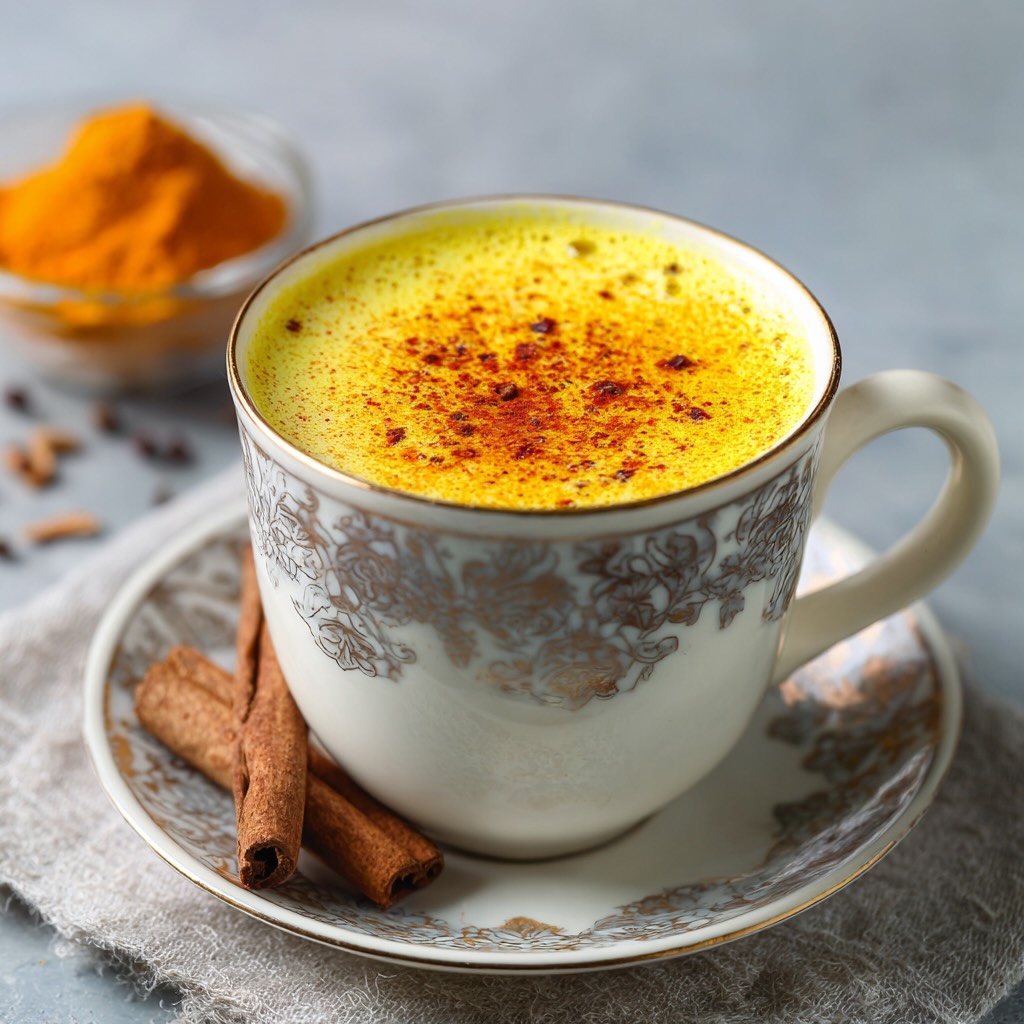
Turmeric milk combines turmeric (curcumin) with milk or plant-based milk. Curcumin is fat-soluble, so the fat in milk can improve its absorption; black pepper (piperine) is also associated with enhanced curcumin absorption. This warming drink is ideal for evening consumption.
Ingredients
- 1 cup milk (dairy or plant-based)
- 1 tsp (5 ml) turmeric powder
- ½ tsp black pepper (optional, for enhanced absorption)
- 1 tsp honey or maple syrup (optional, for sweetness)
- ½ tsp ground cinnamon (optional)
- Pinch of ground ginger (optional)
Nutrition calculation uses whole dairy milk.
Method
- Heat the milk in a small saucepan over medium heat until warm (do not boil).
- Add turmeric powder and stir until well combined.
- Add black pepper, cinnamon, and ginger if using, and stir.
- Simmer gently for 2-3 minutes, stirring occasionally.
- Remove from heat and add honey or maple syrup if desired.
- Strain through a fine mesh sieve if needed to remove any clumps.
- Serve warm.
Nutrition
Per serving. Each included ingredient is scaled from a named per-100 g composition record by edible grams. Optional ingredients are excluded. Missing analytical values are not treated as zero.
| Nutrient | Per serving |
|---|---|
| Energy | 160 kcal |
| Protein | 8 g |
| Carbohydrates | 14 g |
| Sugars | 12 g |
| Fibre | 0.68 g |
| Total fat | 8 g |
| Saturated fat | 4.6 g |
| Sodium | 110 mg |
Key vitamins and minerals
| Nutrient | Per serving | Reference intake |
|---|---|---|
| Vitamin B12 | 1.1 µg | 46% RDA |
| Vitamin B2 | 0.42 mg | 32% RDA |
| Phosphorus | 210 mg | 31% RDA |
| Calcium | 280 mg | 28% RDA |
| Manganese | 0.60 mg | 26% AI |
| Vitamin D | 3.2 µg | 21% RDA |
| Vitamin B5 | 0.93 mg | 19% AI |
| Selenium | 9.2 µg | 17% RDA |
Vitamins and minerals supplying at least 15% of an adult reference intake, plus explicitly featured design-relevant nutrients, up to eight. RDA is a recommended dietary allowance; AI is an adequate intake, used where the evidence does not support an RDA. Nutrients below the threshold are still calculated and still count towards a daily total; a featured row is not a claim that the serving supplies a complete daily dose.
Bioactive compounds
No bioactive compound has a defensible quantitative value for this serving. Values reported only as presence, traces or ranges are not summed into a number.
Calculation details
| Ingredient | Weight used | Composition record |
|---|---|---|
| 1 cup (244 g) whole milk | 244 g | USDA FDC 171265 — Milk, whole, 3.25% milkfat |
| 1 tsp (3 g) ground turmeric | 3 g | USDA FDC 172231 — Spices, turmeric, ground |
Mainly from:
- Energy: Milk
- Protein: Milk
- Carbohydrates: Milk, Turmeric
- Sugars: Milk
- Fibre: Turmeric
- Total fat: Milk
- Saturated fat: Milk
- Sodium: Milk
Assumptions and exclusions:
- 1 cup (244 g) whole milk: USDA SR Legacy FDC 171265 food_portion: 1 cup = 244 g
- 1 tsp (3 g) ground turmeric: USDA SR Legacy FDC 172231 food_portion: 1 tsp = 3 g. The previous entry used 2.6 g, which is the cinnamon teaspoon weight.
- ½ tsp black pepper (optional, for enhanced absorption) — the recipe marks black pepper optional, so it is not in the default total
- 1 tsp honey or maple syrup (optional) — optional sweetener
- ½ tsp ground cinnamon (optional) — optional ingredient
- pinch of ground ginger (optional) — optional ingredient, no stated quantity
- Black pepper is listed as optional in the recipe, so the default total is milk plus turmeric. Adding ½ tsp black pepper contributes about 3 kcal.
Brain Health Notes
- Turmeric contains curcumin, a polyphenol studied for anti-inflammatory and antioxidant effects.
- Milk or plant-based milk provides fat that can improve curcumin absorption, since curcumin is fat-soluble.
- Black pepper contains piperine, which is associated with enhanced curcumin bioavailability.
Explore the foods and substances
Show 3 foods and their substances

Black Pepper
Culinary pepper whose piperine characterises the spice

Milk
Dairy drink providing complete protein and calcium
Substances: Calcium, Indispensable amino acids, Magnesium, Nicotinamide riboside, Phosphorus (Phosphate), Potassium, Vitamin B1 (Thiamine), Vitamin B12 (Cobalamin), Vitamin B2 (Riboflavin), Vitamin B5 (Pantothenic Acid), Vitamin D, Zinc

Turmeric
Curcumin source; pair with black pepper and fat for absorption
Substances: Curcumin (Turmeric)
Ingredient identity is contextual only: this recipe’s ripeness, preparation and delivery have not been reconciled with the composition material below. No recipe-level conversion or PM intervention is established.
Foods supply the named dietary input. They are not shown as containing the downstream metabolite. Conversion evidence does not establish a new downstream PM admission, effective dose or equivalent food intervention.
Vitamin B2 → Riboflavin kinase (RFK) phosphorylates riboflavin to FMN using ATP. → Flavin mononucleotide (FMN)
BRS1-FM1-PM3: Maintain appropriately regulated dopamine synthesis, storage, release, receptor signalling, reuptake and metabolism across changing functional demand.
Existing admission: Type A / derived; versioned-assessment. Production context for an already admitted substrate; no new metabolite-to-PM relationship is admitted.
Rat enzyme capacity, not measured human neurotransmitter clearance, synaptic output or benefit above adequacy. No conclusion about which flavin analogue is effective is taken from the internally inconsistent abstract. The same experiment is shared across the three monoamine PMs, not independent replication.
- Milk — source composition context for Vitamin B2; verified; form not known. Milk, whole, 3.25% milkfat, with added vitamin D
Composition provenance
USDA SR Legacy April 2018
Enzyme identity does not quantify tissue cofactor supply or flux after a meal.
Dependencies: Functional RFK; ATP and divalent metal availability
Vitamin B2 → Riboflavin kinase (RFK) phosphorylates riboflavin to FMN using ATP. → FLAD1 FAD synthase adenylates FMN with ATP to form FAD. → Flavin adenine dinucleotide (FAD)
BRS1-FM1-PM3: Maintain appropriately regulated dopamine synthesis, storage, release, receptor signalling, reuptake and metabolism across changing functional demand.
Existing admission: Type A / derived; versioned-assessment. The complete derived relationship is admitted for this PM.
Rat enzyme capacity, not measured human neurotransmitter clearance, synaptic output or benefit above adequacy. No conclusion about which flavin analogue is effective is taken from the internally inconsistent abstract. The same experiment is shared across the three monoamine PMs, not independent replication.
- Milk — source composition context for Vitamin B2; verified; form not known. Milk, whole, 3.25% milkfat, with added vitamin D
Composition provenance
USDA SR Legacy April 2018
Enzyme identity does not quantify tissue cofactor supply or flux after a meal.
Dependencies: Functional RFK; ATP and divalent metal availability
FAD production and enzyme loading depend on cellular context; no fixed food-to-FAD yield is inferred.
Dependencies: Functional FLAD1 FAD synthase; ATP and divalent metal availability
Vitamin B2 → Riboflavin kinase (RFK) phosphorylates riboflavin to FMN using ATP. → Flavin mononucleotide (FMN)
BRS1-FM1-PM4: Support noradrenergic alertness and executive control so attention and arousal stay appropriately engaged.
Existing admission: Type A / derived; versioned-assessment. Production context for an already admitted substrate; no new metabolite-to-PM relationship is admitted.
Rat enzyme capacity, not measured human neurotransmitter clearance, synaptic output or benefit above adequacy. No conclusion about which flavin analogue is effective is taken from the internally inconsistent abstract. The same experiment is shared across the three monoamine PMs, not independent replication.
- Milk — source composition context for Vitamin B2; verified; form not known. Milk, whole, 3.25% milkfat, with added vitamin D
Composition provenance
USDA SR Legacy April 2018
Enzyme identity does not quantify tissue cofactor supply or flux after a meal.
Dependencies: Functional RFK; ATP and divalent metal availability
Vitamin B2 → Riboflavin kinase (RFK) phosphorylates riboflavin to FMN using ATP. → FLAD1 FAD synthase adenylates FMN with ATP to form FAD. → Flavin adenine dinucleotide (FAD)
BRS1-FM1-PM4: Support noradrenergic alertness and executive control so attention and arousal stay appropriately engaged.
Existing admission: Type A / derived; versioned-assessment. The complete derived relationship is admitted for this PM.
Rat enzyme capacity, not measured human neurotransmitter clearance, synaptic output or benefit above adequacy. No conclusion about which flavin analogue is effective is taken from the internally inconsistent abstract. The same experiment is shared across the three monoamine PMs, not independent replication.
- Milk — source composition context for Vitamin B2; verified; form not known. Milk, whole, 3.25% milkfat, with added vitamin D
Composition provenance
USDA SR Legacy April 2018
Enzyme identity does not quantify tissue cofactor supply or flux after a meal.
Dependencies: Functional RFK; ATP and divalent metal availability
FAD production and enzyme loading depend on cellular context; no fixed food-to-FAD yield is inferred.
Dependencies: Functional FLAD1 FAD synthase; ATP and divalent metal availability
Vitamin B2 → Riboflavin kinase (RFK) phosphorylates riboflavin to FMN using ATP. → Flavin mononucleotide (FMN)
BRS1-FM1-PM5: Support serotonergic signalling so mood stability, inhibition, and behavioural regulation remain well grounded.
Existing admission: Type A / derived; versioned-assessment. Production context for an already admitted substrate; no new metabolite-to-PM relationship is admitted.
Rat enzyme capacity, not measured human neurotransmitter clearance, synaptic output or benefit above adequacy. No conclusion about which flavin analogue is effective is taken from the internally inconsistent abstract. The same experiment is shared across the three monoamine PMs, not independent replication.
- Milk — source composition context for Vitamin B2; verified; form not known. Milk, whole, 3.25% milkfat, with added vitamin D
Composition provenance
USDA SR Legacy April 2018
Enzyme identity does not quantify tissue cofactor supply or flux after a meal.
Dependencies: Functional RFK; ATP and divalent metal availability
Vitamin B2 → Riboflavin kinase (RFK) phosphorylates riboflavin to FMN using ATP. → FLAD1 FAD synthase adenylates FMN with ATP to form FAD. → Flavin adenine dinucleotide (FAD)
BRS1-FM1-PM5: Support serotonergic signalling so mood stability, inhibition, and behavioural regulation remain well grounded.
Existing admission: Type A / derived; versioned-assessment. The complete derived relationship is admitted for this PM.
Rat enzyme capacity, not measured human neurotransmitter clearance, synaptic output or benefit above adequacy. No conclusion about which flavin analogue is effective is taken from the internally inconsistent abstract. The same experiment is shared across the three monoamine PMs, not independent replication.
- Milk — source composition context for Vitamin B2; verified; form not known. Milk, whole, 3.25% milkfat, with added vitamin D
Composition provenance
USDA SR Legacy April 2018
Enzyme identity does not quantify tissue cofactor supply or flux after a meal.
Dependencies: Functional RFK; ATP and divalent metal availability
FAD production and enzyme loading depend on cellular context; no fixed food-to-FAD yield is inferred.
Dependencies: Functional FLAD1 FAD synthase; ATP and divalent metal availability
Vitamin B2 → Riboflavin kinase (RFK) phosphorylates riboflavin to FMN using ATP. → Flavin mononucleotide (FMN)
BRS2-FM1-PM1: Recycle homocysteine to methionine through folate and B12 so methyl-donor supply and homocysteine control stay supported.
Existing admission: Type A / derived; versioned-assessment. Production context for an already admitted substrate; no new metabolite-to-PM relationship is admitted.
Foundational human-enzyme cofactor provenance supports capacity; it is not a measurement of dietary riboflavin-induced remethylation flux, brain methylation or benefit above adequacy. FMN is also required; FAD is the endpoint of the displayed activation chain, not its sole functional cofactor.
- Milk — source composition context for Vitamin B2; verified; form not known. Milk, whole, 3.25% milkfat, with added vitamin D
Composition provenance
USDA SR Legacy April 2018
Enzyme identity does not quantify tissue cofactor supply or flux after a meal.
Dependencies: Functional RFK; ATP and divalent metal availability
Vitamin B2 → Riboflavin kinase (RFK) phosphorylates riboflavin to FMN using ATP. → FLAD1 FAD synthase adenylates FMN with ATP to form FAD. → Flavin adenine dinucleotide (FAD)
BRS2-FM1-PM1: Recycle homocysteine to methionine through folate and B12 so methyl-donor supply and homocysteine control stay supported.
Existing admission: Type A / derived; versioned-assessment. The complete derived relationship is admitted for this PM.
Foundational human-enzyme cofactor provenance supports capacity; it is not a measurement of dietary riboflavin-induced remethylation flux, brain methylation or benefit above adequacy. FMN is also required; FAD is the endpoint of the displayed activation chain, not its sole functional cofactor.
- Milk — source composition context for Vitamin B2; verified; form not known. Milk, whole, 3.25% milkfat, with added vitamin D
Composition provenance
USDA SR Legacy April 2018
Enzyme identity does not quantify tissue cofactor supply or flux after a meal.
Dependencies: Functional RFK; ATP and divalent metal availability
FAD production and enzyme loading depend on cellular context; no fixed food-to-FAD yield is inferred.
Dependencies: Functional FLAD1 FAD synthase; ATP and divalent metal availability
Vitamin B2 → Riboflavin kinase (RFK) phosphorylates riboflavin to FMN using ATP. → Flavin mononucleotide (FMN)
BRS3-FM2-PM6: Regenerate vitamin and thiol antioxidants across networked systems so endogenous defence capacity is sustained.
Existing admission: Type A / derived; versioned-assessment. Production context for an already admitted substrate; no new metabolite-to-PM relationship is admitted.
Human red-cell enzyme evidence supports flavin-dependent capacity. It does not establish neuronal or whole-body recycling flux, benefit above adequacy, or equivalence between an ordinary food and a 5 mg/day supplement.
- Milk — source composition context for Vitamin B2; verified; form not known. Milk, whole, 3.25% milkfat, with added vitamin D
Composition provenance
USDA SR Legacy April 2018
Enzyme identity does not quantify tissue cofactor supply or flux after a meal.
Dependencies: Functional RFK; ATP and divalent metal availability
Vitamin B2 → Riboflavin kinase (RFK) phosphorylates riboflavin to FMN using ATP. → FLAD1 FAD synthase adenylates FMN with ATP to form FAD. → Flavin adenine dinucleotide (FAD)
BRS3-FM2-PM6: Regenerate vitamin and thiol antioxidants across networked systems so endogenous defence capacity is sustained.
Existing admission: Type A / derived; versioned-assessment. The complete derived relationship is admitted for this PM.
Human red-cell enzyme evidence supports flavin-dependent capacity. It does not establish neuronal or whole-body recycling flux, benefit above adequacy, or equivalence between an ordinary food and a 5 mg/day supplement.
- Milk — source composition context for Vitamin B2; verified; form not known. Milk, whole, 3.25% milkfat, with added vitamin D
Composition provenance
USDA SR Legacy April 2018
Enzyme identity does not quantify tissue cofactor supply or flux after a meal.
Dependencies: Functional RFK; ATP and divalent metal availability
FAD production and enzyme loading depend on cellular context; no fixed food-to-FAD yield is inferred.
Dependencies: Functional FLAD1 FAD synthase; ATP and divalent metal availability
Nicotinamide riboside → Human NRK1 phosphorylates beta-NR to beta-NMN using ATP. → Nicotinamide mononucleotide
BRS4-FM1-PM2: Maintain NAD⁺ availability so redox reactions and mitochondrial signalling stay adequately powered.
Existing admission: Type A / derived; versioned-assessment. Production context for an already admitted substrate; no new metabolite-to-PM relationship is admitted.
Supplemental NR chloride at 100–1000 mg is not an effective milk dose. Blood responses do not establish neuronal or mitochondrial NAD delivery, redox flux, superiority to adequate niacin or clinical benefit. Intestinal metabolism and tissue salvage can differ from the displayed intracellular NRK route; other NAD precursors remain alternatives.
- Milk — source composition context for Nicotinamide riboside; verified; form not known. Raw cow milk from individual cows and commercial cow-milk samples, including skim milk
Composition provenance
An established intracellular route is not proof that all oral NR reaches each tissue intact; parallel degradation/salvage can contribute.
Dependencies: Functional NRK activity; ATP and divalent-metal availability; Tissue access to intact NR
Nicotinamide riboside → Human NRK1 phosphorylates beta-NR to beta-NMN using ATP. → NMN adenylyltransferase adenylates oxidised beta-NMN with ATP to form oxidised NAD. → NAD+ (oxidised nicotinamide adenine dinucleotide)
BRS4-FM1-PM2: Maintain NAD⁺ availability so redox reactions and mitochondrial signalling stay adequately powered.
Existing admission: Type A / derived; versioned-assessment. The complete derived relationship is admitted for this PM.
Supplemental NR chloride at 100–1000 mg is not an effective milk dose. Blood responses do not establish neuronal or mitochondrial NAD delivery, redox flux, superiority to adequate niacin or clinical benefit. Intestinal metabolism and tissue salvage can differ from the displayed intracellular NRK route; other NAD precursors remain alternatives.
- Milk — source composition context for Nicotinamide riboside; verified; form not known. Raw cow milk from individual cows and commercial cow-milk samples, including skim milk
Composition provenance
An established intracellular route is not proof that all oral NR reaches each tissue intact; parallel degradation/salvage can contribute.
Dependencies: Functional NRK activity; ATP and divalent-metal availability; Tissue access to intact NR
NMNAT1 establishes reaction identity; other isoforms/transport determine compartmental provision. No fixed dietary conversion yield or mitochondrial/brain endpoint is inferred.
Dependencies: Functional NMNAT activity; ATP availability; Compartment-specific precursor access