Salmon & Grated Beetroot Toast (with Lemon)
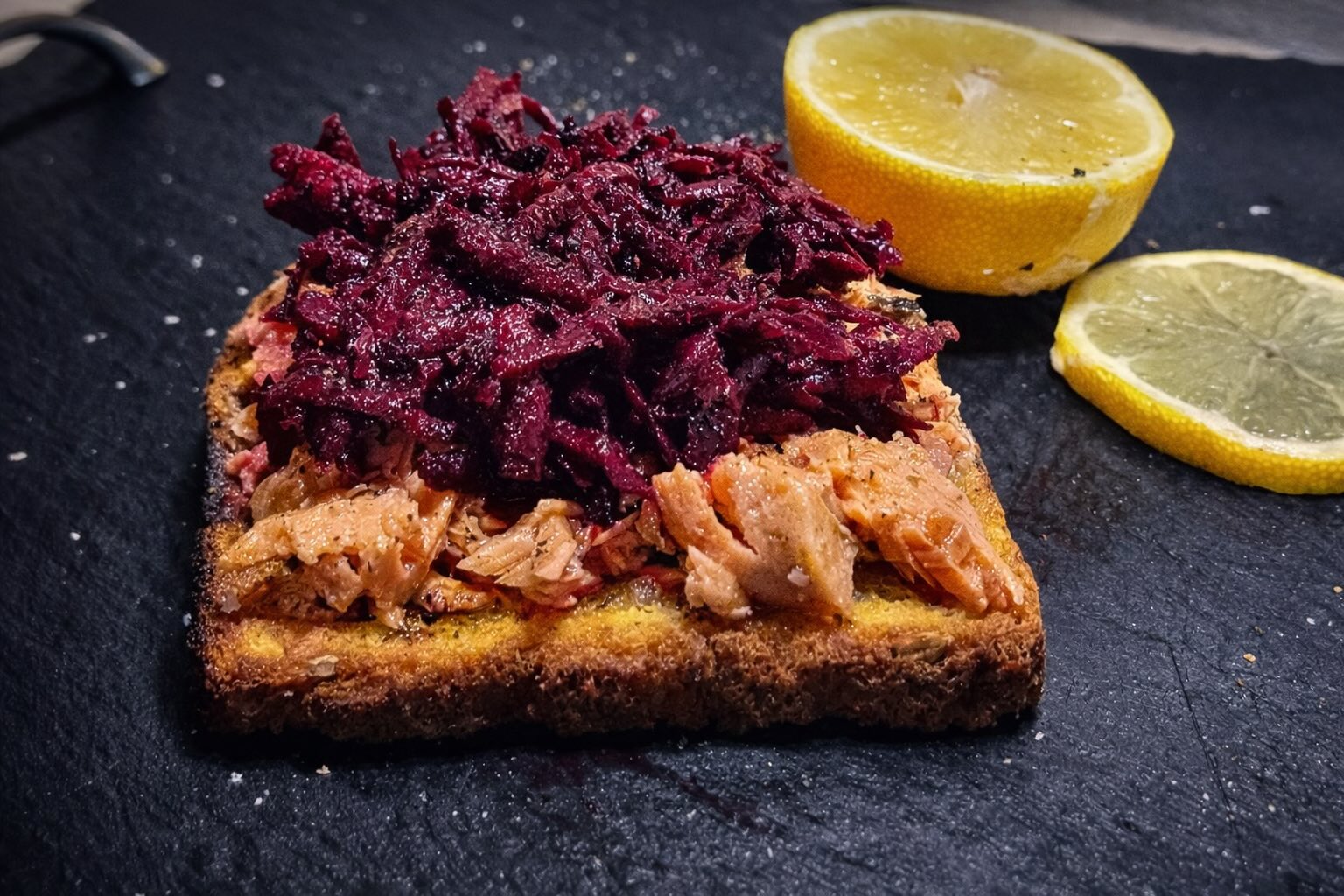
Salmon & Grated Beetroot Toast with Lemon

Overview

A fast, brain-forward open sandwich: omega-3 rich salmon + nitrate/polyphenol beetroot + lemon acidity for a sharp, savoury bite. Ideal for lunch when you need high protein without a long prep. Salmon sources, like all seafood, are important to research.

Ingredients (1 serving)

  • Bread, wholegrain or sourdough: 1 slice (40 g)
  • Salmon, cooked (or canned, drained): 90 g
  • Beetroot, grated (raw or pre-cooked): 60 g
  • Lemon juice: 15 ml (1 tbsp)
  • Extra virgin olive oil (optional): 5 ml (1 tsp)
  • Salt + black pepper: to taste

Optional upgrades (very BRAIN):

  • 1 tsp (5 ml) capers or chopped dill/parsley
  • 1 tsp Dijon mustard (mix into beetroot)
  • A few rocket/arugula leaves

Method

  1. Toast the bread until deeply golden (better texture, slower eating, improved satisfaction).
  2. Mix the beetroot: In a bowl combine grated beetroot + 15 ml lemon juice + a pinch of salt and pepper. Add 5 ml EVOO if using.
  3. Add the salmon: Flake salmon over the toast. Season lightly (pepper is enough if salmon is already salted).
  4. Top & press: Pile the lemony beetroot on top. Press gently so it holds together.
  5. Finish: Extra lemon squeeze if you like it brighter.

Nutrition (estimated, per serving)

Based on: 40 g bread, 90 g cooked salmon, 60 g beetroot, 15 ml lemon juice, 5 ml EVOO.

  • Calories: ~395 kcal
  • Protein: ~25 g
  • Carbohydrates: ~33 g
  • Fat: ~18 g
  • Fiber: ~5 g
  • Omega-3 (EPA+DHA): ~1.8–2.4 g (depends on salmon type)

Key micronutrient highlights (why it's "BRAIN")

  • DHA/EPA (salmon): Provides omega-3 fats important for brain structure and signaling.
  • Nitrates (beetroot): Beetroot contains dietary nitrates that are studied for their role in nitric oxide signaling.
  • Folate + potassium (beetroot): Provides folate and potassium involved in one-carbon metabolism and electrolyte balance.
  • Vitamin C (lemon): A source of vitamin C and polyphenol-preserving acidity.

Brain Health Notes

  • Salmon provides EPA and DHA, omega-3 fats that are important for brain structure and cell membranes.
  • Beetroot contains dietary nitrates that are studied for their role in nitric oxide and vascular function.
  • Lemon provides vitamin C, a water-soluble antioxidant.
  • Wholegrain/sourdough bread provides fibre and a slower release of carbohydrate compared with refined bread.

Salmon sourcing

Both wild-caught and responsibly farm-raised salmon can be good options. Where possible, choose salmon that is sustainably sourced and labelled as free from routine antibiotics and unnecessary additives, whether wild or farmed. Please be sure to research your supermarket and their suppliers — many are moving towards more sustainable, ethical sourcing (e.g. M&S Aquaculture and Fisheries). For a balanced overview of wild versus farmed salmon, see resources such as the summary from North Coast Seafoods.

The U.S. Food and Drug Administration (FDA) and Environmental Protection Agency (EPA) jointly publish guidance on fish mercury levels. They categorize fish into "Best Choices", "Good Choices", and "Choices to Avoid" based on average mercury concentrations and safe weekly intake levels. Salmon is repeatedly in the "Best Choices" category because it consistently has low mercury relative to the reference dose used to set safety advice (≤0.15 µg/g).

Foods/Substances

5 foods in this recipe

Olive Oil

See extra virgin olive oil for detailed information

Recipe nutrition

Figures are still calculated from USDA-based nutrient data on each food page (per 100 g). For this recipe we have not yet added ingredient weights, so the table adds one full “100 g” slice of each linked food, not the grams actually used (which would misrepresent small amounts like herbs, spices, or oil). When portion sizes are added for the recipe, the same panels are multiplied by the real amounts—so the maths can be precise for every ingredient.

Nutrient / classFoods in recipeTotal (100 g per linked food)% RDA aggregate
Core nutrition
EnergyBeetroot, Lemon, Olive Oil, Salmon, Sourdough Bread1792 kcal
Protein*Beetroot, Lemon, Olive Oil, Salmon, Sourdough Bread38.7 g32.2-64.5%*
Total fatBeetroot, Lemon, Olive Oil, Salmon, Sourdough Bread133.9 g
Saturated fatBeetroot, Lemon, Olive Oil, Salmon, Sourdough Bread23.3 g
CarbohydratesBeetroot, Lemon, Olive Oil, Salmon, Sourdough Bread114.7 g
FibreBeetroot, Lemon, Sourdough Bread6.5 g
Key micronutrients
IronLemon, Salmon, Sourdough Bread4.2 mg23.5%
ZincLemon, Salmon, Sourdough Bread1.6 mg14.6%
MagnesiumLemon, Salmon, Sourdough Bread63.4 mg15.1%
SeleniumSalmon, Sourdough Bread51.4 µg93.5%
CalciumBeetroot, Lemon, Salmon, Sourdough Bread209.4 mg20.9%
PotassiumBeetroot, Lemon, Salmon, Sourdough Bread1715.2 mg50.4%
CholineSourdough Bread8.0 mg1.5%
FolateLemon, Sourdough Bread134.0 µg33.5%
Vitamin B12Salmon, Sourdough Bread5.7 µg237.3%
Vitamin B6Lemon, Sourdough Bread0.1 mg8.5%
Bioactive compounds
ALALemon, Salmon, Sourdough Bread610.0 mg
EPALemon, Salmon, Sourdough Bread318.0 mg
DHALemon, Salmon, Sourdough Bread585.0 mg
Total omega-3Lemon, Salmon, Sourdough Bread1513.0 mg
Polyphenols (proxy)

Aggregate %RDA uses adult reference intakes and the summed food-level values shown above.

* Protein is shown as a range, benchmarked to 1.2 g/kg/day using a 50-100 kg reference adult range.

Biological Target Matrix

Inflammation & Oxidative Stress

SubstanceContribution LevelFoodsMechanism of Action
CopperContextual / minor contributorParticipates in redox enzymes and antioxidant networks
DHA (Docosahexaenoic Acid)Contextual / minor contributorPrecursor to specialized pro-resolving mediators (SPMs) including protectins and maresins; terminates inflammation without immunosuppression. Production of docosahexaenoyl ethanolamide (DHEA), an N-acyl ethanolamine for endocannabinoid-like signalling, feeds into CB2-related anti-inflammatory signalling; ECS lipid mediators regulate immune tone and microglial activation (primary anchor: Inflammation & Oxidative Stress).
EPA (Eicosapentaenoic Acid)Contextual / minor contributorPotent anti-inflammatory; precursor to E-series resolvins; specialized pro-resolving mediators (SPMs) terminate inflammation without immunosuppression, downregulate COX-2, inhibit neutrophil infiltration, enhance macrophage clearance. Production of eicosapentaenoyl ethanolamide (EPEA), an N-acyl ethanolamine for endocannabinoid-like signalling, feeds into CB2-related anti-inflammatory signalling; ECS lipid mediators regulate immune tone and microglial activation (primary anchor: Inflammation & Oxidative Stress).
Omega-3 Fatty AcidsContextual / minor contributorSpecialized Pro-Resolving Mediators (SPMs) - resolvins, protectins, maresins terminate inflammation without immunosuppression, downregulate COX-2, inhibit neutrophil infiltration, enhance macrophage clearance, limit glutamate-induced excitotoxicity. Production of DHEA and EPEA (N-acyl ethanolamines) feeds into CB2-related anti-inflammatory signalling; ECS lipid mediators regulate immune tone and microglial activation (primary anchor for ECS mechanism: Inflammation & Oxidative Stress).
Vitamin C (Ascorbate)Contextual / minor contributorAntioxidant properties; supports anti-inflammatory effects
ZincContextual / minor contributorSupports immune signaling; gut barrier integrity disrupted by nutrient deficiencies including zinc

Metabolic & Neuroendocrine Stress (HPA Axis & ANS)

SubstanceContribution LevelFoodsMechanism of Action
MagnesiumContextual / minor contributorHelps manage stress responses; combined with vitamin D reduced behavioral problems; synergy with zinc and omega-3s reported
Omega-3 Fatty AcidsContextual / minor contributorImprove vagal tone and HRV control, improve cortisol rhythms
Vitamin C (Ascorbate)Contextual / minor contributorSupports stress response through antioxidant and neurochemical effects

Methylation & One-Carbon Metabolism

SubstanceContribution LevelFoodsMechanism of Action
Omega-3 Fatty AcidsContextual / minor contributorSupport homocysteine reduction in combination with B12, phospholipid methylation (PLM) dependent on SAMe
Vitamin B12 (Cobalamin)Contextual / minor contributorEssential cofactor in remethylation of homocysteine to methionine, which is converted to S-adenosylmethionine (SAMe); works with B6, B2, and folate; contributes meaningfully to homocysteine reduction, especially in combination with omega-3 fatty acids
Vitamin B9 (Folate; 5-MTHF)Contextual / minor contributorEssential cofactor in remethylation of homocysteine to methionine, which is converted to S-adenosylmethionine (SAMe); SAMe fuels synthesis of dopamine, norepinephrine, and serotonin and drives phospholipid methylation in neuronal membranes
ZincContextual / minor contributorDeficiencies in vitamins and minerals essential for methylation, such as folate, vitamin B12, and zinc, are correlated to ADHD symptoms; supplementing these micronutrients has shown potential in supporting methylation and reducing symptom severity

Mitochondrial Function & Bioenergetics

SubstanceContribution LevelFoodsMechanism of Action
AstaxanthinContextual / minor contributorSupports mitochondrial and cellular resilience through antioxidant protection
DHA (Docosahexaenoic Acid)Contextual / minor contributorECS-related lipid signalling may influence mitochondrial coupling/efficiency (context-dependent; largely preclinical). Omega-3 incorporation changes membrane fluidity (secondary anchor for ECS mechanism: Mitochondrial Function & Bioenergetics).
EPA (Eicosapentaenoic Acid)Contextual / minor contributorECS-related lipid signalling may influence mitochondrial coupling/efficiency (context-dependent; largely preclinical). Omega-3 incorporation changes membrane fluidity (secondary anchor for ECS mechanism: Mitochondrial Function & Bioenergetics).
IronContextual / minor contributorCritical for oxygen delivery to the brain via hemoglobin; supports mitochondrial function and energy production
MagnesiumContextual / minor contributorSupports enzymes involved in glycolysis and the Krebs cycle (processes that generate ATP from glucose); binds to ATP and all triphosphates in cells to activate them
ManganeseContextual / minor contributorSupports mitochondrial antioxidant defense through MnSOD activity
NitrateContextual / minor contributorDietary nitrates convert to nitric oxide (NO), which supports vascular function and cerebral blood flow, enhancing oxygen and nutrient delivery to brain tissue; nitric oxide improves mitochondrial efficiency by optimizing blood flow and supporting vascular tone
Omega-3 Fatty AcidsContextual / minor contributorECS-related lipid signalling may influence mitochondrial coupling/efficiency (context-dependent; largely preclinical). Omega-3 incorporation changes membrane fluidity (secondary anchor for ECS mechanism: Mitochondrial Function & Bioenergetics).
SeleniumContextual / minor contributorProtects mitochondria from oxidative damage through antioxidant enzyme activity
Vitamin B12 (Cobalamin)Contextual / minor contributorCrucial role in conversion of methylmalonyl-CoA to succinyl-CoA, a key step in mitochondrial energy production; deficiency leads to buildup of methylmalonic acid and odd-chain fatty acids, which are neurotoxic

Neurotransmitter Regulation

SubstanceContribution LevelFoodsMechanism of Action
CopperContextual / minor contributorCofactor in dopamine β-hydroxylase, supporting catecholamine synthesis; supports norepinephrine synthesis
DHA (Docosahexaenoic Acid)Contextual / minor contributorAccounts for ~10–15% of total brain fatty acids, but represents 20–30% of fatty acids in neuronal phospholipids such as PE and PS, and more than 90% of the brain's omega-3 PUFA; critical for membrane fluidity, synaptic vesicle fusion, and neurodevelopment; transported across BBB as LPC-DHA via MFSD2A
EPA (Eicosapentaenoic Acid)Contextual / minor contributorModulates dopamine and serotonin signalling; synergises with DHA but has independent mechanisms; membrane fluidity and neurotransmitter receptor function
IronContextual / minor contributorEssential cofactor for tyrosine hydroxylase, the rate-limiting enzyme in the conversion of tyrosine to dopamine; critical for catecholamine synthesis
MagnesiumContextual / minor contributorBroad cofactor for neurotransmitter synthesis and receptor modulation (e.g., NMDA, GABA); functions as an NMDA receptor antagonist and GABA receptor modulator; assists enzymes involved in synthesis of dopamine and serotonin
Omega-3 Fatty AcidsContextual / minor contributorMembrane fluidity and neurotransmitter receptor function, ion channel behavior and gamma oscillations, support neurotransmission and phospholipid methylation
PotassiumContextual / minor contributorCritical for membrane potential, nerve signaling, and neuronal excitability; adequate intake balances sodium effects
Vitamin B12 (Cobalamin)Contextual / minor contributorSupports neurotransmitter production through methylation; essential for myelin synthesis
Vitamin B9 (Folate; 5-MTHF)Contextual / minor contributorSupports neurotransmitter synthesis through methylation; cofactor for dopamine synthesis alongside iron, B6, and omega-3s
Vitamin C (Ascorbate)Contextual / minor contributorSupports norepinephrine synthesis; transported in brain via SVCT2
ZincContextual / minor contributorImportant for DNA synthesis, cell division, and neurotransmitter regulation, particularly in modulating dopamine—a key neurotransmitter implicated in ADHD; acts as an allosteric modulator of the GABA receptor; supports glutamate regulation