Fermented Hot Sauce

Overview
Fermented hot sauce is made by fermenting chilli peppers (often with garlic, salt, and sometimes other vegetables) before blending into a pourable sauce.
Fermentation develops acidity and flavour, but finished products vary and may be pasteurised. At the dash-sized quantities used as a condiment, fermented hot sauce should be treated as a flavouring rather than a probiotic intervention.
Food Context
Synergies
- Use sparingly to add heat and acidity to meals built around BRAIN Diet staple foods (vegetables, legumes, whole grains, quality proteins).
Sourcing
- After fermentation, the mixture is blended and strained to create a smooth hot sauce; some versions are left unpasteurised and stored chilled.
Preparation
- Typically produced by fermenting chopped chillies with salt (and sometimes garlic and other aromatics) at room temperature for several days to weeks.
Recipes
1 recipe containing this food
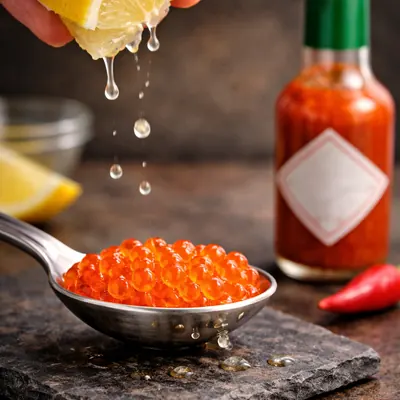
Neuroeshot (Roe, Lemon, Hot Sauce)
A small savory shot of roe, lemon juice, and fermented hot sauce for concentrated omega-3s and choline.
Nutrient Tables (per 100 g)
Selected food and preparation: Sauce, ready-to-serve, pepper, TABASCO. per 100 g edible portion.
Core nutrients
| Nutrient | Amount per 100 g | % reference intake per 100 g |
|---|---|---|
| Energy | 12 kcal | — |
| Protein | 1.3 g | — |
| Total fat | 0.8 g | — |
| Saturated fat | 0.1 g | — |
| Carbohydrates | 0.8 g | — |
| Sugars | 0.1 g | — |
| Fibre | 0.6 g | — |
Key vitamins and minerals
Vitamins and minerals supplying at least 10% of an adult reference intake per 100 g, derived from the composition panel.
| Nutrient | Amount per 100 g | % reference intake per 100 g |
|---|---|---|
| Vitamin B6 | 0.2 mg | 11.8% |
Substances
References
[1] Fermented foods can modulate gut–brain signalling through microbiota and metabolite pathways. Bravo et al. 2011. Ingestion of Lactobacillus strain regulates emotional behavior and central GABA receptor expression in a mouse via the vagus nerve
[2] Fermentation-derived products contribute organic acids and microbial metabolites alongside capsaicin-rich matrices. Antony et al. 2023. Gut microbiome supplementation as therapy for metabolic syndrome