Pomegranates

Overview
Pomegranates provide ellagitannins that gut bacteria convert to urolithin A, supporting mitochondrial resilience, mitophagy, and cognitive function. They also contribute anthocyanins built on Cyanidin, Delphinidin, and Pelargonidin backbones. The Green Mediterranean Diet study showed greater visceral adipose tissue loss that tracked with higher total plasma polyphenols and with the microbiome-derived markers urolithin A (via ellagitannins: walnuts/pomegranate).
Within the BRAIN Diet framework, higher polyphenol intake and microbial diversity increase urolithin A and related metabolites, supporting mitochondrial resilience and mitophagy and improving cognitive endurance.
Food Context
Synergies
- Pair with diverse plant foods to support microbiome; dietary diversity (≥30 plant foods per week) supports microbial richness and resilience
Preparation
- Consume whole fruit or juice to obtain ellagitannins
- Production of urolithin A depends on gut microbiome diversity; higher polyphenol intake and microbial diversity increase urolithin A production
- Part of polyphenol-rich dietary pattern; polyphenol sources including berries, green tea catechins, cocoa flavanols, cranberries, pomegranate support gut microbiome health
Recipes
1 recipe containing this food
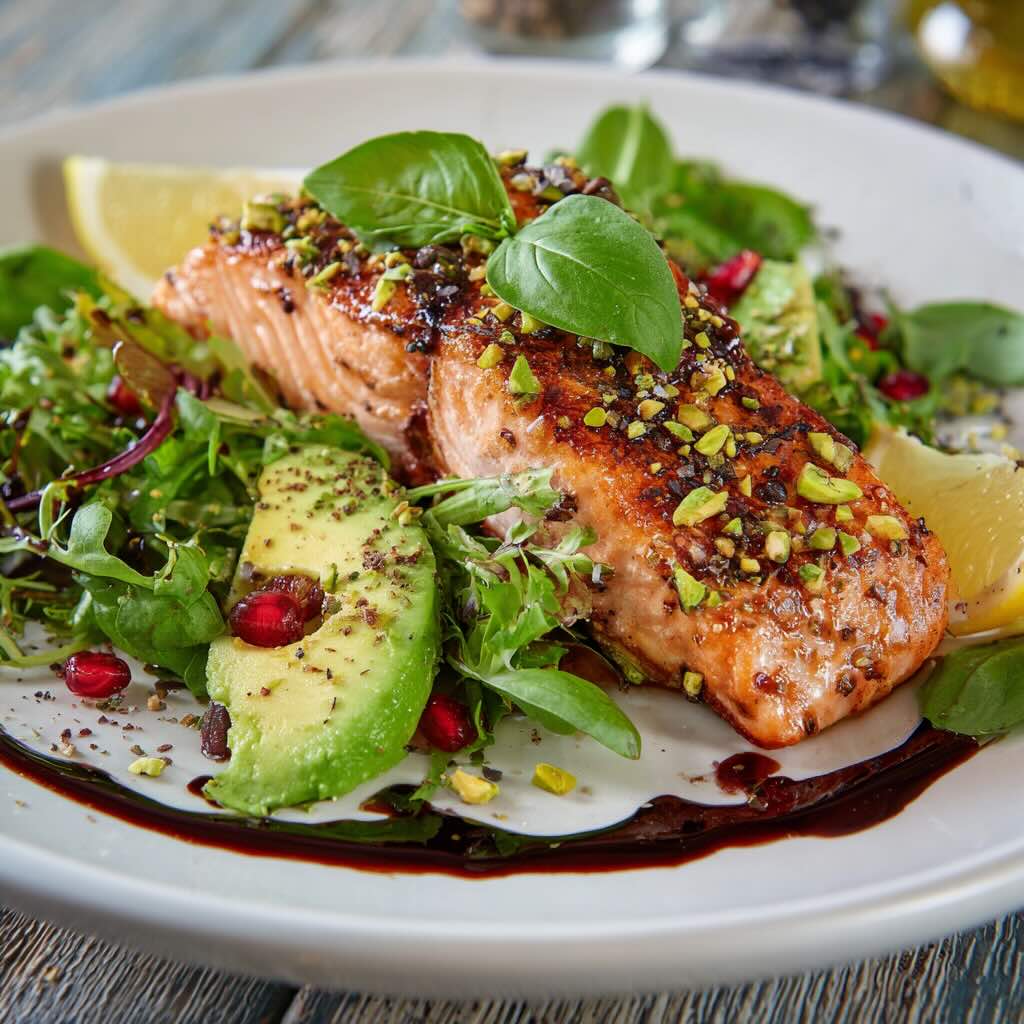
Salmon Bowl-pistachio-cacao-nibs
A Mediterranean-style bowl combining salmon, avocado, pistachios, cacao nibs, and early harvest olive oil — rich in omega-3 fats, polyphenols, and fibre.
Nutrient Tables (per 100 g)
Selected food and preparation: Pomegranates, raw. per 100 g edible portion.
Core nutrients
| Nutrient | Amount per 100 g | % reference intake per 100 g |
|---|---|---|
| Energy | 83 kcal | — |
| Protein | 1.7 g | — |
| Total fat | 1.2 g | — |
| Saturated fat | 0.1 g | — |
| Carbohydrates | 18.7 g | — |
| Sugars | 13.7 g | — |
| Fibre | 4 g | — |
Key vitamins and minerals
Vitamins and minerals supplying at least 10% of an adult reference intake per 100 g, derived from the composition panel.
| Nutrient | Amount per 100 g | % reference intake per 100 g |
|---|---|---|
| Copper | 0.2 mg | 17.6% |
| Vitamin C | 10.2 mg | 11.3% |
| Vitamin K | 16.4 µg | 13.7% |
Bioactive compounds
| Compound / class | Amount per 100 g | Notes |
|---|---|---|
| Cyanidin | Present [3] | pomegranate juice |
| Delphinidin | Present [3] | pomegranate juice |
| Pelargonidin | Present [3] | pomegranate juice |
- Cyanidin, Delphinidin, Pelargonidin: Occurs as anthocyanin glycosides in pomegranate juice. [3]
Technical provenance
Cyanidin: Elucidation of Anthocyanins in Pomegranate Juices from Three Extraction Methods (2021). Six separately identified glycosides include cyanidin, delphinidin and pelargonidin glucosides/diglucosides in juice; not free-aglycone concentrations. [3]
Delphinidin: Elucidation of Anthocyanins in Pomegranate Juices from Three Extraction Methods (2021). Six separately identified glycosides include cyanidin, delphinidin and pelargonidin glucosides/diglucosides in juice; not free-aglycone concentrations. [3]
Pelargonidin: Elucidation of Anthocyanins in Pomegranate Juices from Three Extraction Methods (2021). Six separately identified glycosides include cyanidin, delphinidin and pelargonidin glucosides/diglucosides in juice; not free-aglycone concentrations. [3]
Substances
5 substances in this food

References
[1] The Green Mediterranean Diet study showed greater visceral adipose tissue loss that tracked with higher total plasma polyphenols and with the microbiome-derived markers urolithin A (via ellagitannins: walnuts/pomegranate). Zelicha & Kloting 2022. The effect of high-polyphenol Mediterranean diet on visceral adiposity: the DIRECT PLUS randomized controlled trial
[2] Urolithin A supports mitochondrial resilience and mitophagy, improving cognitive endurance Andreux et al. 2019. Singh & D’Amico 2022. Direct supplementation with Urolithin A overcomes limitations of dietary exposure and gut microbiome variability in healthy adults to achieve consistent levels across the population
[3] Elucidation of Anthocyanins in Pomegranate Juices from Three Extraction Methods (2021)