Chocolate Quinoa Crisp Clusters
Overview
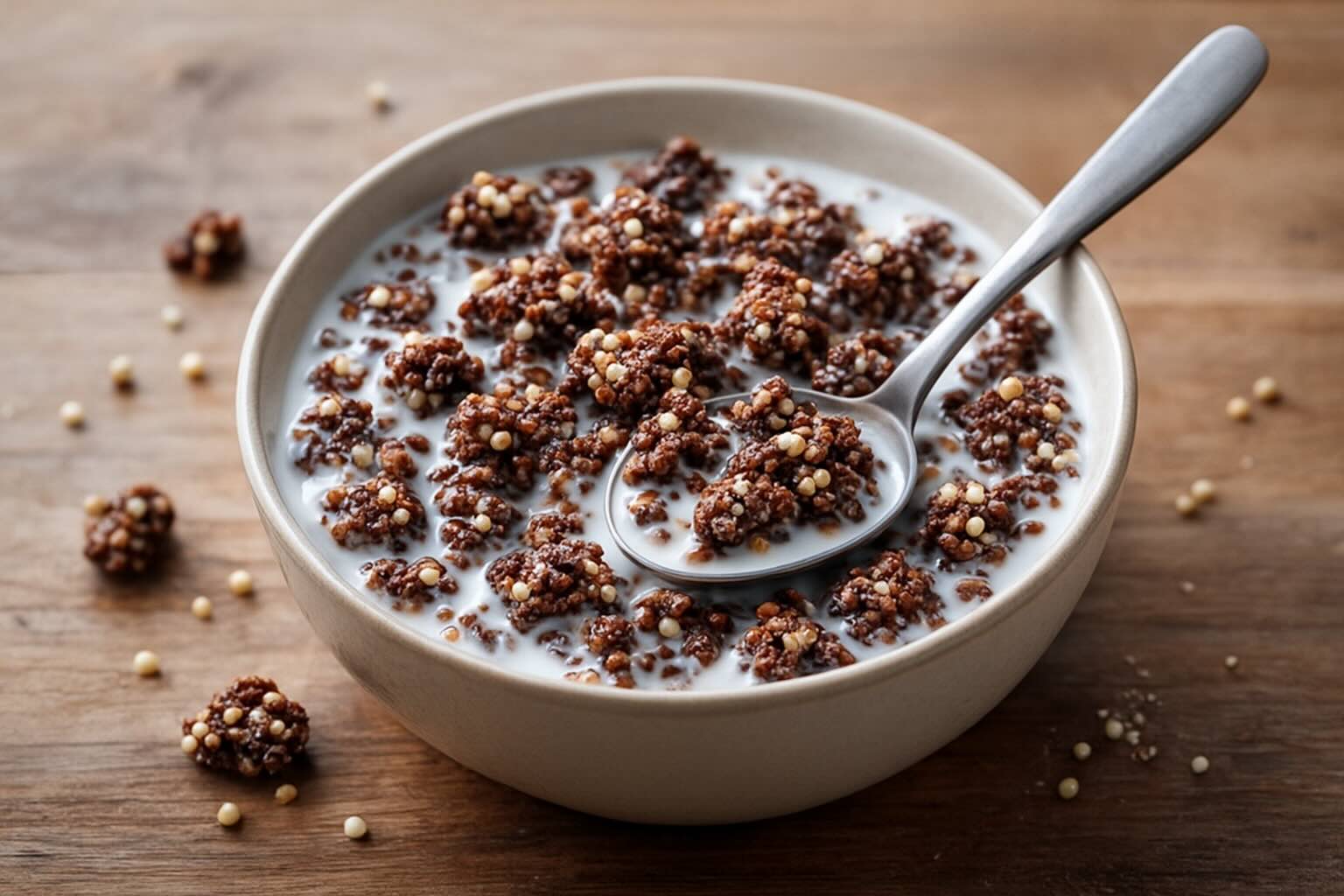
A delicious cereal-to-snack hybrid that delivers satisfying crunch and steady energy. Made with whole quinoa grains, ground flaxseed, and a touch of coconut oil, these clusters offer a low glycemic profile perfect for sustained focus and energy. Enjoy them as a breakfast cereal with milk, or grab a handful for a wholesome snack anytime.
Ingredients
Core
- 2 cups cooked quinoa, cooled & surface-dried
- 2 tbsp homemade oat flour (finely blended rolled oats)
- 1 tbsp ground flaxseed
- 2–3 tbsp unsweetened cocoa or cacao powder
- ¼ tsp fine sea salt
Wet binder
- 1–2 tbsp refined coconut oil, melted (35–45 °C)
- 2–2.5 tbsp maple syrup or date syrup
- 1 tsp vanilla extract
Optional texture boosters
- 2–3 tbsp puffed quinoa, for surface coating
- ½ tsp cinnamon
- 1–2 tbsp hemp hearts (protein upgrade)
Method
-
Cook & cool the quinoa: Rinse quinoa thoroughly. Cook using 2:1 water : quinoa ratio until tender. Drain well. Spread quinoa onto a tray and let it air-dry 10–20 minutes. This reduces surface moisture and preserves the grain's outer wall, which is key for cluster crunch.
-
Mix the dry ingredients: In a large bowl, combine quinoa (whole, not blended), oat flour, ground flax, cocoa/cacao, and salt. Fold gently until distributed. Avoid mashing — intact grains provide microstructure and aeration.
-
Add the wet binder: Melt coconut oil (35–45 °C — not smoking). Stir maple/date syrup + vanilla into the oil. Pour into the bowl and fold until coated. The coconut oil coats the surface of the clusters and crystallises as it cools, forming a thin lipid shell that reduces moisture absorption and helps maintain the cereal-style crunch.
-
Form clusters: Scoop ½ tbsp (6–8 g) portions. Lightly compress into loose clusters — not spheres. Place on a parchment-lined tray with 2 cm spacing. Small clusters offer a higher surface-to-volume ratio, leading to stronger cereal-type crunch.
-
Bake low + slow: 165 °C (325 °F) — 45–55 min. Rotate tray halfway. They should smell like chocolate cereal, not brownies. The aim is dehydration, not caramelisation.
-
Cool fully: Rest 20–30 minutes. As the clusters cool, the lipid shell sets and the internal structure stabilises.
-
Puffed quinoa finish (optional): Place puffed quinoa in a bowl. Roll or pat the cooled clusters over the surface. This preserves the identity of puffed grains and prevents them from softening during baking.
Extra Guidance
⚠️ Do not blend cooked quinoa: Blending destroys grain walls resulting in a fudge texture. You lose aeration and crunch.
Storage: Airtight container: 7–10 days room temp. Refrigerated: max crunch retention.
Serving: Dry as a snack, as cereal with milk / oat milk / coconut milk, or mixed into granola or yogurt bowls.
Nutrition
~180–220 kcal per 30g serving · 6–8g protein · high fiber · low glycemic · moderate polyphenols
Brain Health Notes
- Quinoa provides complete plant protein with all essential amino acids.
- Flax seeds contribute ALA omega-3, soluble fibre (mucilage), and lignans — nutrients and compounds associated with gut health.
- Cocoa/cacao provides polyphenols (flavanols) studied for antioxidant and vascular effects.
- Coconut oil provides medium-chain triglycerides; its crystallisation on cooling helps create the cluster texture.
- Whole grains and minimal added sugars give a lower glycemic profile than refined cereals.
Foods/Substances
6 foods in this recipe

Coconut Oil
MCTs for rapid brain energy and ketone production
Substances: Capric Triglyceride (Tridecanoin), Caproic Triglyceride (Tricaproin), Caprylic Triglyceride (Trioctanoin), MCT (Medium-Chain Triglycerides)
Flax Seeds
ALA omega-3 and soluble fiber source
Substances: ALA (Alpha-Linolenic Acid), Histidine, Isoleucine, Leucine, Linoleic Acid (LA, n-6), Lysine, Magnesium, Manganese, Methionine, Phenylalanine, Threonine, Tryptophan, Valine
Oats
Beta-glucans, tryptophan, and B vitamins for gut and neurotransmitter support
Substances: Acetate, Butyrate, Histidine, Iron, Isoleucine, Leucine, Lysine, Magnesium, Manganese, Methionine, Phenylalanine, Phosphatidylethanolamine (PE), Propionate, Short-Chain Fatty Acids (SCFAs), Threonine, Tryptophan, Valine, Vitamin B1 (Thiamine), Vitamin B6 (Pyridoxine → PLP), Zinc
Quinoa
Pseudograin with complete protein, magnesium, and GABA potential in sourdough
Substances: Choline, Histidine, Iron, Isoleucine, Leucine, Lysine, Magnesium, Manganese, Methionine, Phenylalanine, Threonine, Tryptophan, Valine, Vitamin B1 (Thiamine), Vitamin B2 (Riboflavin), Vitamin B6 (Pyridoxine → PLP), Vitamin B9 (Folate; 5-MTHF), Zinc
Biological Target Matrix
Gut–Brain Axis & Enteric Nervous System (ENS)
| Substance | Foods | Mechanism of Action |
|---|---|---|
| Acetate | Byproduct of fibre fermentation; supports intestinal barrier integrity; regulates immune responses; promotes synthesis of key neurotransmitters such as dopamine and serotonin | |
| Butyrate | Byproduct of fibre fermentation; supports intestinal barrier integrity; regulates immune responses; promotes synthesis of key neurotransmitters such as dopamine and serotonin | |
| Choline | Choline is metabolised by gut bacteria; some strains (e.g. Lactobacillus) can produce acetylcholine. Microbial choline metabolism (e.g. trimethylamine) shows inter-individual variability and may influence host metabolism and gut–brain signalling. | |
| Propionate | Byproduct of fibre fermentation; supports intestinal barrier integrity; regulates immune responses | |
| Short-Chain Fatty Acids (SCFAs) | Byproducts of fibre fermentation; support intestinal barrier integrity; regulate immune responses; promote synthesis of key neurotransmitters such as dopamine and serotonin |
Inflammation & Oxidative Stress
| Substance | Foods | Mechanism of Action |
|---|---|---|
| Choline | Choline-derived betaine supports homocysteine remethylation; elevated homocysteine is linked to oxidative stress and inflammatory signalling. Phosphatidylcholine supports membrane integrity and cell signalling in immune and redox contexts. |
Metabolic & Neuroendocrine Stress (HPA Axis & ANS)
| Substance | Foods | Mechanism of Action |
|---|---|---|
| Choline | Choline supports hepatic VLDL assembly and lipid export; methyl donors (choline, betaine) may influence adenosine metabolism and HPA axis activity. Adequate choline status supports metabolic stability and stress physiology. |
Methylation & One-Carbon Metabolism
| Substance | Foods | Mechanism of Action |
|---|---|---|
| Choline | Precursor to trimethylglycine (TMG/betaine), a dietary methyl donor that helps recycle homocysteine to methionine via an alternative pathway; supports one-carbon metabolism alongside folate, riboflavin, and B12; influences methylation dynamics relevant to MTHFR and COMT activity |
Mitochondrial Function & Bioenergetics
| Substance | Foods | Mechanism of Action |
|---|---|---|
| Choline | Phosphatidylcholine and other choline-containing phospholipids support mitochondrial membrane integrity and energy metabolism; choline-derived betaine contributes to one-carbon status that can influence mitochondrial resilience |
Neurotransmitter Regulation
| Substance | Foods | Mechanism of Action |
|---|---|---|
| Capric Triglyceride (Tridecanoin) | Ketones produced from capric triglyceride provide ATP through mitochondrial metabolism; ATP is essential for neurotransmitter synthesis, release, and reuptake, indirectly supporting neurochemical balance by ensuring adequate energy for neuronal function | |
| Caproic Triglyceride (Tricaproin) | Ketones produced from caproic triglyceride provide ATP through mitochondrial metabolism; ATP is essential for neurotransmitter synthesis, release, and reuptake, indirectly supporting neurochemical balance by ensuring adequate energy for neuronal function | |
| Caprylic Triglyceride (Trioctanoin) | Ketones produced from caprylic triglyceride provide ATP through mitochondrial metabolism; ATP is essential for neurotransmitter synthesis, release, and reuptake, indirectly supporting neurochemical balance by ensuring adequate energy for neuronal function | |
| Choline | Essential precursor for acetylcholine synthesis, supporting memory, learning, and neuroplasticity; supports membrane phospholipid biosynthesis (PC) which is critical for membrane fluidity and neurotransmitter receptor function; phospholipid methylation (PLM) alters membrane structure, facilitating faster neuronal recovery and influencing ion channel behavior in gamma oscillations linked to attention and cognition | |
| Iron | Essential cofactor for tyrosine hydroxylase, the rate-limiting enzyme in the conversion of tyrosine to dopamine; critical for catecholamine synthesis | |
| Magnesium | Broad cofactor for neurotransmitter synthesis and receptor modulation (e.g., NMDA, GABA); functions as an NMDA receptor antagonist and GABA receptor modulator; assists enzymes involved in synthesis of dopamine and serotonin | |
| MCT (Medium-Chain Triglycerides) | Ketones produced from MCTs provide ATP through mitochondrial metabolism; ATP is essential for neurotransmitter synthesis, release, and reuptake, indirectly supporting neurochemical balance by ensuring adequate energy for neuronal function | |
| Phenylalanine | Essential amino acid that converts to tyrosine and supports catecholamine synthesis (dopamine, norepinephrine); participates in LAT1 competition at the blood-brain barrier | |
| Propionate | Stimulates secretion of norepinephrine and may influence dopamine regulation; promotes synthesis of key neurotransmitters | |
| Short-Chain Fatty Acids (SCFAs) | Propionate stimulates secretion of norepinephrine and may influence dopamine regulation; SCFAs promote synthesis of dopamine and serotonin | |
| Tryptophan | Precursor for serotonin and melatonin; brain entry competes at LAT1 with other large neutral amino acids (LNAAs); carbohydrate-rich, low-protein meals raise the plasma tryptophan:LNAA ratio because insulin pushes competing LNAAs out to muscles; can feed NAD+ synthesis via the kynurenine pathway | |
| Vitamin B6 (Pyridoxine → PLP) | Cofactor for synthesis of dopamine, serotonin, GABA, and glutamate; supports rate-limiting steps in catecholamine synthesis; requires PDXK activation with magnesium and ATP support | |
| Vitamin B9 (Folate; 5-MTHF) | Supports neurotransmitter synthesis through methylation; cofactor for dopamine synthesis alongside iron, B6, and omega-3s | |
| Zinc | Important for DNA synthesis, cell division, and neurotransmitter regulation, particularly in modulating dopamine—a key neurotransmitter implicated in ADHD; acts as an allosteric modulator of the GABA receptor; supports glutamate regulation |