Rocket Lentil Avocado Midday Salad (Gut-Supporting)
Overview
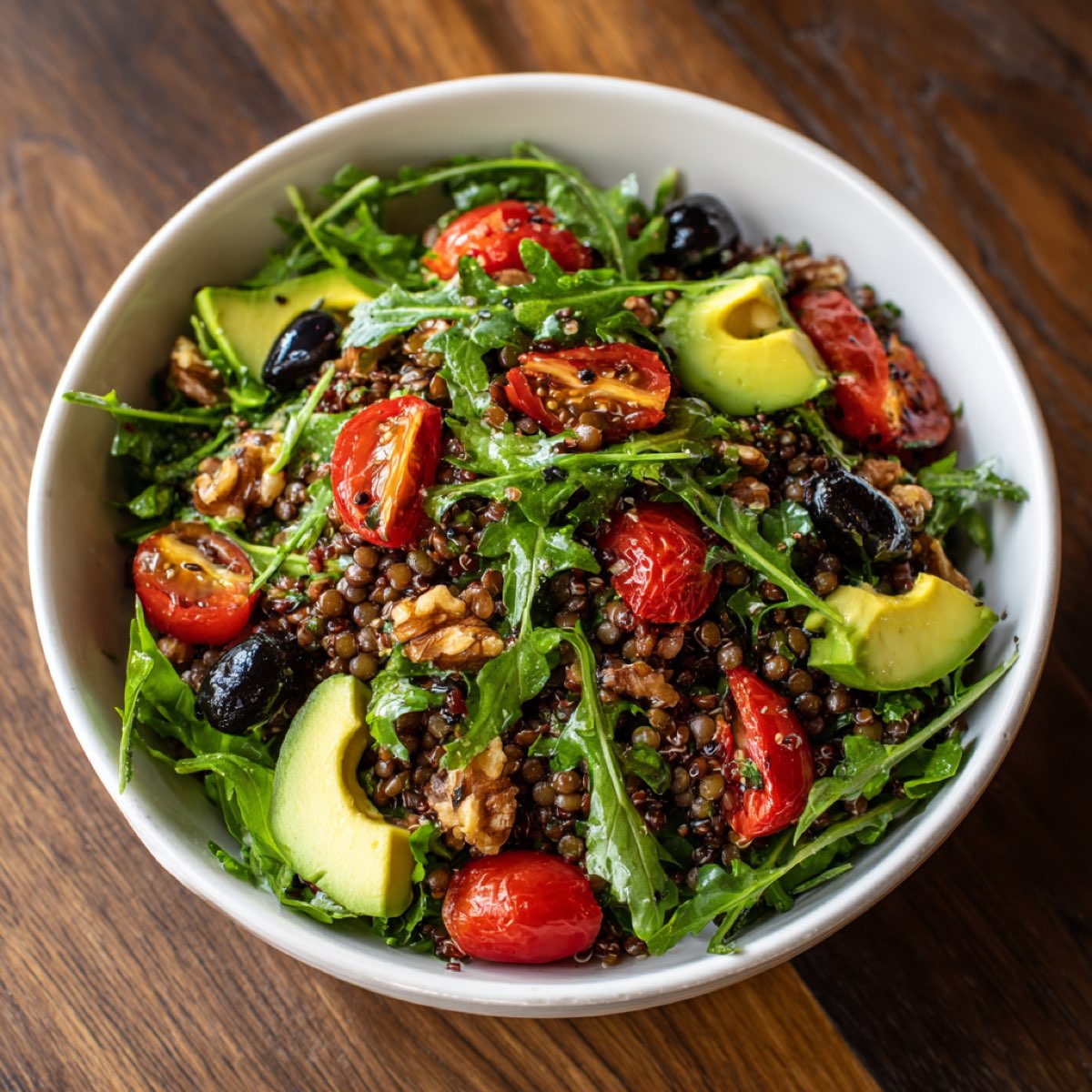
This polyphenol-rich midday salad combines quinoa or lentils with vegetables, healthy fats from avocado and early harvest olive oil, and omega-3 from walnuts. Lentils and quinoa provide fibre that feeds gut bacteria; walnuts provide omega-3 and polyphenols; olive oil contributes phenolic compounds.
Ingredients
- 1 cup (240 ml) rocket
- ¼ cup olives
- 1 tbsp (15 ml) walnuts
- ½ avocado
- ½ cup cherry tomatoes
- ½ cup cooked quinoa or ½ cup cooked lentils (key for gut health)
- 1 tbsp (15 ml) early harvest olive oil
- Lemon juice
- Optional: basil, herbs
Nutrition calculation uses cooked quinoa as the grain.
Method
- Add cooked quinoa or lentils as the base.
- Top with rocket, tomatoes, olives, avocado.
- Add walnuts.
- Drizzle with early harvest olive oil + lemon.
- Toss lightly.
Nutrition
Per serving. Each included ingredient is scaled from a named per-100 g composition record by edible grams. Optional ingredients are excluded. Missing analytical values are not treated as zero.
| Nutrient | Per serving |
|---|---|
| Energy | 460 kcal |
| Protein | 8.1 g |
| Carbohydrates | 33 g |
| Sugars | 3.9 g |
| Fibre | 9.9 g |
| Total fat | 35 g |
| Saturated fat | 4.9 g |
| Sodium | 270 mg |
Sodium comes almost entirely from the canned olives. No salt is added in the method.
Key vitamins and minerals
| Nutrient | Per serving | Reference intake |
|---|---|---|
| Copper | 0.58 mg | 64% RDA |
| Manganese | 1.1 mg | 48% AI |
| Vitamin K | 52 µg | 43% AI |
| Vitamin E | 5.2 mg | 34% RDA |
| Folate | 140 µg | 34% RDA |
| Phosphorus | 230 mg | 33% RDA |
| Vitamin B6 | 0.42 mg | 33% RDA |
| Magnesium | 110 mg | 27% RDA |
Vitamins and minerals supplying at least 15% of an adult reference intake, plus explicitly featured design-relevant nutrients, up to eight. RDA is a recommended dietary allowance; AI is an adequate intake, used where the evidence does not support an RDA. Nutrients below the threshold are still calculated and still count towards a daily total; a featured row is not a claim that the serving supplies a complete daily dose.
Bioactive compounds
| Compound | Per serving |
|---|---|
| Alpha-linolenic acid (ALA; 18:3 n-3) | 750 mg |
| Lutein | 0.30 mg |
| Hydroxytyrosol | Present |
| Tyrosol | Present |
| Oleocanthal | Present |
| Oleacein | Present |
| CoQ10 | Present |
These compounds have no recognised intake target, so quantified amounts are shown without a percentage. A presence-only entry is carried from a supported food relationship and is not converted into an invented serving amount.
Calculation details
| Ingredient | Weight used | Composition record |
|---|---|---|
| 1 cup (20 g) rocket | 20 g | USDA FDC 169387 — Arugula, raw |
| ¼ cup (34 g) olives | 34 g | USDA FDC 169094 — Olives, ripe, canned |
| 1 tbsp (7.3 g) walnuts | 7.3 g | USDA FDC 170187 — Nuts, walnuts, english |
| ½ avocado (75 g) | 75 g | USDA FDC 171705 — Avocados, raw |
| ½ cup (75 g) cherry tomatoes | 75 g | USDA FDC 170457 — Tomatoes, red, ripe, raw |
| ½ cup (93 g) cooked quinoa | 93 g | USDA FDC 168917 — Quinoa, cooked |
| 1 tbsp (13.5 g) early harvest olive oil | 14 g | USDA FDC 171413 — Oil, olive, salad or cooking |
Mainly from:
- Energy: Avocado, Olive Oil (Early Harvest)
- Protein: ½ cup (93 g) cooked quinoa, Avocado
- Carbohydrates: ½ cup (93 g) cooked quinoa, Avocado
- Sugars: Tomatoes, ½ cup (93 g) cooked quinoa
- Fibre: Avocado, ½ cup (93 g) cooked quinoa
- Total fat: Olive Oil (Early Harvest), Avocado
- Saturated fat: Olive Oil (Early Harvest), Avocado
- Sodium: Olives
Assumptions and exclusions:
- 1 cup (20 g) rocket: USDA SR Legacy FDC 169387 food_portion: 0.5 cup = 10 g; 1 cup = 20 g
- ¼ cup (34 g) olives: USDA SR Legacy FDC 169094 food_portion: 1 tbsp = 8.4 g; ¼ cup = 4 tbsp = 33.6 g
- 1 tbsp (7.3 g) walnuts: USDA SR Legacy FDC 170187 food_portion: 1 cup chopped = 117 g; 1 tbsp = 7.3 g
- ½ avocado (75 g): USDA SR Legacy FDC 171705 food_portion: 1 cup cubes = 150 g, which the site also uses for one medium avocado; half = 75 g.
- ½ cup (75 g) cherry tomatoes: USDA SR Legacy FDC 170457 food_portion: 1 cup cherry tomatoes = 149 g; ½ cup = 74.5 g
- ½ cup (93 g) cooked quinoa: USDA SR Legacy FDC 168917 food_portion: 1 cup = 185 g; ½ cup = 92.5 g
- 1 tbsp (13.5 g) early harvest olive oil: USDA SR Legacy FDC 171413 food_portion: 1 tablespoon = 13.5 g
- 1 cup (20 g) rocket: ; no Rocket food page
- ½ cup (93 g) cooked quinoa: The Quinoa food page records uncooked grain.
- lemon juice — no stated quantity; 1 tbsp would add about 3 kcal
- optional: basil, herbs — optional garnish
- The recipe declares no serving count; the quantities describe a single salad, so one serving is used. See the editorial list.
The cooked-lentil option gives slightly more protein and fibre for slightly less energy than the cooked quinoa calculated here. Almost all the sodium comes from the canned olives.
Brain Health Notes
- Quinoa or lentils provide fibre and resistant starch that feed gut bacteria; fibre fermentation produces SCFAs, which are studied for gut health.
- Walnuts provide fibre, omega-3 (ALA), and polyphenols.
- Early harvest olive oil contains phenolic compounds associated with antioxidant activity.
- Vegetables and olive oil contribute polyphenols studied for various cellular effects.
Explore the foods and substances
Show 8 foods and their substances
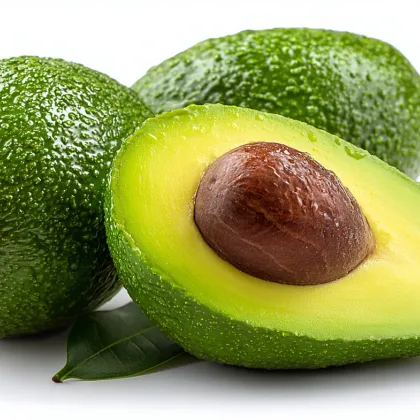
Avocado
Fibre-rich fruit with mostly monounsaturated fat, vitamin E and carotenoids
Substances: Lutein, Oleic Acid (OA, n-9), Potassium, Vitamin E (Tocopherols/Tocotrienols), β-Carotene

Lemon
Vitamin C for iron absorption enhancement and pH adjustment
Substances: Eriocitrin, Hesperidin, Vitamin C (Ascorbate)

Lentils
Folate-rich legume with plant protein, fibre and non-haem iron
Substances: Cysteine, Iron, Vitamin B9 (Folate), Zinc
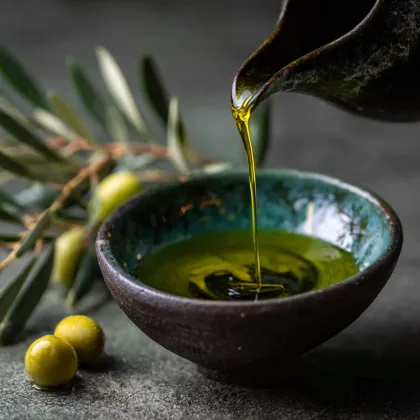
Olive Oil (Early Harvest)
Premium extra virgin olive oil with enhanced CoQ10, oleuropein, and polyphenol content from early harvest timing
Substances: Coenzyme Q10 (CoQ10), Hydroxytyrosol (Olive Polyphenol), Oleacein, Oleocanthal, Tyrosol

Olives
MUFA source with polyphenols

Quinoa
Pseudograin with magnesium, iron, and balanced plant protein
Substances: Betaine, Choline, Iron, Magnesium, Manganese, Phosphorus (Phosphate), Vitamin B1 (Thiamine), Vitamin B2 (Riboflavin), Vitamin B6 (Pyridoxine → PLP), Vitamin B9 (Folate), Zinc

Tomatoes
Lycopene, vitamin C, and food matrix effects on absorption
Substances: Lycopene, Potassium, Vitamin C (Ascorbate)

Walnuts
ALA omega-3, polyphenols, and ellagitannins for urolithin A production
Substances: ALA (Alpha-Linolenic Acid), Copper, Linoleic Acid (LA, n-6), Magnesium, Manganese, Phosphorus (Phosphate)