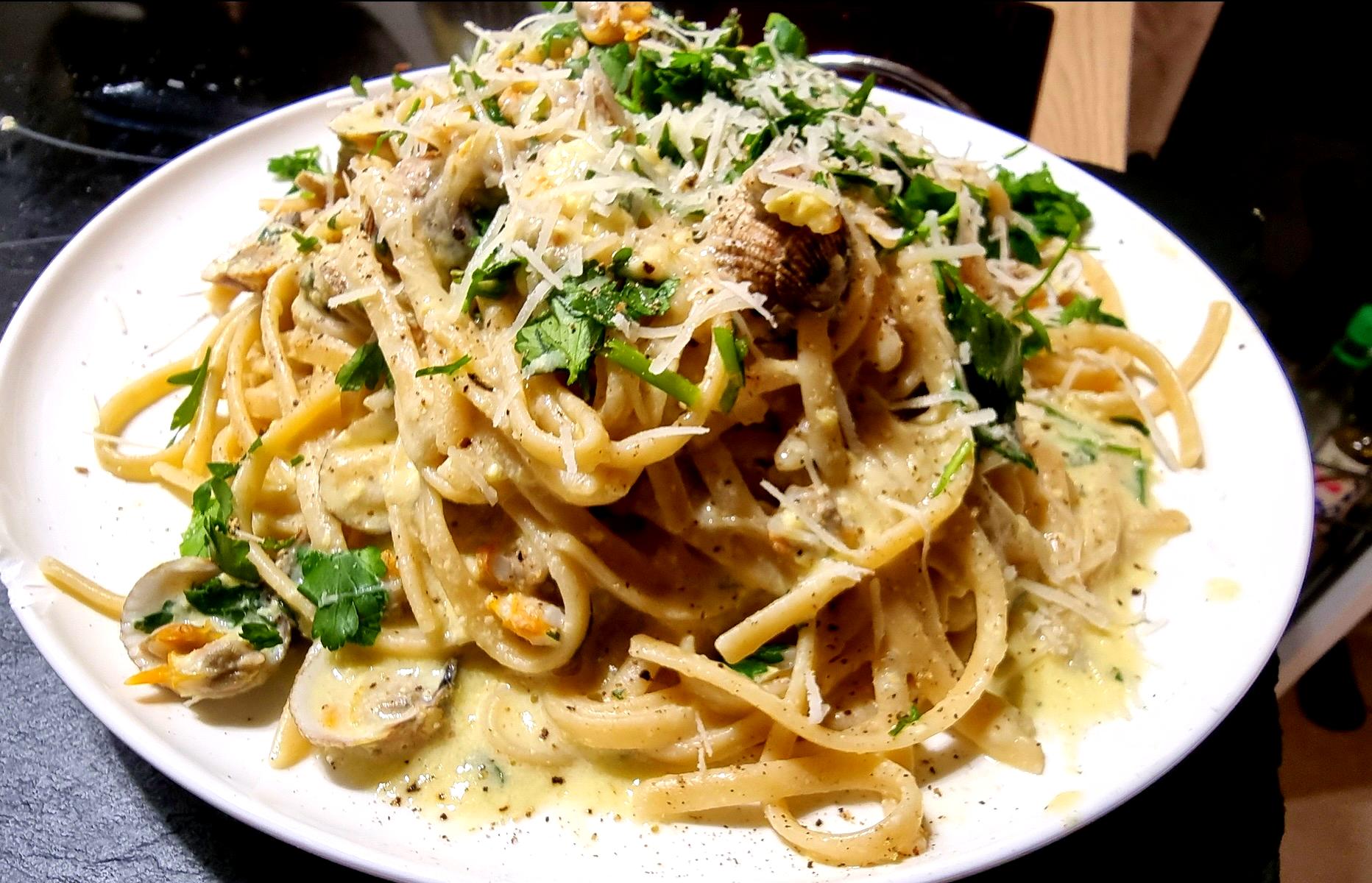
Linguine con le Cozze Mantecate (Linguine with cockles in a silky emulsified sauce)
Overview
This dish applies a classic Italian emulsification technique to shellfish pasta, producing a glossy, integrated sauce without the use of cream. Cockles are briefly steamed to preserve their natural liquor, which contains amino acids, minerals, and marine peptides contributing to both flavour and nutritional value. The dish works equally well with mussels or clams, which have similar nutritional profiles; clams and mussels are even higher in taurine Wójcik et al. 2009. Whole-wheat linguine provides a fibre-rich carbohydrate base, while onion, garlic, olive oil, and parsley create a balanced aromatic structure. The sauce is finished with egg yolk and cheese off heat, forming a stable emulsion that increases nutrient density while maintaining a light texture.
Rationale (BRAIN Diet Context)
This recipe supports several core BRAIN Diet principles:
- Marine amino acids such as taurine contribute to neuronal stability and mitochondrial function.
- Shellfish provide highly bioavailable B12, iron, zinc, and selenium, which are relevant to neurotransmitter synthesis and energy metabolism.
- Whole-grain pasta moderates glucose release and provides fibre supporting gut-brain signalling.
- Olive oil supplies monounsaturated fats and polyphenols linked with vascular and anti-inflammatory pathways.
- Egg yolk contributes phospholipids, choline, and cholesterol, supporting membrane structure, acetylcholine pathways, and lipid-mediated nutrient absorption.
The result is a meal combining stable energy supply, micronutrient density, and flavour integrity.
Ingredients (2 servings)
- 300 g whole-wheat linguine
- 1 kg cockles (or mussels, or clams), purged and rinsed
- 1 small onion, finely chopped
- 2 garlic cloves, thinly sliced
- 4 tbsp extra-virgin olive oil
- 120 ml dry white wine
- 2 egg yolks
- 25–30 g finely grated parmesan
- 1 small knob butter (optional)
- Parsley, finely chopped
- Zest of half a lemon
- Black pepper
Salted water for pasta
Method
1. Purge and prepare cockles
Ensure cockles have been purged in salted water and rinsed. Discard any that remain open when tapped.
2. Steam cockles
Place cockles in a wide pan with a splash of wine or water. Cover and cook 2–3 minutes until they open. Remove immediately from heat. Transfer cockles to a bowl and strain the cooking liquid through a fine sieve or cloth, keeping the clear liquor and discarding any sediment. Remove most cockle meat from shells, reserving a few whole for presentation if desired.
3. Cook pasta
Bring salted water to a rolling boil and cook whole-wheat linguine until just al dente. Reserve a mug of pasta water before draining.
4. Build the sauce base
In a large pan, warm olive oil over medium-low heat. Add onion and cook gently for 5–6 minutes until softened but not browned. Add garlic and cook briefly (30–40 seconds). Pour in white wine and strained cockle liquor and allow to simmer gently.
5. Combine pasta and sauce
Transfer the cooked linguine directly into the sauce with a splash of pasta water. Toss vigorously to emulsify the oil, liquor, and starch.
6. Finish with yolk emulsion
In a separate bowl, whisk egg yolks with parmesan. Slowly add 3–5 tablespoons of hot pasta water while whisking continuously. This tempers the yolks, loosening the mixture and preventing scrambling when added to the pasta. Remove pasta pan from heat and immediately add the yolk mixture, tossing continuously to form a glossy sauce. Add cockle meat and optional butter, then finish with parsley, lemon zest, and black pepper. Add more water from the boiled pasta to increase the sauce. Serve immediately.
Nutritional Estimate (per serving)
- Energy: approximately 700–760 kcal
- Protein: ~30 g
- Carbohydrate: ~70–75 g
- Fibre: ~10–12 g
- Fat: ~30–35 g
Micronutrient highlights
- Very high vitamin B12
- High iron and zinc
- Significant selenium
- Meaningful choline from egg yolk
- Marine taurine intake estimated 300–450 mg per serving
Values vary with cockle yield and pasta brand.
BRAIN Diet Summary
This dish targets multiple regulatory domains:
- Neurotransmitter support: taurine, iron, zinc, B12
- Bioenergetics: B-vitamins, selenium, whole-grain carbohydrates
- Inflammation modulation: olive oil polyphenols, allium compounds, flavonoids from parsley
- Gut-brain axis: whole-grain fibre and prebiotic substrates from onion and garlic
- Membrane and signalling support: egg yolk phospholipids and choline
The recipe demonstrates how traditional culinary techniques can be used to construct a metabolically stable, micronutrient-dense meal without relying on heavy dairy or processed ingredients.
Foods/Substances
11 foods in this recipe

Butter
See grass-fed butter for detailed information
Substances: Vitamin A (Retinoids; β-Carotene precursor), Vitamin D, Vitamin E (Tocopherols/Tocotrienols), Vitamin K2 (MK forms)
Clams
High taurine and B12 content
Substances: Iron, Taurine, Tryptophan, Tyrosine, Vitamin B12 (Cobalamin)
Cockles
Bivalve shellfish providing B12, iron, zinc, selenium, and marine taurine
Substances: DHA (Docosahexaenoic Acid), EPA (Eicosapentaenoic Acid), Iron, Omega-3 Fatty Acids, Selenium, Taurine, Vitamin B12 (Cobalamin), Zinc
Egg Yolks
Nutrient-dense part of eggs with choline, lutein, and fat-soluble vitamins
Substances: Choline, Lutein, Vitamin A (Retinoids; β-Carotene precursor), Vitamin D, Vitamin E (Tocopherols/Tocotrienols), Vitamin K2 (MK forms), Zeaxanthin
Extra Virgin Olive Oil
Polyphenol-rich oil with hydroxytyrosol and anti-inflammatory properties
Substances: Hydroxytyrosol (Olive Polyphenol), Oleacein, Oleocanthal, Oleuropein, Tyrosol
Garlic
Allicin, sulfur compounds, and prebiotic fiber for gut and antioxidant support
Substances: Acetate, Manganese, Propionate, Short-Chain Fatty Acids (SCFAs)
Mussels
Nutrient-dense bivalve providing phospholipid-bound omega-3s; accepted by some vegans (ostroveganism)
Substances: DHA (Docosahexaenoic Acid), EPA (Eicosapentaenoic Acid), Iron, Omega-3 Fatty Acids, Phosphatidylcholine (PC), Selenium, Vitamin B12 (Cobalamin), Vitamin D, Zinc
Onions
Inulin prebiotic, quercetin, and glutathione precursors
Substances: Butyrate, Quercetin (and Isoquercetin), Short-Chain Fatty Acids (SCFAs), Vitamin C (Ascorbate)
Parmesan Cheese
CLA, K2, C15:0, and high protein/calcium
Substances: Butyrate, Calcium, Short-Chain Fatty Acids (SCFAs), Tyrosine, Vitamin K2 (MK forms)
Parsley
Reduces harmful cholesterol oxidation products when added to cooking
Substances: Vitamin B9 (Folate; 5-MTHF), Vitamin C (Ascorbate), Vitamin K2 (MK forms)
Biological Target Matrix
Gut–Brain Axis & Enteric Nervous System (ENS)
| Substance | Foods | Mechanism of Action |
|---|---|---|
| Acetate | Byproduct of fibre fermentation; supports intestinal barrier integrity; regulates immune responses; promotes synthesis of key neurotransmitters such as dopamine and serotonin | |
| Butyrate | Byproduct of fibre fermentation; supports intestinal barrier integrity; regulates immune responses; promotes synthesis of key neurotransmitters such as dopamine and serotonin | |
| Choline | Choline is metabolised by gut bacteria; some strains (e.g. Lactobacillus) can produce acetylcholine. Microbial choline metabolism (e.g. trimethylamine) shows inter-individual variability and may influence host metabolism and gut–brain signalling. | |
| Propionate | Byproduct of fibre fermentation; supports intestinal barrier integrity; regulates immune responses | |
| Short-Chain Fatty Acids (SCFAs) | Byproducts of fibre fermentation; support intestinal barrier integrity; regulate immune responses; promote synthesis of key neurotransmitters such as dopamine and serotonin | |
| Vitamin D | Supports gut barrier integrity; nutrient deficiencies including vitamin D disrupt tight junctions, increasing permeability |
Inflammation & Oxidative Stress
| Substance | Foods | Mechanism of Action |
|---|---|---|
| Acetate | Supports immune regulation and anti-inflammatory processes | |
| Butyrate | Has anti-inflammatory effects, potentially reducing neuroinflammation; deficiencies linked to many neurological disorders including ADHD | |
| Choline | Choline-derived betaine supports homocysteine remethylation; elevated homocysteine is linked to oxidative stress and inflammatory signalling. Phosphatidylcholine supports membrane integrity and cell signalling in immune and redox contexts. | |
| DHA (Docosahexaenoic Acid) | Precursor to specialized pro-resolving mediators (SPMs) including protectins and maresins; terminates inflammation without immunosuppression. Production of docosahexaenoyl ethanolamide (DHEA), an N-acyl ethanolamine for endocannabinoid-like signalling, feeds into CB2-related anti-inflammatory signalling; ECS lipid mediators regulate immune tone and microglial activation (primary anchor: Inflammation & Oxidative Stress). | |
| EPA (Eicosapentaenoic Acid) | Potent anti-inflammatory; precursor to E-series resolvins; specialized pro-resolving mediators (SPMs) terminate inflammation without immunosuppression, downregulate COX-2, inhibit neutrophil infiltration, enhance macrophage clearance. Production of eicosapentaenoyl ethanolamide (EPEA), an N-acyl ethanolamine for endocannabinoid-like signalling, feeds into CB2-related anti-inflammatory signalling; ECS lipid mediators regulate immune tone and microglial activation (primary anchor: Inflammation & Oxidative Stress). | |
| Hydroxytyrosol (Olive Polyphenol) | Strong anti-inflammatory profile; contributes to neuroprotective effects of extra-virgin olive oil | |
| Lutein | Anti-inflammatory properties; supports immune regulation | |
| Oleocanthal | NF-κB inhibition; strong anti-inflammatory effects similar to ibuprofen; contributes to neuroprotective effects of extra-virgin olive oil | |
| Oleuropein | Anti-inflammatory properties; contributes to neuroprotective effects of extra-virgin olive oil | |
| Omega-3 Fatty Acids | Specialized Pro-Resolving Mediators (SPMs) - resolvins, protectins, maresins terminate inflammation without immunosuppression, downregulate COX-2, inhibit neutrophil infiltration, enhance macrophage clearance, limit glutamate-induced excitotoxicity. Production of DHEA and EPEA (N-acyl ethanolamines) feeds into CB2-related anti-inflammatory signalling; ECS lipid mediators regulate immune tone and microglial activation (primary anchor for ECS mechanism: Inflammation & Oxidative Stress). | |
| Propionate | Helps reduce neuroinflammation and protects the blood-brain barrier; enhances cognitive function | |
| Quercetin (and Isoquercetin) | Anti-inflammatory, anti-neuroinflammatory, and neuroprotective properties; supports gut barrier integrity and TLR4 suppression | |
| Short-Chain Fatty Acids (SCFAs) | Butyrate has anti-inflammatory effects, potentially reducing neuroinflammation; propionate helps reduce neuroinflammation and protects the blood-brain barrier | |
| Vitamin C (Ascorbate) | Antioxidant properties; supports anti-inflammatory effects | |
| Zeaxanthin | Anti-inflammatory properties; supports immune regulation | |
| Zinc | Supports immune signaling; gut barrier integrity disrupted by nutrient deficiencies including zinc |
Metabolic & Neuroendocrine Stress (HPA Axis & ANS)
| Substance | Foods | Mechanism of Action |
|---|---|---|
| Choline | Choline supports hepatic VLDL assembly and lipid export; methyl donors (choline, betaine) may influence adenosine metabolism and HPA axis activity. Adequate choline status supports metabolic stability and stress physiology. | |
| Omega-3 Fatty Acids | Improve vagal tone and HRV control, improve cortisol rhythms |
Methylation & One-Carbon Metabolism
| Substance | Foods | Mechanism of Action |
|---|---|---|
| Choline | Precursor to trimethylglycine (TMG/betaine), a dietary methyl donor that helps recycle homocysteine to methionine via an alternative pathway; supports one-carbon metabolism alongside folate, riboflavin, and B12; influences methylation dynamics relevant to MTHFR and COMT activity | |
| Omega-3 Fatty Acids | Support homocysteine reduction in combination with B12, phospholipid methylation (PLM) dependent on SAMe |
Mitochondrial Function & Bioenergetics
| Substance | Foods | Mechanism of Action |
|---|---|---|
| Butyrate | Supports mitochondrial function, enhancing brain energy metabolism; aids in reducing cholesterol and neuroinflammation | |
| Choline | Phosphatidylcholine and other choline-containing phospholipids support mitochondrial membrane integrity and energy metabolism; choline-derived betaine contributes to one-carbon status that can influence mitochondrial resilience | |
| DHA (Docosahexaenoic Acid) | ECS-related lipid signalling may influence mitochondrial coupling/efficiency (context-dependent; largely preclinical). Omega-3 incorporation changes membrane fluidity (secondary anchor for ECS mechanism: Mitochondrial Function & Bioenergetics). | |
| EPA (Eicosapentaenoic Acid) | ECS-related lipid signalling may influence mitochondrial coupling/efficiency (context-dependent; largely preclinical). Omega-3 incorporation changes membrane fluidity (secondary anchor for ECS mechanism: Mitochondrial Function & Bioenergetics). | |
| Iron | Critical for oxygen delivery to the brain via hemoglobin; supports mitochondrial function and energy production | |
| Manganese | Supports mitochondrial antioxidant defense through MnSOD activity | |
| Oleuropein | Oleuropein aglycone (the active form) supports mitophagy, SIRT1 activation, and AMPK activation; enhances mitochondrial function, autophagy, and neuroprotective effects through modulation of mitochondrial dynamics and antioxidant pathways | |
| Omega-3 Fatty Acids | ECS-related lipid signalling may influence mitochondrial coupling/efficiency (context-dependent; largely preclinical). Omega-3 incorporation changes membrane fluidity (secondary anchor for ECS mechanism: Mitochondrial Function & Bioenergetics). | |
| Quercetin (and Isoquercetin) | Enhances mitochondrial baseline activity and energy production; supports mitochondrial function | |
| Selenium | Protects mitochondria from oxidative damage through antioxidant enzyme activity | |
| Short-Chain Fatty Acids (SCFAs) | Butyrate supports mitochondrial function, enhancing brain energy metabolism; aids in reducing cholesterol and neuroinflammation | |
| Taurine | Protects mitochondrial function under oxidative stress; stabilizes mitochondrial membranes; supports ATP production | |
| Vitamin B12 (Cobalamin) | Crucial role in conversion of methylmalonyl-CoA to succinyl-CoA, a key step in mitochondrial energy production; deficiency leads to buildup of methylmalonic acid and odd-chain fatty acids, which are neurotoxic |
Neurotransmitter Regulation
| Substance | Foods | Mechanism of Action |
|---|---|---|
| Calcium | Essential for nerve impulse transmission and neurotransmission | |
| Choline | Essential precursor for acetylcholine synthesis, supporting memory, learning, and neuroplasticity; supports membrane phospholipid biosynthesis (PC) which is critical for membrane fluidity and neurotransmitter receptor function; phospholipid methylation (PLM) alters membrane structure, facilitating faster neuronal recovery and influencing ion channel behavior in gamma oscillations linked to attention and cognition | |
| DHA (Docosahexaenoic Acid) | Accounts for ~10–15% of total brain fatty acids, but represents 20–30% of fatty acids in neuronal phospholipids such as PE and PS, and more than 90% of the brain's omega-3 PUFA; critical for membrane fluidity, synaptic vesicle fusion, and neurodevelopment; transported across BBB as LPC-DHA via MFSD2A | |
| EPA (Eicosapentaenoic Acid) | Modulates dopamine and serotonin signalling; synergises with DHA but has independent mechanisms; membrane fluidity and neurotransmitter receptor function | |
| Iron | Essential cofactor for tyrosine hydroxylase, the rate-limiting enzyme in the conversion of tyrosine to dopamine; critical for catecholamine synthesis | |
| Omega-3 Fatty Acids | Membrane fluidity and neurotransmitter receptor function, ion channel behavior and gamma oscillations, support neurotransmission and phospholipid methylation | |
| Phosphatidylcholine (PC) | Major neuronal membrane phospholipid central to membrane fluidity, receptor function, and acetylcholine synthesis; DHA/EPA incorporated into PC are converted to lysophosphatidylcholine (LPC), a key transport form across the BBB | |
| Propionate | Stimulates secretion of norepinephrine and may influence dopamine regulation; promotes synthesis of key neurotransmitters | |
| Short-Chain Fatty Acids (SCFAs) | Propionate stimulates secretion of norepinephrine and may influence dopamine regulation; SCFAs promote synthesis of dopamine and serotonin | |
| Taurine | Modulates calcium handling; influences GABAergic tone; supports neurotransmitter balance | |
| Tryptophan | Precursor for serotonin and melatonin; brain entry competes at LAT1 with other large neutral amino acids (LNAAs); carbohydrate-rich, low-protein meals raise the plasma tryptophan:LNAA ratio because insulin pushes competing LNAAs out to muscles; can feed NAD+ synthesis via the kynurenine pathway | |
| Tyrosine | Catecholamine precursor (dopamine, norepinephrine); brain transport via LAT1 competes with other LNAAs; iron is an essential cofactor for tyrosine hydroxylase, the rate-limiting enzyme in conversion of tyrosine to dopamine; cofactors include iron, B6, folate, omega-3s, and BH₄ (tetrahydrobiopterin) to support rate-limiting steps in catecholamine synthesis | |
| Tyrosol | Neuroprotective effects; contributes to brain health benefits of extra-virgin olive oil | |
| Vitamin B12 (Cobalamin) | Supports neurotransmitter production through methylation; essential for myelin synthesis | |
| Vitamin B9 (Folate; 5-MTHF) | Supports neurotransmitter synthesis through methylation; cofactor for dopamine synthesis alongside iron, B6, and omega-3s | |
| Vitamin C (Ascorbate) | Supports norepinephrine synthesis; transported in brain via SVCT2 | |
| Zinc | Important for DNA synthesis, cell division, and neurotransmitter regulation, particularly in modulating dopamine—a key neurotransmitter implicated in ADHD; acts as an allosteric modulator of the GABA receptor; supports glutamate regulation |