Turmeric Lentil Dahl
Overview
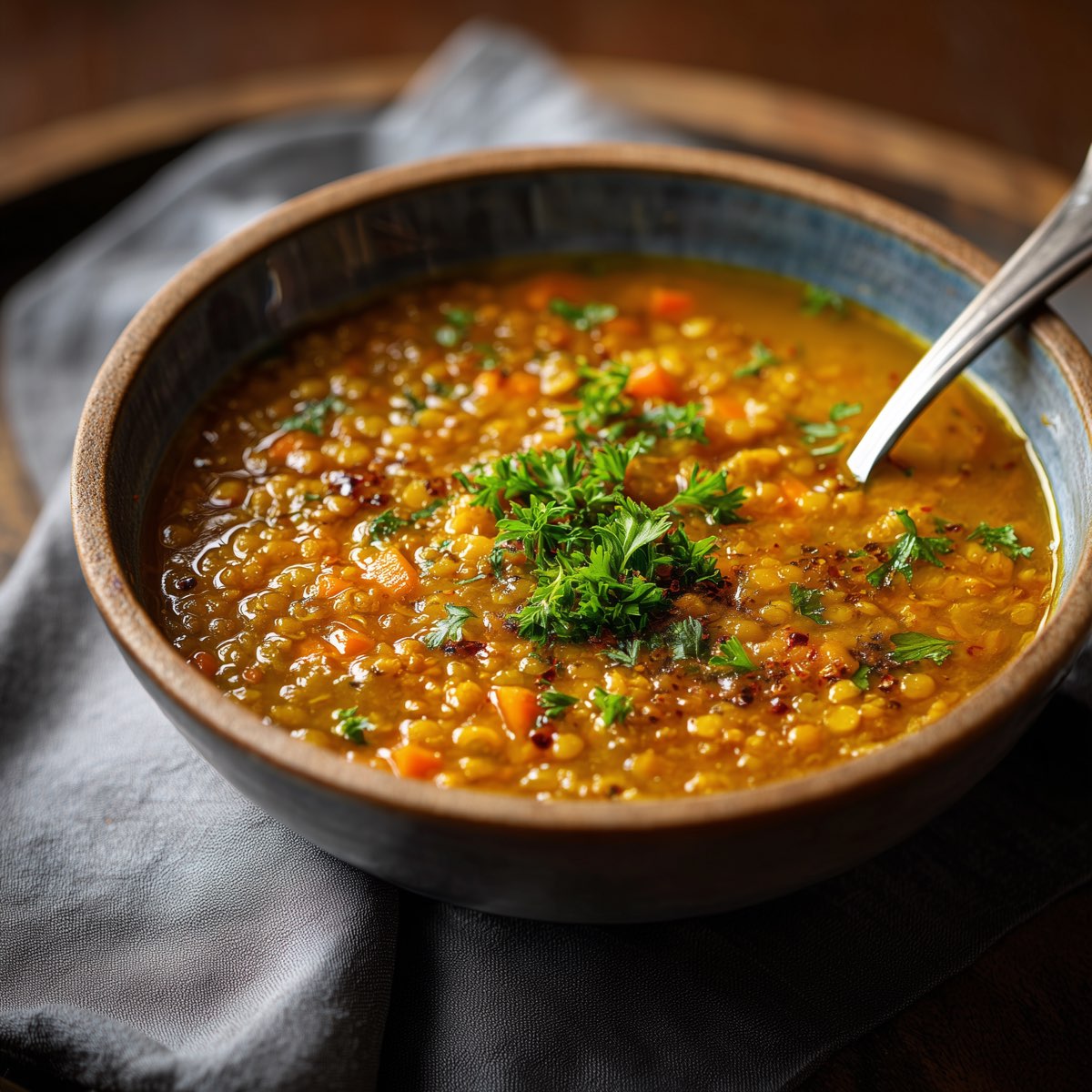
This warming dahl combines turmeric (curcumin), ginger, high-fibre lentils, and folate-rich spinach. Lentils provide fibre that feeds gut bacteria; turmeric and ginger contain compounds studied for anti-inflammatory effects; spinach provides folate, a B vitamin involved in one-carbon metabolism.
Ingredients
- 1 cup red lentils
- 1 tbsp grated fresh turmeric (or 1 tsp ground turmeric)
- 1 tsp grated ginger
- 1 tsp cumin
- 1 tbsp coconut oil
- 2 cups water or stock
- 1 cup spinach
- Salt & pepper to taste
- Optional: lemon juice, coriander
Method
- Rinse lentils thoroughly until the water runs clear.
- Heat coconut oil in a pot over medium heat.
- Add turmeric, ginger, and cumin; sauté for 1 minute until fragrant.
- Add lentils and water (or stock).
- Bring to a boil, then reduce heat and simmer for 15–20 minutes until soft and creamy.
- Stir in spinach and cook until wilted.
- Season with salt, pepper, and optional lemon juice.
- Serve warm.
Nutrition
~400 kcal · 18–20 g protein (≈ 40% RDA) · 13–15 g fibre (≈ 45–50% RDA) · 25–30% RDA magnesium · 40–50% RDA folate · high polyphenols
Brain Health Notes
- Turmeric contains curcumin, a polyphenol studied for anti-inflammatory effects.
- Ginger contains gingerols studied for anti-inflammatory effects.
- Lentils provide high fibre that feeds gut bacteria; fibre fermentation produces SCFAs associated with gut health.
- Spinach supplies folate, a B vitamin involved in one-carbon metabolism.
Foods/Substances
7 foods in this recipe
Cilantro
Herb with potential heavy metal chelation properties
Coconut Oil
MCTs for rapid brain energy and ketone production
Substances: Capric Triglyceride (Tridecanoin), Caproic Triglyceride (Tricaproin), Caprylic Triglyceride (Trioctanoin), MCT (Medium-Chain Triglycerides)
Ginger
Gut-brain axis support and anti-inflammatory; prokinetic for SIBO
Lentils
Legume rich in protein, fiber, folate, iron, and prebiotics
Substances: Acetate, Copper, Histidine, Iron, Isoleucine, Leucine, Lysine, Magnesium, Manganese, Methionine, Phenylalanine, Potassium, Propionate, Short-Chain Fatty Acids (SCFAs), Threonine, Tryptophan, Tyrosine, Valine, Vitamin B1 (Thiamine), Vitamin B6 (Pyridoxine → PLP), Vitamin B9 (Folate; 5-MTHF), Zinc
Spinach
Leafy green rich in iron, magnesium, folate, and carotenoids
Substances: Calcium, Coenzyme Q10 (CoQ10), Copper, Iron, Lutein, Magnesium, Manganese, Potassium, Vitamin A (Retinoids; β-Carotene precursor), Vitamin B1 (Thiamine), Vitamin B2 (Riboflavin), Vitamin B6 (Pyridoxine → PLP), Vitamin B9 (Folate; 5-MTHF), Vitamin C (Ascorbate), Vitamin K2 (MK forms), Zeaxanthin, Zinc, β-Carotene
Turmeric
Curcumin source; pair with black pepper and fat for absorption
Substances: Curcumin (Turmeric)
Biological Target Matrix
Gut–Brain Axis & Enteric Nervous System (ENS)
| Substance | Foods | Mechanism of Action |
|---|---|---|
| Acetate | Byproduct of fibre fermentation; supports intestinal barrier integrity; regulates immune responses; promotes synthesis of key neurotransmitters such as dopamine and serotonin | |
| Propionate | Byproduct of fibre fermentation; supports intestinal barrier integrity; regulates immune responses | |
| Short-Chain Fatty Acids (SCFAs) | Byproducts of fibre fermentation; support intestinal barrier integrity; regulate immune responses; promote synthesis of key neurotransmitters such as dopamine and serotonin |
Inflammation & Oxidative Stress
| Substance | Foods | Mechanism of Action |
|---|---|---|
| Acetate | Supports immune regulation and anti-inflammatory processes | |
| Copper | Participates in redox enzymes and antioxidant networks | |
| Curcumin (Turmeric) | Anti-inflammatory and neuroprotective effects; supports BDNF expression through polyphenol synergy | |
| Lutein | Anti-inflammatory properties; supports immune regulation | |
| Propionate | Helps reduce neuroinflammation and protects the blood-brain barrier; enhances cognitive function | |
| Short-Chain Fatty Acids (SCFAs) | Butyrate has anti-inflammatory effects, potentially reducing neuroinflammation; propionate helps reduce neuroinflammation and protects the blood-brain barrier | |
| Vitamin C (Ascorbate) | Antioxidant properties; supports anti-inflammatory effects | |
| Zeaxanthin | Anti-inflammatory properties; supports immune regulation | |
| Zinc | Supports immune signaling; gut barrier integrity disrupted by nutrient deficiencies including zinc | |
| β-Carotene | Anti-inflammatory properties; supports immune regulation |
Methylation & One-Carbon Metabolism
| Substance | Foods | Mechanism of Action |
|---|---|---|
| Methionine | Essential amino acid that forms S-adenosylmethionine (SAMe), the universal methyl donor for neurotransmitter synthesis and membrane phospholipid methylation | |
| Vitamin B2 (Riboflavin) | FAD acts as a critical cofactor for MTHFR, linking riboflavin to homocysteine recycling and methylation capacity | |
| Vitamin B6 (Pyridoxine → PLP) | Essential cofactor in remethylation of homocysteine to methionine, which is converted to S-adenosylmethionine (SAMe); works with B2, folate, and B12 | |
| Vitamin B9 (Folate; 5-MTHF) | Essential cofactor in remethylation of homocysteine to methionine, which is converted to S-adenosylmethionine (SAMe); SAMe fuels synthesis of dopamine, norepinephrine, and serotonin and drives phospholipid methylation in neuronal membranes | |
| Zinc | Deficiencies in vitamins and minerals essential for methylation, such as folate, vitamin B12, and zinc, are correlated to ADHD symptoms; supplementing these micronutrients has shown potential in supporting methylation and reducing symptom severity |
Neurotransmitter Regulation
| Substance | Foods | Mechanism of Action |
|---|---|---|
| Calcium | Essential for nerve impulse transmission and neurotransmission | |
| Capric Triglyceride (Tridecanoin) | Ketones produced from capric triglyceride provide ATP through mitochondrial metabolism; ATP is essential for neurotransmitter synthesis, release, and reuptake, indirectly supporting neurochemical balance by ensuring adequate energy for neuronal function | |
| Caproic Triglyceride (Tricaproin) | Ketones produced from caproic triglyceride provide ATP through mitochondrial metabolism; ATP is essential for neurotransmitter synthesis, release, and reuptake, indirectly supporting neurochemical balance by ensuring adequate energy for neuronal function | |
| Caprylic Triglyceride (Trioctanoin) | Ketones produced from caprylic triglyceride provide ATP through mitochondrial metabolism; ATP is essential for neurotransmitter synthesis, release, and reuptake, indirectly supporting neurochemical balance by ensuring adequate energy for neuronal function | |
| Copper | Cofactor in dopamine β-hydroxylase, supporting catecholamine synthesis; supports norepinephrine synthesis | |
| Iron | Essential cofactor for tyrosine hydroxylase, the rate-limiting enzyme in the conversion of tyrosine to dopamine; critical for catecholamine synthesis | |
| Magnesium | Broad cofactor for neurotransmitter synthesis and receptor modulation (e.g., NMDA, GABA); functions as an NMDA receptor antagonist and GABA receptor modulator; assists enzymes involved in synthesis of dopamine and serotonin | |
| MCT (Medium-Chain Triglycerides) | Ketones produced from MCTs provide ATP through mitochondrial metabolism; ATP is essential for neurotransmitter synthesis, release, and reuptake, indirectly supporting neurochemical balance by ensuring adequate energy for neuronal function | |
| Phenylalanine | Essential amino acid that converts to tyrosine and supports catecholamine synthesis (dopamine, norepinephrine); participates in LAT1 competition at the blood-brain barrier | |
| Potassium | Critical for membrane potential, nerve signaling, and neuronal excitability; adequate intake balances sodium effects | |
| Propionate | Stimulates secretion of norepinephrine and may influence dopamine regulation; promotes synthesis of key neurotransmitters | |
| Short-Chain Fatty Acids (SCFAs) | Propionate stimulates secretion of norepinephrine and may influence dopamine regulation; SCFAs promote synthesis of dopamine and serotonin | |
| Tryptophan | Precursor for serotonin and melatonin; brain entry competes at LAT1 with other large neutral amino acids (LNAAs); carbohydrate-rich, low-protein meals raise the plasma tryptophan:LNAA ratio because insulin pushes competing LNAAs out to muscles; can feed NAD+ synthesis via the kynurenine pathway | |
| Tyrosine | Catecholamine precursor (dopamine, norepinephrine); brain transport via LAT1 competes with other LNAAs; iron is an essential cofactor for tyrosine hydroxylase, the rate-limiting enzyme in conversion of tyrosine to dopamine; cofactors include iron, B6, folate, omega-3s, and BH₄ (tetrahydrobiopterin) to support rate-limiting steps in catecholamine synthesis | |
| Vitamin B6 (Pyridoxine → PLP) | Cofactor for synthesis of dopamine, serotonin, GABA, and glutamate; supports rate-limiting steps in catecholamine synthesis; requires PDXK activation with magnesium and ATP support | |
| Vitamin B9 (Folate; 5-MTHF) | Supports neurotransmitter synthesis through methylation; cofactor for dopamine synthesis alongside iron, B6, and omega-3s | |
| Vitamin C (Ascorbate) | Supports norepinephrine synthesis; transported in brain via SVCT2 | |
| Zinc | Important for DNA synthesis, cell division, and neurotransmitter regulation, particularly in modulating dopamine—a key neurotransmitter implicated in ADHD; acts as an allosteric modulator of the GABA receptor; supports glutamate regulation |