Flavin mononucleotide (FMN)
Overview
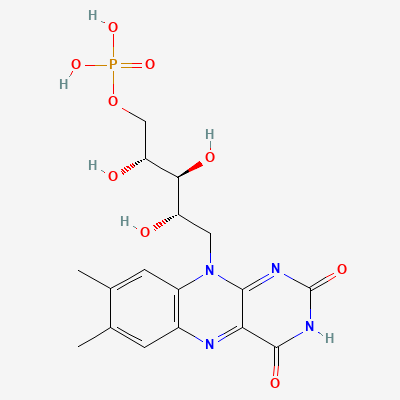
Flavin mononucleotide (FMN), also called riboflavin 5′-phosphate, is the phosphorylated coenzyme made from vitamin B2 (riboflavin). The structure shown is that phosphate. In respiratory complex I it is the flavin that accepts the electrons NADH donates at the start of the mitochondrial electron transport chain [1].
That role is an enzyme fact. The review that places flavin mononucleotide (FMN) at the NADH entry site does not show that the amount of this cofactor limits complex I in ordinary conditions, or that eating more riboflavin, once the cofactor is adequate, raises electron transport or ATP synthesis [1]. A riboflavin figure on a food page is the vitamin, not a measured amount of flavin mononucleotide (FMN).
Dietary Context
The dietary route is conversion, not a separate food constituent.
Endogenous formation. Riboflavin from food is phosphorylated to flavin mononucleotide (FMN). That cofactor can be adenylated further to flavin adenine dinucleotide. The vitamin B2 record is the dietary precursor. This page does not copy those riboflavin amounts as flavin mononucleotide (FMN).
Food sources
Foods that supply riboflavin are listed on the vitamin B2 page. No food here is linked as containing a measured amount of flavin mononucleotide (FMN).
Supplement versus food
A riboflavin supplement and a riboflavin-containing meal both supply the vitamin precursor. Neither is a measured dose of the complex I cofactor, and the complex I review does not test intake [1].
Research Spotlights & Evidence Checks
Foods
Recipes
Biological Regulatory Systems
| Biological Regulatory System | Evidence-qualified relationship | Evidence |
|---|---|---|
| Mitochondrial Function & Bioenergetics (BRS4) | Flavin mononucleotide (FMN) accepts electrons from NADH in complex I on the electron transport chain. Riboflavin is the dietary precursor. Necessity of the cofactor does not show that raising intake increases electron transport. | [1] |
References
[1] Curtabbi and Enríquez (2022). The ins and outs of the flavin mononucleotide cofactor of respiratory complex I. Places flavin mononucleotide (FMN) at the NADH entry site of complex I. Does not show that cofactor abundance limits the complex in ordinary conditions, or that riboflavin intake raises electron transport.