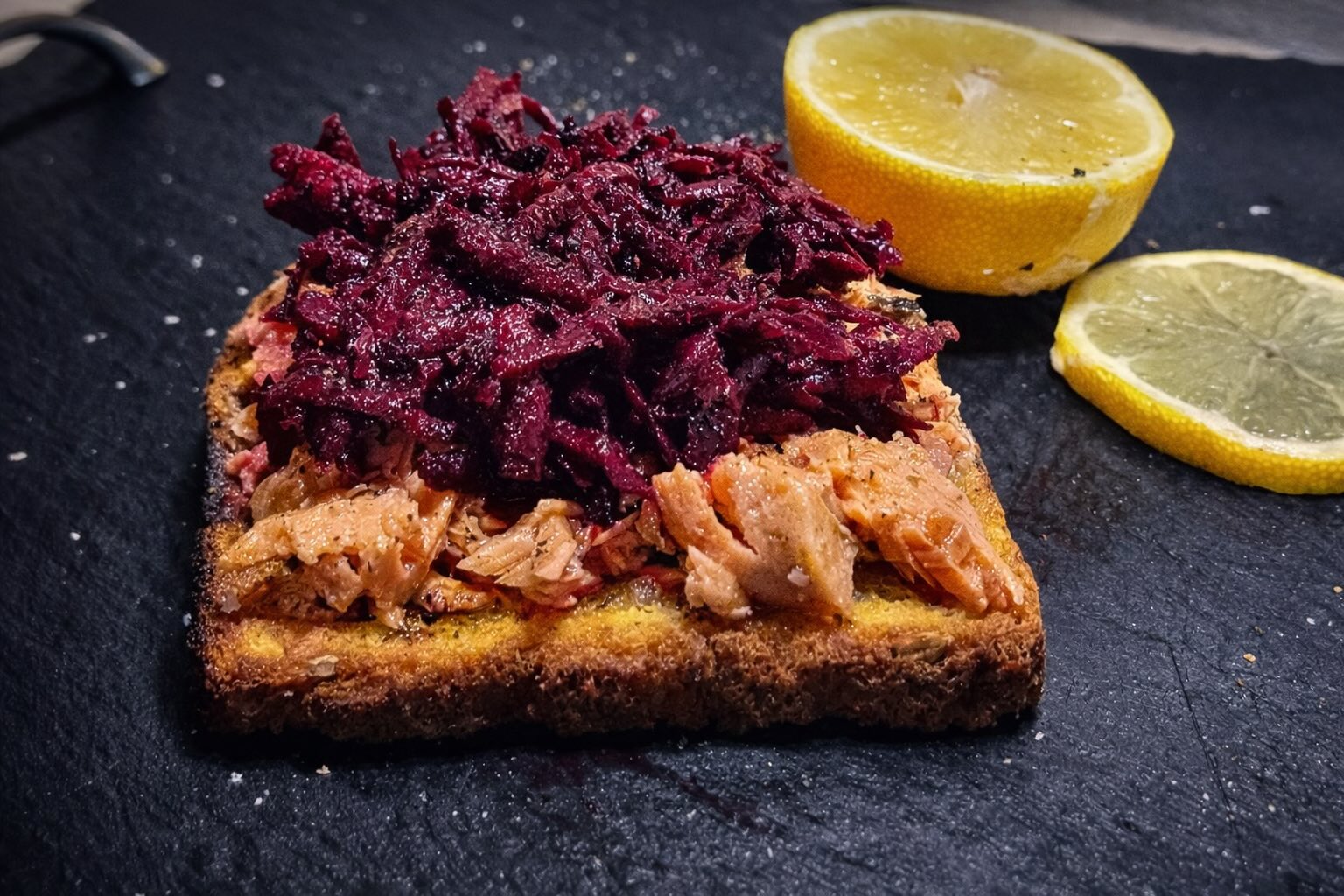
Salmon & Grated Beetroot Toast (with Lemon)
Overview
A fast, brain-forward open sandwich: omega-3 rich salmon + nitrate/polyphenol beetroot + lemon acidity for a sharp, savoury bite. Ideal for lunch when you need high protein without a long prep. Salmon sources, like all seafood, are important to research.
Ingredients (1 serving)
- Bread, wholegrain or sourdough: 1 slice (40 g)
- Salmon, cooked (or canned, drained): 90 g
- Beetroot, grated (raw or pre-cooked): 60 g
- Lemon juice: 15 ml (1 tbsp)
- Extra virgin olive oil (optional): 5 ml (1 tsp)
- Salt + black pepper: to taste
Optional upgrades (very BRAIN):
- 1 tsp capers or chopped dill/parsley
- 1 tsp Dijon mustard (mix into beetroot)
- A few rocket/arugula leaves
Method
- Toast the bread until deeply golden (better texture, slower eating, improved satisfaction).
- Mix the beetroot: In a bowl combine grated beetroot + 15 ml lemon juice + a pinch of salt and pepper. Add 5 ml EVOO if using.
- Add the salmon: Flake salmon over the toast. Season lightly (pepper is enough if salmon is already salted).
- Top & press: Pile the lemony beetroot on top. Press gently so it holds together.
- Finish: Extra lemon squeeze if you like it brighter.
Nutrition (estimated, per serving)
Based on: 40 g bread, 90 g cooked salmon, 60 g beetroot, 15 ml lemon juice, 5 ml EVOO.
- Calories: ~395 kcal
- Protein: ~25 g
- Carbohydrates: ~33 g
- Fat: ~18 g
- Fiber: ~5 g
- Omega-3 (EPA+DHA): ~1.8–2.4 g (depends on salmon type)
Key micronutrient highlights (why it's "BRAIN")
- DHA/EPA (salmon): Provides omega-3 fats important for brain structure and signaling.
- Nitrates (beetroot): Beetroot contains dietary nitrates that are studied for their role in nitric oxide signaling.
- Folate + potassium (beetroot): Provides folate and potassium involved in one-carbon metabolism and electrolyte balance.
- Vitamin C (lemon): A source of vitamin C and polyphenol-preserving acidity.
Brain Health Notes
- Salmon provides EPA and DHA, omega-3 fats that are important for brain structure and cell membranes.
- Beetroot contains dietary nitrates that are studied for their role in nitric oxide and vascular function.
- Lemon provides vitamin C, a water-soluble antioxidant.
- Wholegrain/sourdough bread provides fibre and a slower release of carbohydrate compared with refined bread.
Salmon sourcing
Both wild-caught and responsibly farm-raised salmon can be good options. Where possible, choose salmon that is sustainably sourced and labelled as free from routine antibiotics and unnecessary additives, whether wild or farmed. Please be sure to research your supermarket and their suppliers — many are moving towards more sustainable, ethical sourcing (e.g. M&S Aquaculture and Fisheries). For a balanced overview of wild versus farmed salmon, see resources such as the summary from North Coast Seafoods.
The U.S. Food and Drug Administration (FDA) and Environmental Protection Agency (EPA) jointly publish guidance on fish mercury levels. They categorize fish into "Best Choices", "Good Choices", and "Choices to Avoid" based on average mercury concentrations and safe weekly intake levels. Salmon is repeatedly in the "Best Choices" category because it consistently has low mercury relative to the reference dose used to set safety advice (≤0.15 µg/g).
Foods/Substances
5 foods in this recipe

Olive Oil
See extra virgin olive oil for detailed information
Salmon
Oily fish rich in EPA/DHA, protein, and B vitamins
Substances: Astaxanthin, DHA (Docosahexaenoic Acid), EPA (Eicosapentaenoic Acid), Histidine, Isoleucine, Leucine, Lysine, Magnesium, Methionine, Omega-3 Fatty Acids, Phenylalanine, Potassium, Selenium, Threonine, Tryptophan, Tyrosine, Valine, Vitamin B1 (Thiamine), Vitamin B12 (Cobalamin), Vitamin B2 (Riboflavin), Vitamin B3 (Niacin; Niacinamide), Vitamin B5 (Pantothenic Acid), Vitamin B6 (Pyridoxine → PLP), Vitamin D
Sourdough Bread
Fermented bread with GABA, improved amino acid bioavailability, and optimized Maillard products
Substances: Copper, Iron, Magnesium, Manganese, Potassium, Short-Chain Fatty Acids (SCFAs), Zinc
Biological Target Matrix
Gut–Brain Axis & Enteric Nervous System (ENS)
| Substance | Foods | Mechanism of Action |
|---|---|---|
| Short-Chain Fatty Acids (SCFAs) | Byproducts of fibre fermentation; support intestinal barrier integrity; regulate immune responses; promote synthesis of key neurotransmitters such as dopamine and serotonin | |
| Vitamin D | Supports gut barrier integrity; nutrient deficiencies including vitamin D disrupt tight junctions, increasing permeability |
Inflammation & Oxidative Stress
| Substance | Foods | Mechanism of Action |
|---|---|---|
| Copper | Participates in redox enzymes and antioxidant networks | |
| DHA (Docosahexaenoic Acid) | Precursor to specialized pro-resolving mediators (SPMs) including protectins and maresins; terminates inflammation without immunosuppression. Production of docosahexaenoyl ethanolamide (DHEA), an N-acyl ethanolamine for endocannabinoid-like signalling, feeds into CB2-related anti-inflammatory signalling; ECS lipid mediators regulate immune tone and microglial activation (primary anchor: Inflammation & Oxidative Stress). | |
| EPA (Eicosapentaenoic Acid) | Potent anti-inflammatory; precursor to E-series resolvins; specialized pro-resolving mediators (SPMs) terminate inflammation without immunosuppression, downregulate COX-2, inhibit neutrophil infiltration, enhance macrophage clearance. Production of eicosapentaenoyl ethanolamide (EPEA), an N-acyl ethanolamine for endocannabinoid-like signalling, feeds into CB2-related anti-inflammatory signalling; ECS lipid mediators regulate immune tone and microglial activation (primary anchor: Inflammation & Oxidative Stress). | |
| Omega-3 Fatty Acids | Specialized Pro-Resolving Mediators (SPMs) - resolvins, protectins, maresins terminate inflammation without immunosuppression, downregulate COX-2, inhibit neutrophil infiltration, enhance macrophage clearance, limit glutamate-induced excitotoxicity. Production of DHEA and EPEA (N-acyl ethanolamines) feeds into CB2-related anti-inflammatory signalling; ECS lipid mediators regulate immune tone and microglial activation (primary anchor for ECS mechanism: Inflammation & Oxidative Stress). | |
| Short-Chain Fatty Acids (SCFAs) | Butyrate has anti-inflammatory effects, potentially reducing neuroinflammation; propionate helps reduce neuroinflammation and protects the blood-brain barrier | |
| Vitamin C (Ascorbate) | Antioxidant properties; supports anti-inflammatory effects | |
| Zinc | Supports immune signaling; gut barrier integrity disrupted by nutrient deficiencies including zinc |
Metabolic & Neuroendocrine Stress (HPA Axis & ANS)
| Substance | Foods | Mechanism of Action |
|---|---|---|
| Magnesium | Helps manage stress responses; combined with vitamin D reduced behavioral problems; synergy with zinc and omega-3s reported | |
| Omega-3 Fatty Acids | Improve vagal tone and HRV control, improve cortisol rhythms | |
| Vitamin B5 (Pantothenic Acid) | Supports stress response through energy metabolism and ATP production | |
| Vitamin C (Ascorbate) | Supports stress response through antioxidant and neurochemical effects | |
| Vitamin D | Modulates immune responses to reduce inflammation in the brain; supports stress response through neurotrophic and immune effects |
Methylation & One-Carbon Metabolism
| Substance | Foods | Mechanism of Action |
|---|---|---|
| Methionine | Essential amino acid that forms S-adenosylmethionine (SAMe), the universal methyl donor for neurotransmitter synthesis and membrane phospholipid methylation | |
| Omega-3 Fatty Acids | Support homocysteine reduction in combination with B12, phospholipid methylation (PLM) dependent on SAMe | |
| Vitamin B12 (Cobalamin) | Essential cofactor in remethylation of homocysteine to methionine, which is converted to S-adenosylmethionine (SAMe); works with B6, B2, and folate; contributes meaningfully to homocysteine reduction, especially in combination with omega-3 fatty acids | |
| Vitamin B2 (Riboflavin) | FAD acts as a critical cofactor for MTHFR, linking riboflavin to homocysteine recycling and methylation capacity | |
| Vitamin B6 (Pyridoxine → PLP) | Essential cofactor in remethylation of homocysteine to methionine, which is converted to S-adenosylmethionine (SAMe); works with B2, folate, and B12 | |
| Vitamin B9 (Folate; 5-MTHF) | Essential cofactor in remethylation of homocysteine to methionine, which is converted to S-adenosylmethionine (SAMe); SAMe fuels synthesis of dopamine, norepinephrine, and serotonin and drives phospholipid methylation in neuronal membranes | |
| Zinc | Deficiencies in vitamins and minerals essential for methylation, such as folate, vitamin B12, and zinc, are correlated to ADHD symptoms; supplementing these micronutrients has shown potential in supporting methylation and reducing symptom severity |
Mitochondrial Function & Bioenergetics
| Substance | Foods | Mechanism of Action |
|---|---|---|
| Astaxanthin | Supports mitochondrial and cellular resilience through antioxidant protection | |
| DHA (Docosahexaenoic Acid) | ECS-related lipid signalling may influence mitochondrial coupling/efficiency (context-dependent; largely preclinical). Omega-3 incorporation changes membrane fluidity (secondary anchor for ECS mechanism: Mitochondrial Function & Bioenergetics). | |
| EPA (Eicosapentaenoic Acid) | ECS-related lipid signalling may influence mitochondrial coupling/efficiency (context-dependent; largely preclinical). Omega-3 incorporation changes membrane fluidity (secondary anchor for ECS mechanism: Mitochondrial Function & Bioenergetics). | |
| Iron | Critical for oxygen delivery to the brain via hemoglobin; supports mitochondrial function and energy production | |
| Magnesium | Supports enzymes involved in glycolysis and the Krebs cycle (processes that generate ATP from glucose); binds to ATP and all triphosphates in cells to activate them | |
| Manganese | Supports mitochondrial antioxidant defense through MnSOD activity | |
| Nitrate | Dietary nitrates convert to nitric oxide (NO), which supports vascular function and cerebral blood flow, enhancing oxygen and nutrient delivery to brain tissue; nitric oxide improves mitochondrial efficiency by optimizing blood flow and supporting vascular tone | |
| Omega-3 Fatty Acids | ECS-related lipid signalling may influence mitochondrial coupling/efficiency (context-dependent; largely preclinical). Omega-3 incorporation changes membrane fluidity (secondary anchor for ECS mechanism: Mitochondrial Function & Bioenergetics). | |
| Selenium | Protects mitochondria from oxidative damage through antioxidant enzyme activity | |
| Short-Chain Fatty Acids (SCFAs) | Butyrate supports mitochondrial function, enhancing brain energy metabolism; aids in reducing cholesterol and neuroinflammation | |
| Vitamin B1 (Thiamine) | Essential for mitochondrial glucose metabolism in the brain leading to ATP production; supports PDH (pyruvate dehydrogenase) and α-KGDH (alpha-ketoglutarate dehydrogenase) function | |
| Vitamin B12 (Cobalamin) | Crucial role in conversion of methylmalonyl-CoA to succinyl-CoA, a key step in mitochondrial energy production; deficiency leads to buildup of methylmalonic acid and odd-chain fatty acids, which are neurotoxic | |
| Vitamin B2 (Riboflavin) | Forms FMN/FAD coenzymes, supporting oxidative metabolism and redox balance; facilitates metabolism of B12, B6, and niacin; supports antioxidant enzymes | |
| Vitamin B3 (Niacin; Niacinamide) | Replenishes NAD+, supporting oxidative phosphorylation, sirtuin signaling, and mitochondrial biogenesis; key for neuronal energy metabolism | |
| Vitamin B5 (Pantothenic Acid) | Forms CoA (coenzyme A), required for β-oxidation and TCA cycle acetyl-CoA flux; deficiency impairs ATP production impacting brain energy |
Neurotransmitter Regulation
| Substance | Foods | Mechanism of Action |
|---|---|---|
| Copper | Cofactor in dopamine β-hydroxylase, supporting catecholamine synthesis; supports norepinephrine synthesis | |
| DHA (Docosahexaenoic Acid) | Accounts for ~10–15% of total brain fatty acids, but represents 20–30% of fatty acids in neuronal phospholipids such as PE and PS, and more than 90% of the brain's omega-3 PUFA; critical for membrane fluidity, synaptic vesicle fusion, and neurodevelopment; transported across BBB as LPC-DHA via MFSD2A | |
| EPA (Eicosapentaenoic Acid) | Modulates dopamine and serotonin signalling; synergises with DHA but has independent mechanisms; membrane fluidity and neurotransmitter receptor function | |
| Iron | Essential cofactor for tyrosine hydroxylase, the rate-limiting enzyme in the conversion of tyrosine to dopamine; critical for catecholamine synthesis | |
| Magnesium | Broad cofactor for neurotransmitter synthesis and receptor modulation (e.g., NMDA, GABA); functions as an NMDA receptor antagonist and GABA receptor modulator; assists enzymes involved in synthesis of dopamine and serotonin | |
| Omega-3 Fatty Acids | Membrane fluidity and neurotransmitter receptor function, ion channel behavior and gamma oscillations, support neurotransmission and phospholipid methylation | |
| Phenylalanine | Essential amino acid that converts to tyrosine and supports catecholamine synthesis (dopamine, norepinephrine); participates in LAT1 competition at the blood-brain barrier | |
| Potassium | Critical for membrane potential, nerve signaling, and neuronal excitability; adequate intake balances sodium effects | |
| Short-Chain Fatty Acids (SCFAs) | Propionate stimulates secretion of norepinephrine and may influence dopamine regulation; SCFAs promote synthesis of dopamine and serotonin | |
| Tryptophan | Precursor for serotonin and melatonin; brain entry competes at LAT1 with other large neutral amino acids (LNAAs); carbohydrate-rich, low-protein meals raise the plasma tryptophan:LNAA ratio because insulin pushes competing LNAAs out to muscles; can feed NAD+ synthesis via the kynurenine pathway | |
| Tyrosine | Catecholamine precursor (dopamine, norepinephrine); brain transport via LAT1 competes with other LNAAs; iron is an essential cofactor for tyrosine hydroxylase, the rate-limiting enzyme in conversion of tyrosine to dopamine; cofactors include iron, B6, folate, omega-3s, and BH₄ (tetrahydrobiopterin) to support rate-limiting steps in catecholamine synthesis | |
| Vitamin B12 (Cobalamin) | Supports neurotransmitter production through methylation; essential for myelin synthesis | |
| Vitamin B6 (Pyridoxine → PLP) | Cofactor for synthesis of dopamine, serotonin, GABA, and glutamate; supports rate-limiting steps in catecholamine synthesis; requires PDXK activation with magnesium and ATP support | |
| Vitamin B9 (Folate; 5-MTHF) | Supports neurotransmitter synthesis through methylation; cofactor for dopamine synthesis alongside iron, B6, and omega-3s | |
| Vitamin C (Ascorbate) | Supports norepinephrine synthesis; transported in brain via SVCT2 | |
| Zinc | Important for DNA synthesis, cell division, and neurotransmitter regulation, particularly in modulating dopamine—a key neurotransmitter implicated in ADHD; acts as an allosteric modulator of the GABA receptor; supports glutamate regulation |