Salmon Bowl-pistachio-cacao-nibs
Overview
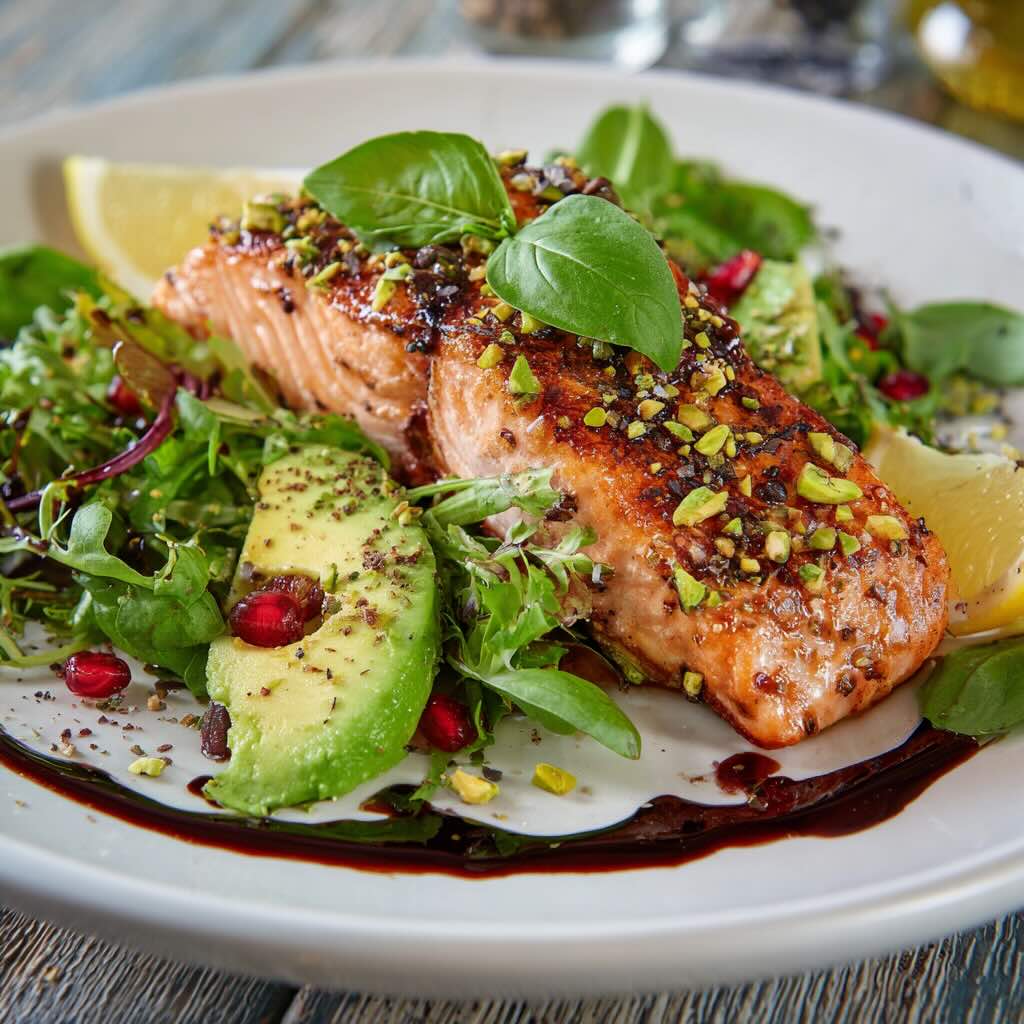
A Mediterranean-style bowl combining salmon, avocado, pistachio, raw cacao nibs, and pomegranates. These ingredients provide omega-3 fats, polyphenols, fibre, and a favourable omega-6:omega-3 ratio. Lemon and fresh greens add brightness, fibre, and micronutrients.
Ingredients (2 servings)
- 120–150 g wild salmon (baked or lightly pan-seared)
- 1 ripe avocado, sliced
- 40–50 g pistachios (raw or dry-roasted, unsalted)
- 1 cup mixed leafy greens (rocket, lamb’s lettuce, baby spinach)
- 1 tbsp raw cacao nibs
- handful of pomegranate seeds (arils)
- 1–2 tbsp early harvest olive oil
- 1 tsp hemp seeds or chia seeds
- juice of ½ lemon
- a few sprigs of mint or basil
- sea salt to taste
Method
-
Cook the salmon
Bake at 180°C for 10–12 min, or gently pan-sear.
Avoid browning or hard searing to protect omega-3 fatty acids. -
Plate the greens and avocado
Arrange leafy greens in a wide bowl. Add sliced avocado. -
Add the salmon
Flake or slice gently.
Keep structure visible for visual and textural balance. -
Add toppings
Sprinkle pistachios, chia/hemp.
Lightly scatter cacao nibs (0.5–1 tsp per bowl) to provide bitterness and crunch.
Sprinkle a handful of pomegranate seeds over the bowl for sweetness and color. -
Dress
Drizzle early harvest olive oil, add lemon juice, season lightly with salt.
Finish with mint or basil leaves.
Extra Guidance
- Serve at room temperature.
- Do not add sweet dressings — cacao functions as a bitter spice, not dessert.
- Sprinkle cacao nibs just before serving to preserve snap and aromatic bitterness.
Nutrition — per 100 g of the prepared bowl
Composite values using a normalized blend of salmon, avocado, pistachio, leafy greens, early harvest olive oil, chia, cacao nibs, and pomegranates.
Based on EU/UK reference guidelines.
| Nutrient / Substance | Amount per 100 g | RDA / RI (EU/UK) | % RDA |
|---|---|---|---|
| Energy | 183 kcal (766 kJ) | 2000 kcal | 9.1% |
| Protein | 7.8 g | 50 g | 15.6% |
| Total Fat | 14.4 g | 70 g | 20.6% |
| Saturated | 2.2 g | 20 g | 11% |
| Monounsaturated | 7.5 g | — | — |
| Polyunsaturated | 3.7 g | — | — |
| Omega-3 total | 650–730 mg | ≥250 mg | 130–200% |
| EPA | ~140 mg | — | — |
| DHA | ~420 mg | — | — |
| Omega-6 total | ~960–1050 mg | — | — |
| n6:n3 ratio | 1.4–1.6 : 1 | — | — |
| Carbohydrates | 5.2 g | — | — |
| Sugars | 0.7 g | <90 g | 0.8% |
| Fiber | 2.6 g | 30 g | 8.6% |
| Magnesium | 28–36 mg | 375 mg | 7–9% |
| Potassium | 240–290 mg | 3500 mg | 6.8% |
| Vitamin E | 1.2–1.6 mg | 12 mg | 10–13% |
| Folate | 35–44 µg | 200 µg | 17–22% |
| Vitamin B6 | 0.15–0.19 mg | 1.4 mg | 11–13% |
| Vitamin B12 | 0.85–1.0 µg | 2.4 µg | 35–42% |
| Copper | 0.08–0.10 mg | 1 mg | 8–10% |
| Manganese | 0.12–0.15 mg | 3 mg | 4–5% |
| Zinc | 0.4–0.6 mg | 10 mg | 4–6% |
Brain Health Notes
- Salmon provides EPA and DHA, omega-3 fats important for brain structure and cell membranes.
- Pistachios and avocado supply oleic acid and other fats; avocado contains compounds studied in relation to endocannabinoid-like signalling.
- Cacao nibs provide polyphenols (flavanols) that are studied for antioxidant and vascular effects.
- Early harvest olive oil contains phenolic compounds associated with antioxidant activity.
- Leafy greens and nuts provide fibre that feeds gut bacteria; fibre fermentation produces SCFAs, which are studied for gut–brain communication.
Salmon sourcing
This bowl works with either wild-caught or responsibly farm-raised salmon. Aim for salmon that is sustainably sourced and clearly labelled as free from routine antibiotics and unnecessary additives, whether wild or farmed. Please be sure to research your supermarket and their suppliers — many are moving towards more sustainable, ethical sourcing (e.g. M&S Aquaculture and Fisheries). For a balanced overview of wild versus farmed salmon, see resources such as the summary from North Coast Seafoods.
The U.S. Food and Drug Administration (FDA) and Environmental Protection Agency (EPA) jointly publish guidance on fish mercury levels. They categorize fish into "Best Choices", "Good Choices", and "Choices to Avoid" based on average mercury concentrations and safe weekly intake levels. Salmon is repeatedly in the "Best Choices" category because it consistently has low mercury relative to the reference dose used to set safety advice (≤0.15 µg/g).
Foods/Substances
5 foods in this recipe

Avocado
MUFA-rich fruit with vitamin E, lutein, and glutathione
Substances: Lutein, Potassium, Vitamin E (Tocopherols/Tocotrienols), β-Carotene
Olive Oil (Early Harvest)
Premium extra virgin olive oil with enhanced CoQ10, oleuropein, and polyphenol content from early harvest timing
Substances: Coenzyme Q10 (CoQ10), Hydroxytyrosol (Olive Polyphenol), Oleacein, Oleocanthal, Oleuropein, Tyrosol
Pomegranates
Ellagitannins for urolithin A production and polyphenol support
Substances: Potassium, Vitamin C (Ascorbate)
Salmon
Oily fish rich in EPA/DHA, protein, and B vitamins
Substances: Astaxanthin, DHA (Docosahexaenoic Acid), EPA (Eicosapentaenoic Acid), Histidine, Isoleucine, Leucine, Lysine, Magnesium, Methionine, Omega-3 Fatty Acids, Phenylalanine, Potassium, Selenium, Threonine, Tryptophan, Tyrosine, Valine, Vitamin B1 (Thiamine), Vitamin B12 (Cobalamin), Vitamin B2 (Riboflavin), Vitamin B3 (Niacin; Niacinamide), Vitamin B5 (Pantothenic Acid), Vitamin B6 (Pyridoxine → PLP), Vitamin D
Biological Target Matrix
Inflammation & Oxidative Stress
| Substance | Foods | Mechanism of Action |
|---|---|---|
| DHA (Docosahexaenoic Acid) | Precursor to specialized pro-resolving mediators (SPMs) including protectins and maresins; terminates inflammation without immunosuppression. Production of docosahexaenoyl ethanolamide (DHEA), an N-acyl ethanolamine for endocannabinoid-like signalling, feeds into CB2-related anti-inflammatory signalling; ECS lipid mediators regulate immune tone and microglial activation (primary anchor: Inflammation & Oxidative Stress). | |
| EPA (Eicosapentaenoic Acid) | Potent anti-inflammatory; precursor to E-series resolvins; specialized pro-resolving mediators (SPMs) terminate inflammation without immunosuppression, downregulate COX-2, inhibit neutrophil infiltration, enhance macrophage clearance. Production of eicosapentaenoyl ethanolamide (EPEA), an N-acyl ethanolamine for endocannabinoid-like signalling, feeds into CB2-related anti-inflammatory signalling; ECS lipid mediators regulate immune tone and microglial activation (primary anchor: Inflammation & Oxidative Stress). | |
| Omega-3 Fatty Acids | Specialized Pro-Resolving Mediators (SPMs) - resolvins, protectins, maresins terminate inflammation without immunosuppression, downregulate COX-2, inhibit neutrophil infiltration, enhance macrophage clearance, limit glutamate-induced excitotoxicity. Production of DHEA and EPEA (N-acyl ethanolamines) feeds into CB2-related anti-inflammatory signalling; ECS lipid mediators regulate immune tone and microglial activation (primary anchor for ECS mechanism: Inflammation & Oxidative Stress). |
Metabolic & Neuroendocrine Stress (HPA Axis & ANS)
| Substance | Foods | Mechanism of Action |
|---|---|---|
| Omega-3 Fatty Acids | Improve vagal tone and HRV control, improve cortisol rhythms |
Methylation & One-Carbon Metabolism
| Substance | Foods | Mechanism of Action |
|---|---|---|
| Omega-3 Fatty Acids | Support homocysteine reduction in combination with B12, phospholipid methylation (PLM) dependent on SAMe |
Mitochondrial Function & Bioenergetics
| Substance | Foods | Mechanism of Action |
|---|---|---|
| DHA (Docosahexaenoic Acid) | ECS-related lipid signalling may influence mitochondrial coupling/efficiency (context-dependent; largely preclinical). Omega-3 incorporation changes membrane fluidity (secondary anchor for ECS mechanism: Mitochondrial Function & Bioenergetics). | |
| EPA (Eicosapentaenoic Acid) | ECS-related lipid signalling may influence mitochondrial coupling/efficiency (context-dependent; largely preclinical). Omega-3 incorporation changes membrane fluidity (secondary anchor for ECS mechanism: Mitochondrial Function & Bioenergetics). | |
| Omega-3 Fatty Acids | ECS-related lipid signalling may influence mitochondrial coupling/efficiency (context-dependent; largely preclinical). Omega-3 incorporation changes membrane fluidity (secondary anchor for ECS mechanism: Mitochondrial Function & Bioenergetics). |
Neurotransmitter Regulation
| Substance | Foods | Mechanism of Action |
|---|---|---|
| DHA (Docosahexaenoic Acid) | Accounts for ~10–15% of total brain fatty acids, but represents 20–30% of fatty acids in neuronal phospholipids such as PE and PS, and more than 90% of the brain's omega-3 PUFA; critical for membrane fluidity, synaptic vesicle fusion, and neurodevelopment; transported across BBB as LPC-DHA via MFSD2A | |
| EPA (Eicosapentaenoic Acid) | Modulates dopamine and serotonin signalling; synergises with DHA but has independent mechanisms; membrane fluidity and neurotransmitter receptor function | |
| Omega-3 Fatty Acids | Membrane fluidity and neurotransmitter receptor function, ion channel behavior and gamma oscillations, support neurotransmission and phospholipid methylation |