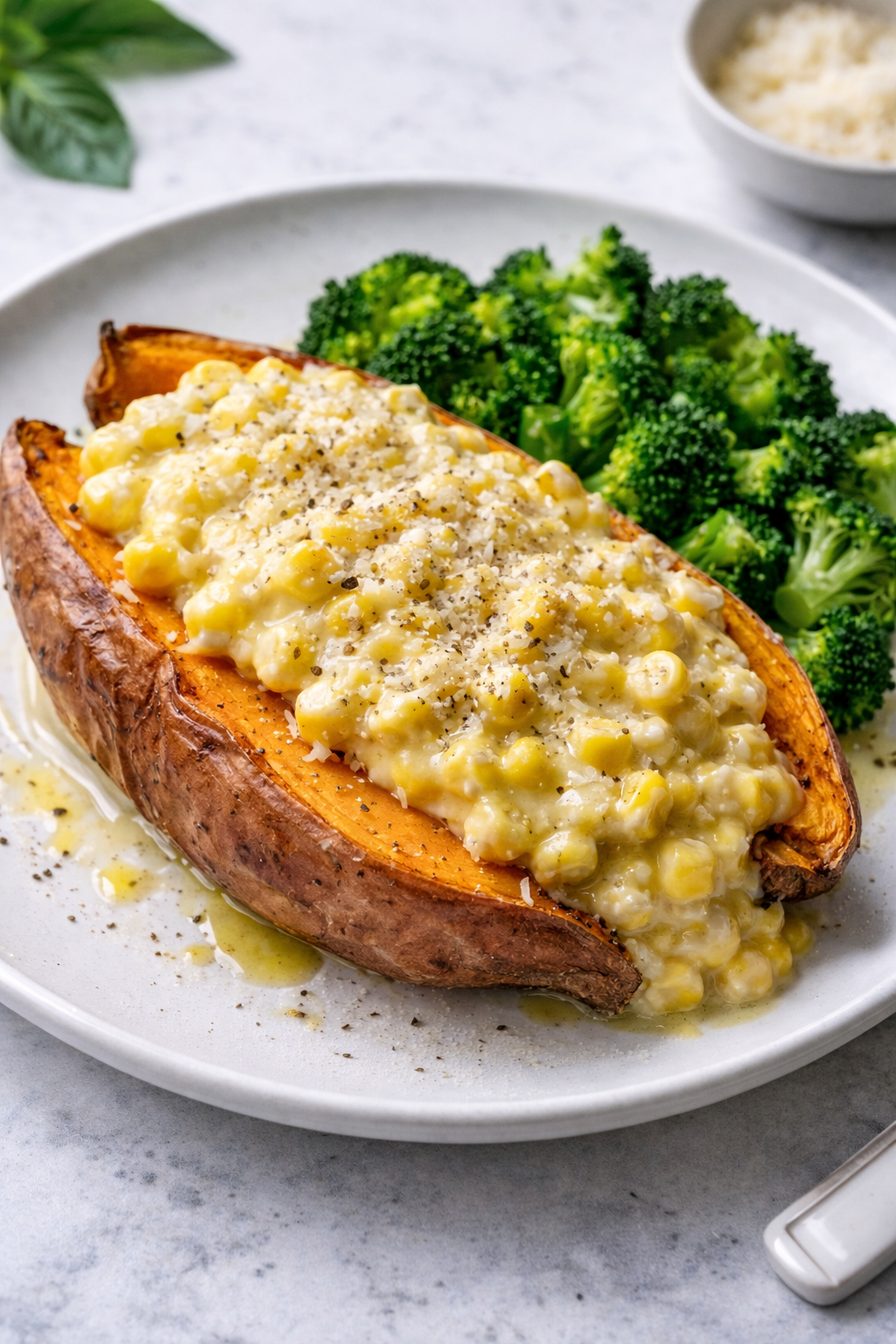
Creamed Corn on Roasted Sweet Potato
Overview
This dish illustrates a core BRAIN Diet principle: preparation and food structure influence nutrient availability and metabolic response as much as ingredient selection. Roasting the sweet potato softens plant cell walls and enhances carotenoid accessibility while providing a fibre-rich carbohydrate base with a relatively gradual glucose release. The corn is gently heated and partially blended to disrupt plant cell matrices, improving the release of lutein and zeaxanthin. Butter, curried coconut milk, olive oil, and parmesan create a mixed lipid phase that facilitates absorption of these fat-soluble compounds while also moderating gastric emptying and stabilising the post-prandial glucose response. Served with broccoli, the meal also provides additional fibre, micronutrients, and glucosinolate-derived compounds formed through myrosinase activation when the broccoli is chopped before cooking.
Ingredients (1 serving)
- 1 large sweet potato (≈350 g raw)
- 1 tin sweetcorn, drained (≈240 g)
- 150 ml full-fat curried coconut milk (or 150 ml coconut milk + 1 tsp curry powder)
- 30 g butter
- 25 g parmesan, finely grated
- 1 tbsp extra-virgin olive oil
- Salt and black pepper
To serve:
- 150 g broccoli, steamed (ideally cut ~30 minutes before cooking)
Method
Roasting the sweet potato
Preheat oven to 200 °C. Pierce the potato and rub lightly with oil and salt. Roast 45–60 minutes until fully softened. Rest briefly before splitting.
Preparing the creamed corn
Melt butter in a pan over medium-low heat. Add drained corn and cook 3–4 minutes. Add curried coconut milk and simmer gently ~5–6 minutes. Blend roughly 70 % of the mixture until smooth, return to the pan with remaining kernels. Remove from heat, stir in parmesan, and season to taste.
Assembly
Split the roasted potato, spoon the creamed corn on top, finish with olive oil, and serve with broccoli.
Nutritional information (estimated)
Whole plate (including broccoli and olive oil)
- Energy: ~880–910 kcal
- Protein: ~22 g
- Carbohydrate: ~115 g
- Sugars: ~30–35 g (primarily intrinsic)
- Fibre: ~20 g
- Fat: ~45 g
- Saturated fat: ~26–28 g (mainly curried coconut milk and butter)
Functional highlights
- High carotenoid availability (beta-carotene, lutein, zeaxanthin) supported by lipid phase
- High potassium and fibre content
- Mixed macronutrient structure supporting stable glucose response
- Broccoli contributes vitamin C, folate, and glucosinolate-derived compounds
Footnote: Sweet Potato Surface Syrup
The sticky syrup that may appear is primarily composed of these natural sugars, but contains small quantities of potassium, magnesium, and other soluble minerals, along with trace carotenoids and phenolic compounds. Retaining this syrup while cooking is worthwhile.
Optimal "syrup harvest" setup
- Thick glass baking dish
- Potato slightly tilted
- One small piercing on the lower side
- 1–2 tbsp water in the dish corner
- Roast at ~190 °C
- Collect syrup just before the end
Foods/Substances
6 foods in this recipe

Broccoli
Cruciferous vegetable rich in sulforaphane, folate, and glutathione precursors
Substances: Choline, Coenzyme Q10 (CoQ10), Iron, Magnesium, Manganese, Potassium, Vitamin B1 (Thiamine), Vitamin B2 (Riboflavin), Vitamin B5 (Pantothenic Acid), Vitamin B6 (Pyridoxine → PLP), Vitamin B9 (Folate; 5-MTHF), Vitamin C (Ascorbate), Vitamin K2 (MK forms), Zinc
Butter
See grass-fed butter for detailed information
Substances: Vitamin A (Retinoids; β-Carotene precursor), Vitamin D, Vitamin E (Tocopherols/Tocotrienols), Vitamin K2 (MK forms)
Olive Oil
See extra virgin olive oil for detailed information
Parmesan Cheese
CLA, K2, C15:0, and high protein/calcium
Substances: Butyrate, Calcium, Short-Chain Fatty Acids (SCFAs), Tyrosine, Vitamin K2 (MK forms)
Potatoes
Starchy vegetable providing resistant starch when cooled
Substances: Potassium, Vitamin B6 (Pyridoxine → PLP), Vitamin C (Ascorbate)
Biological Target Matrix
Gut–Brain Axis & Enteric Nervous System (ENS)
| Substance | Foods | Mechanism of Action |
|---|---|---|
| Butyrate | Byproduct of fibre fermentation; supports intestinal barrier integrity; regulates immune responses; promotes synthesis of key neurotransmitters such as dopamine and serotonin | |
| Choline | Choline is metabolised by gut bacteria; some strains (e.g. Lactobacillus) can produce acetylcholine. Microbial choline metabolism (e.g. trimethylamine) shows inter-individual variability and may influence host metabolism and gut–brain signalling. | |
| Short-Chain Fatty Acids (SCFAs) | Byproducts of fibre fermentation; support intestinal barrier integrity; regulate immune responses; promote synthesis of key neurotransmitters such as dopamine and serotonin | |
| Vitamin D | Supports gut barrier integrity; nutrient deficiencies including vitamin D disrupt tight junctions, increasing permeability |
Inflammation & Oxidative Stress
| Substance | Foods | Mechanism of Action |
|---|---|---|
| Choline | Choline-derived betaine supports homocysteine remethylation; elevated homocysteine is linked to oxidative stress and inflammatory signalling. Phosphatidylcholine supports membrane integrity and cell signalling in immune and redox contexts. |
Metabolic & Neuroendocrine Stress (HPA Axis & ANS)
| Substance | Foods | Mechanism of Action |
|---|---|---|
| Choline | Choline supports hepatic VLDL assembly and lipid export; methyl donors (choline, betaine) may influence adenosine metabolism and HPA axis activity. Adequate choline status supports metabolic stability and stress physiology. |
Methylation & One-Carbon Metabolism
| Substance | Foods | Mechanism of Action |
|---|---|---|
| Choline | Precursor to trimethylglycine (TMG/betaine), a dietary methyl donor that helps recycle homocysteine to methionine via an alternative pathway; supports one-carbon metabolism alongside folate, riboflavin, and B12; influences methylation dynamics relevant to MTHFR and COMT activity |
Mitochondrial Function & Bioenergetics
| Substance | Foods | Mechanism of Action |
|---|---|---|
| Choline | Phosphatidylcholine and other choline-containing phospholipids support mitochondrial membrane integrity and energy metabolism; choline-derived betaine contributes to one-carbon status that can influence mitochondrial resilience |
Neurotransmitter Regulation
| Substance | Foods | Mechanism of Action |
|---|---|---|
| Choline | Essential precursor for acetylcholine synthesis, supporting memory, learning, and neuroplasticity; supports membrane phospholipid biosynthesis (PC) which is critical for membrane fluidity and neurotransmitter receptor function; phospholipid methylation (PLM) alters membrane structure, facilitating faster neuronal recovery and influencing ion channel behavior in gamma oscillations linked to attention and cognition |