Ginger Yogurt and Blueberries
Overview
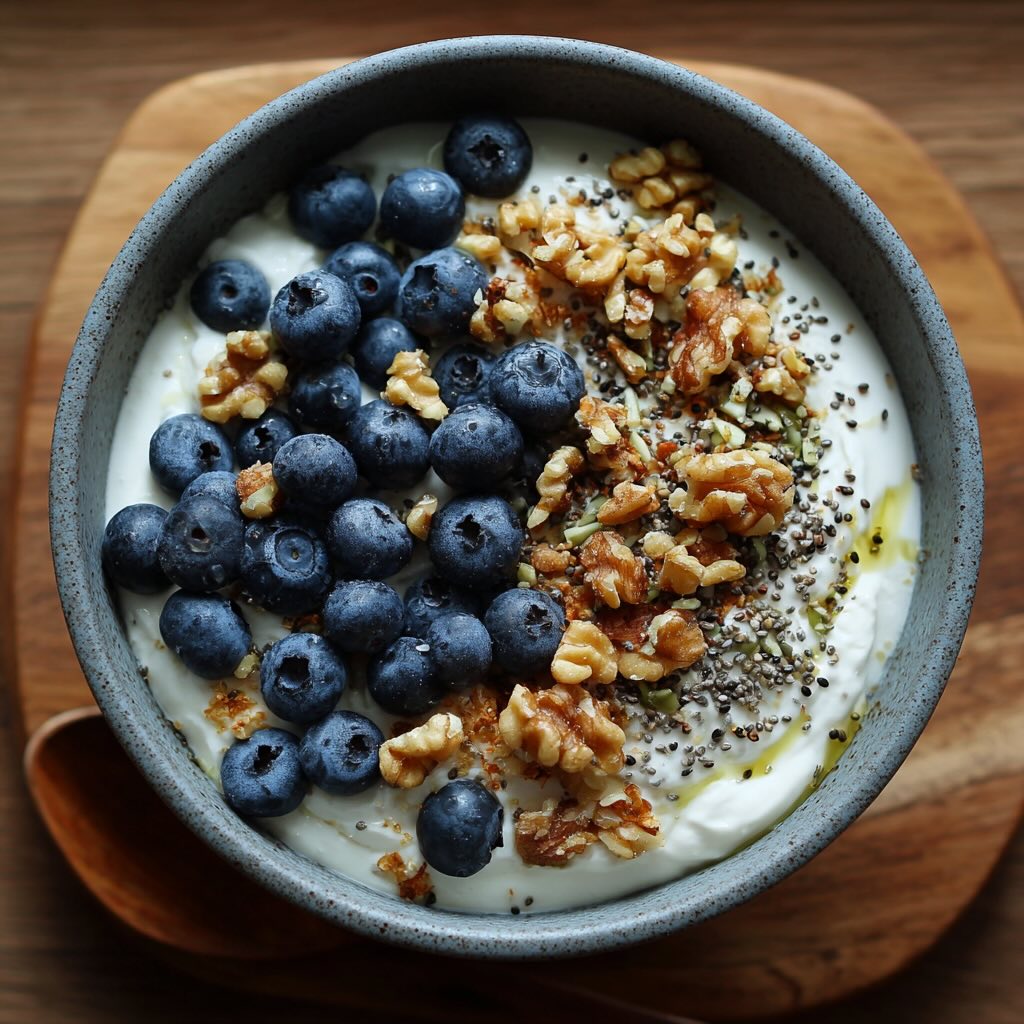
This polyphenol-rich breakfast bowl combines ginger, blueberry polyphenols, omega-3 rich seeds and nuts, and probiotic yogurt. Ginger contains gingerols, blueberries contain anthocyanins, and seeds provide ALA omega-3 — all compounds studied for various health effects. Yogurt provides probiotics associated with gut health.
Ingredients
- 150 g full-fat Greek yogurt
- ½ cup fresh blueberries
- 1 tbsp mixed seeds (chia, flax, pumpkin)
- 1 tbsp crushed walnuts
- ½ tsp grated ginger
- ½–1 tsp raw honey
- Optional: cinnamon
Method
- Mix yogurt + ginger.
- Add blueberries, seeds, walnuts.
- Drizzle honey.
- Serve.
Extra Guidance
Nuts and seeds are high calorie and high omega 6 density; used sparingly and gauge amounts.
Nutrition
~350 kcal · 18 g protein · high fiber · moderate polyphenols · omega-3 from seeds and nuts
Brain Health Notes
- Ginger contains gingerols studied for anti-inflammatory effects.
- Blueberries provide anthocyanins, polyphenols studied for antioxidant and vascular effects.
- Seeds provide ALA omega-3 and magnesium, nutrients important for brain structure and function.
- Yogurt provides probiotics and postbiotic compounds associated with gut health.
Foods/Substances
8 foods in this recipe

Blueberries
Polyphenol-rich berries supporting cognitive function and antioxidant networks
Substances: Manganese, Vitamin C (Ascorbate)
Chia Seeds
ALA omega-3, fiber, and minerals
Substances: ALA (Alpha-Linolenic Acid), Calcium, Histidine, Isoleucine, Leucine, Linoleic Acid (LA, n-6), Lysine, Magnesium, Manganese, Methionine, Phenylalanine, Threonine, Tryptophan, Valine
Flax Seeds
ALA omega-3 and soluble fiber source
Substances: ALA (Alpha-Linolenic Acid), Histidine, Isoleucine, Leucine, Linoleic Acid (LA, n-6), Lysine, Magnesium, Manganese, Methionine, Phenylalanine, Threonine, Tryptophan, Valine
Ginger
Gut-brain axis support and anti-inflammatory; prokinetic for SIBO
Pumpkin Seeds
High zinc, tryptophan, and magnesium for neurotransmitter support
Substances: Iron, Magnesium, Tryptophan, Tyrosine, Zinc
Walnuts
ALA omega-3, polyphenols, and ellagitannins for urolithin A production
Substances: ALA (Alpha-Linolenic Acid), Copper, Histidine, Isoleucine, Leucine, Linoleic Acid (LA, n-6), Lysine, Magnesium, Manganese, Methionine, Phenylalanine, Threonine, Tryptophan, Urolithin A, Valine
Yogurt
Fermented dairy providing probiotics and complete protein
Substances: Calcium, Histidine, Isoleucine, Leucine, Lysine, Magnesium, Methionine, Phenylalanine, Potassium, Threonine, Tryptophan, Tyrosine, Valine, Vitamin B12 (Cobalamin), Vitamin B2 (Riboflavin), Vitamin B5 (Pantothenic Acid), Zinc
Biological Target Matrix
Gut–Brain Axis & Enteric Nervous System (ENS)
| Substance | Foods | Mechanism of Action |
|---|---|---|
| Urolithin A | Produced from ellagitannins by gut bacteria; production varies by individual gut microbiome composition, particularly Firmicutes-to-Bacteroidetes ratio; higher polyphenol intake and microbial diversity increase urolithin A production |
Inflammation & Oxidative Stress
| Substance | Foods | Mechanism of Action |
|---|---|---|
| ALA (Alpha-Linolenic Acid) | Essential omega-3 precursor; limited conversion to DHA/EPA; contributes to omega-3 pool for anti-inflammatory effects | |
| Copper | Participates in redox enzymes and antioxidant networks | |
| Linoleic Acid (LA, n-6) | Essential omega-6 fatty acid; precursor to arachidonic acid and eicosanoids; excessive n-6:n-3 ratios may skew toward pro-inflammatory eicosanoids | |
| Urolithin A | Powerful antioxidant; supports anti-inflammatory effects | |
| Vitamin C (Ascorbate) | Antioxidant properties; supports anti-inflammatory effects | |
| Zinc | Supports immune signaling; gut barrier integrity disrupted by nutrient deficiencies including zinc |
Neurotransmitter Regulation
| Substance | Foods | Mechanism of Action |
|---|---|---|
| Calcium | Essential for nerve impulse transmission and neurotransmission | |
| Copper | Cofactor in dopamine β-hydroxylase, supporting catecholamine synthesis; supports norepinephrine synthesis | |
| Iron | Essential cofactor for tyrosine hydroxylase, the rate-limiting enzyme in the conversion of tyrosine to dopamine; critical for catecholamine synthesis | |
| Magnesium | Broad cofactor for neurotransmitter synthesis and receptor modulation (e.g., NMDA, GABA); functions as an NMDA receptor antagonist and GABA receptor modulator; assists enzymes involved in synthesis of dopamine and serotonin | |
| Phenylalanine | Essential amino acid that converts to tyrosine and supports catecholamine synthesis (dopamine, norepinephrine); participates in LAT1 competition at the blood-brain barrier | |
| Potassium | Critical for membrane potential, nerve signaling, and neuronal excitability; adequate intake balances sodium effects | |
| Tryptophan | Precursor for serotonin and melatonin; brain entry competes at LAT1 with other large neutral amino acids (LNAAs); carbohydrate-rich, low-protein meals raise the plasma tryptophan:LNAA ratio because insulin pushes competing LNAAs out to muscles; can feed NAD+ synthesis via the kynurenine pathway | |
| Tyrosine | Catecholamine precursor (dopamine, norepinephrine); brain transport via LAT1 competes with other LNAAs; iron is an essential cofactor for tyrosine hydroxylase, the rate-limiting enzyme in conversion of tyrosine to dopamine; cofactors include iron, B6, folate, omega-3s, and BH₄ (tetrahydrobiopterin) to support rate-limiting steps in catecholamine synthesis | |
| Vitamin B12 (Cobalamin) | Supports neurotransmitter production through methylation; essential for myelin synthesis | |
| Vitamin C (Ascorbate) | Supports norepinephrine synthesis; transported in brain via SVCT2 | |
| Zinc | Important for DNA synthesis, cell division, and neurotransmitter regulation, particularly in modulating dopamine—a key neurotransmitter implicated in ADHD; acts as an allosteric modulator of the GABA receptor; supports glutamate regulation |