Acetyl-CoA
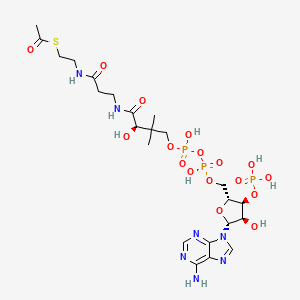
Overview
Acetyl-CoA is an endogenous thioester used in many reactions. Hepatic ketogenesis condenses acetyl-CoA through acetoacetyl-CoA and HMG-CoA before producing acetoacetate. Identity does not establish a dietary acetyl-CoA requirement. [1,2]
Dietary Context
This record resolves an endogenous pathway node. Upstream dietary provision must pass the receiving PM’s admission gate. No direct food amount, fixed conversion yield or new dietary requirement is created here.
Foods
Recipes
Biological Regulatory Systems
Relevant qualified pathways are shown with their receiving PM. A chemical identity does not itself prove dietary target engagement or benefit.
References
[1] UniProt Consortium (2026). Human lipolysis, beta-oxidation and ketogenesis enzymes. P16233/P11310/P24752/P54868/P35914 and reaction provenance, retrieved 26 October 2026; not a dietary efficacy experiment.
[2] PubChem (2026). Verified ketone-pathway chemical identities. CID 444493, InChIKey ZSLZBFCDCINBPY-ZSJPKINUSA-N, retrieved 26 October 2026; chemical identity only.
Foods supply the named dietary input. They are not shown as containing the downstream metabolite. Conversion evidence does not establish a new downstream PM admission, effective dose or equivalent food intervention.
Caprylic Triglyceride → Digestive lipolysis releases C8 fatty acid from trioctanoin; the absorbed fatty acid is represented as octanoate at physiological pH. → Hepatic fatty-acid activation and successive mitochondrial beta-oxidation reactions generate acetyl-CoA from the C8 chain. → Acetyl-CoA
BRS4-FM3-PM7: Enable mitochondrial ketone utilisation so alternative fuel is available when glucose conditions shift.
Existing admission: Type A / derived; versioned-assessment. Production context for an already admitted substrate; no new metabolite-to-PM relationship is admitted.
Uncontrolled sequential exposure: C8/C10 mixture (n=11) then 95% tricaprylin (n=6), 30 g/day for one month each. No claim of isolated C8 superiority, cognitive efficacy, healthy-person requirement or ordinary coconut-oil equivalence. PET uptake/metabolism is not a direct cellular ATP assay; no food-effective dose or fixed conversion yield is inferred.
- MCT Oil — supplies Caprylic Triglyceride; verified; Oil. unheated commercial St. Francis Herb Farm C8/C10 MCT oil from a health-food store; formulation-dependent
Composition provenance
Kosarac et al. (2021), Frontiers in Chemistry 9:756745, unheated MCT oil, Table 1; ABITEC CAPTEX product identity
The C8 acyl form is not free octanoate content in food. Mixed-chain MCT products have formulation-dependent composition.
Dependencies: Functional triglyceride digestion and absorption
This is a multireaction biological process, not a single chemical reaction. Tissue partitioning and energy state prevent a fixed food-to-acetyl-CoA yield. Cofactor participation creates no separate dietary admissions.
Dependencies: Fatty-acid activation; Mitochondrial beta-oxidation machinery; CoA, ATP and redox-cofactor availability