Guanidinoacetate
Overview
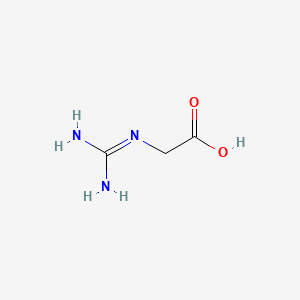
AGAT transfers an amidino group from arginine to glycine, forming guanidinoacetate; GAMT uses a SAM methyl group to produce creatine. Human renal arteriovenous measurements establish GAA production, separately from cerebral synthesis or dietary intervention efficacy [1,2].
Dietary Context
This is an endogenous conversion node. Qualified upstream arginine/glycine provision does not imply foods contain GAA or provide a fixed creatine yield. Precursor supply, organ exchange, feedback regulation and tissue transport remain distinct [1,2].
Foods
Recipes
Biological Regulatory Systems
Evidence-qualified upstream pathways are resolved relative to each receiving PM; this identity is not a dietary requirement [1,2].
References
[1] Edison et al. (2007). Creatine synthesis: production of guanidinoacetate by the rat and human kidney in vivo. Human and rat production measurements; PMID 17928413.
[2] UniProt Consortium (2026). AGAT and GAMT reaction provenance. P50440 v227 / Q14353 v215; Rhea 13201 / 10656; retrieved 26 October 2026.
Foods supply the named dietary input. They are not shown as containing the downstream metabolite. Conversion evidence does not establish a new downstream PM admission, effective dose or equivalent food intervention.
Arginine → Human AGAT transfers the amidino group of arginine to glycine, yielding guanidinoacetate and ornithine. → Guanidinoacetate
BRS4-FM1-PM3: Enable rapid ATP buffering so high-energy-demand tissues can meet sudden metabolic spikes.
Existing admission: Type A / derived; versioned-assessment. Production context for an already admitted substrate; no new metabolite-to-PM relationship is admitted.
Capacity of the endogenous synthesis route is distinct from a claim that extra amino-acid intake raises cerebral creatine, phosphocreatine buffering or cognition. AGAT feedback, GAMT methyl supply, organ exchange and SLC6A8-mediated tissue transport constrain delivery. Human renal GAA production is not a measurement of brain synthesis flux; rat arginine infusion and glycine null responses are not oral human efficacy experiments.
- Lupin Beans — supplies Arginine; verified; raw. Lupins, mature seeds, raw
Composition provenance
USDA SR Legacy April 2018
- Watermelon — supplies Arginine; verified; raw. Watermelon, raw
Composition provenance
USDA SR Legacy April 2018
Both co-substrates are required; this is not a fixed dietary yield or an assertion that extra intake is rate-limiting.
Dependencies: Functional AGAT; glycine co-substrate availability; Tissue access and feedback regulation
Glycine → Human AGAT transfers the amidino group of arginine to glycine, yielding guanidinoacetate and ornithine. → Guanidinoacetate
BRS4-FM1-PM3: Enable rapid ATP buffering so high-energy-demand tissues can meet sudden metabolic spikes.
Existing admission: Type A / derived; versioned-assessment. Production context for an already admitted substrate; no new metabolite-to-PM relationship is admitted.
Capacity of the endogenous synthesis route is distinct from a claim that extra amino-acid intake raises cerebral creatine, phosphocreatine buffering or cognition. AGAT feedback, GAMT methyl supply, organ exchange and SLC6A8-mediated tissue transport constrain delivery. Human renal GAA production is not a measurement of brain synthesis flux; rat arginine infusion and glycine null responses are not oral human efficacy experiments.
Input identity/conversion is recorded; usable food-composition mapping remains unresolved.
Both co-substrates are required; this is not a fixed dietary yield or an assertion that extra intake is rate-limiting.
Dependencies: Functional AGAT; arginine co-substrate availability; Tissue access and feedback regulation