Ginger Yogurt and Blueberries
Overview
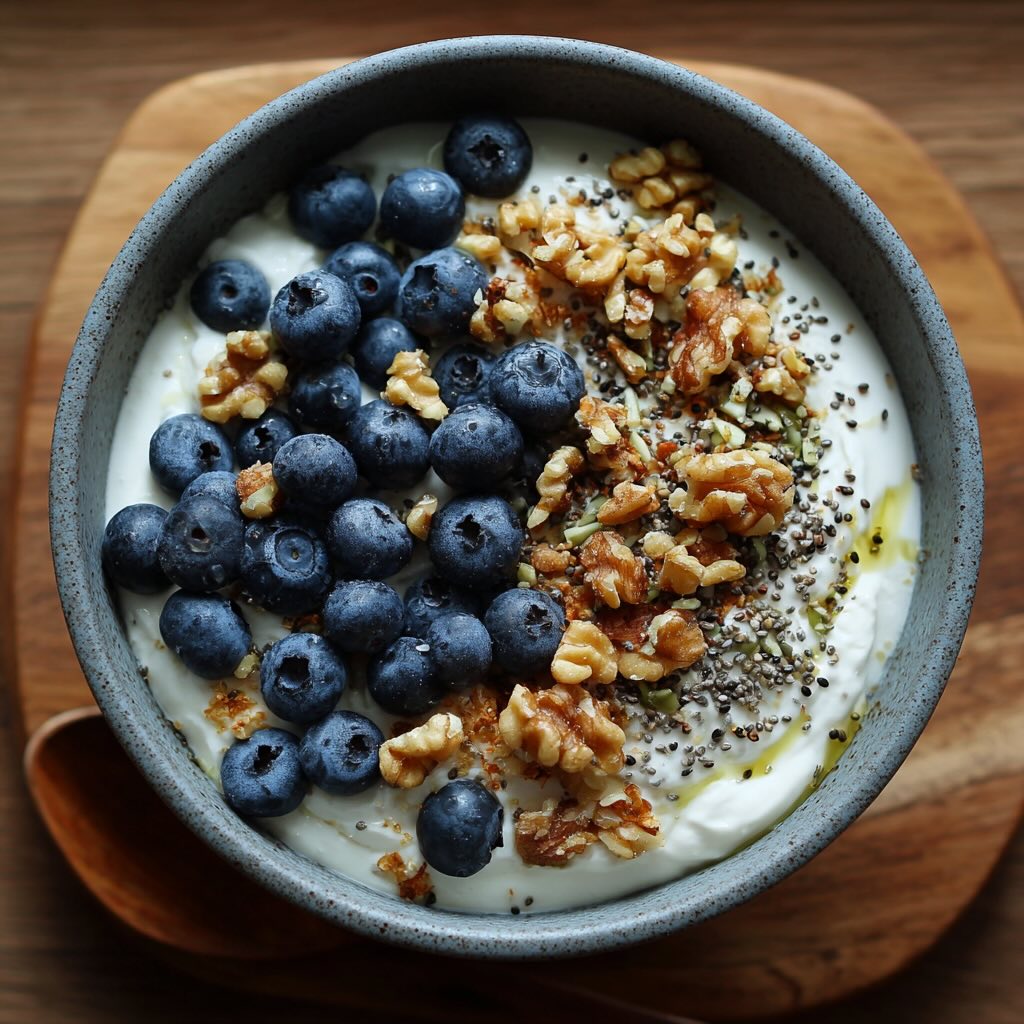
This polyphenol-rich breakfast bowl combines ginger, blueberry polyphenols, omega-3 rich seeds and nuts, and probiotic yogurt. Ginger contains gingerols, blueberries contain anthocyanins, and seeds provide ALA omega-3 — all compounds studied for various health effects. Yogurt provides probiotics associated with gut health.
Ingredients
- 150 g (5.3 oz) full-fat Greek yogurt
- ½ cup (74 g) fresh blueberries
- 9 g mixed seeds (3 g each chia, flax, pumpkin)
- 1 tbsp (7.3 g) crushed walnuts
- ½ tsp (1 g) grated ginger
- ½ tsp (3.5 g) raw honey
- Optional: cinnamon
Method
- Mix yogurt + ginger.
- Add blueberries, seeds, walnuts.
- Drizzle honey.
- Serve.
Nutrition
Per serving. Each included ingredient is scaled from a named per-100 g composition record by edible grams. Optional ingredients are excluded. Missing analytical values are not treated as zero.
| Nutrient | Per serving |
|---|---|
| Energy | 290 kcal |
| Protein | 17 g |
| Carbohydrates | 23 g |
| Sugars | 17 g |
| Fibre | 4.3 g |
| Total fat | 16 g |
| Saturated fat | 4.5 g |
| Sodium | 55 mg |
Key vitamins and minerals
| Nutrient | Per serving | Reference intake |
|---|---|---|
| Vitamin B12 | 1.1 µg | 47% RDA |
| Phosphorus | 320 mg | 46% RDA |
| Vitamin B2 | 0.47 mg | 36% RDA |
| Manganese | 0.81 mg | 35% AI |
| Copper | 0.29 mg | 32% RDA |
| Selenium | 18 µg | 32% RDA |
| Calcium | 190 mg | 19% RDA |
| Magnesium | 73 mg | 17% RDA |
Vitamins and minerals supplying at least 15% of an adult reference intake, plus explicitly featured design-relevant nutrients, up to eight. RDA is a recommended dietary allowance; AI is an adequate intake, used where the evidence does not support an RDA. Nutrients below the threshold are still calculated and still count towards a daily total; a featured row is not a claim that the serving supplies a complete daily dose.
Bioactive compounds
| Compound | Per serving |
|---|---|
| Alpha-linolenic acid (ALA; 18:3 n-3) | 1920 mg |
| Cyanidin | Present — quantity not established |
| Delphinidin | Present — quantity not established |
| Malvidin | Present — quantity not established |
| Peonidin | Present — quantity not established |
| Petunidin | Present — quantity not established |
| Quercetin | Present — quantity not established |
| Kaempferol | Present — quantity not established |
These compounds have no recognised intake target, so quantified amounts are shown without a percentage. A presence-only entry is carried from a supported food relationship and is not converted into an invented serving amount.
Calculation details
| Ingredient | Weight used | Composition record |
|---|---|---|
| 150 g (5.3 oz) full-fat Greek yogurt | 150 g | USDA FDC 171304 — Yogurt, Greek, plain, whole milk |
| ½ cup (74 g) fresh blueberries | 74 g | USDA FDC 171711 — Blueberries, raw |
| 9 g mixed seeds (3 g each chia, flax, pumpkin) | 3 g | USDA FDC 170554 — Seeds, chia seeds, dried |
| 9 g mixed seeds (3 g each chia, flax, pumpkin) | 3 g | USDA FDC 169414 — Seeds, flaxseed |
| 9 g mixed seeds (3 g each chia, flax, pumpkin) | 3 g | USDA FDC 170556 — Seeds, pumpkin and squash seed kernels, dried |
| 1 tbsp (7.3 g) crushed walnuts | 7.3 g | USDA FDC 170187 — Nuts, walnuts, english |
| ½ tsp (1 g) grated ginger | 1 g | USDA FDC 169231 — Ginger root, raw |
| ½ tsp (3.5 g) raw honey | 3.5 g | USDA FDC 169640 — no Honey food page on this site |
Mainly from:
- Energy: Greek Yogurt, Walnuts
- Protein: Greek Yogurt
- Carbohydrates: Blueberries, Greek Yogurt
- Sugars: Blueberries, Greek Yogurt
- Fibre: Blueberries, Chia Seeds
- Total fat: Greek Yogurt, Walnuts
- Saturated fat: Greek Yogurt
- Sodium: Greek Yogurt
Assumptions and exclusions:
- ½ cup (74 g) fresh blueberries: USDA SR Legacy FDC 171711 food_portion: 1 cup = 148 g; ½ cup = 74 g
- 1 tbsp (7.3 g) crushed walnuts: USDA SR Legacy FDC 170187 food_portion: 1 cup chopped = 117 g. 1 US tablespoon = 1/16 cup = 7.3125 g. The former "(15 ml)" note is spoon volume, not 15 g.
- ½ tsp (1 g) grated ginger: USDA SR Legacy FDC 169231 food_portion: 1 tsp = 2 g; ½ tsp = 1 g
- ½ tsp (3.5 g) raw honey: USDA SR Legacy FDC 169640 food_portion: 1 tbsp = 21 g; 1 tsp = 7 g (1/3 tbsp); default ½ tsp = 3.5 g. 1 tsp is an optional variation, not the default.
- Optional: cinnamon — optional ingredient, no stated quantity
- "Mixed seeds" is calculated as the recipe's own stated 9 g split equally between chia, flax and pumpkin, not as one tablespoon of each seed.
These values replace an earlier untraced line of ~350 kcal and 18 g protein.
Extra Guidance
Nuts and seeds are energy-dense; the default topping is 9 g mixed seeds plus 7.3 g walnuts. Optional cinnamon is excluded from the default nutrition calculation. 1 tsp honey is an optional variation; the default uses ½ tsp.
Brain Health Notes
- Ginger contains gingerols studied for anti-inflammatory effects.
- Blueberries provide anthocyanins, polyphenols studied for antioxidant and vascular effects.
- Seeds provide ALA omega-3 and magnesium, nutrients important for brain structure and function.
- Yogurt provides probiotics and postbiotic compounds associated with gut health.
Explore the foods and substances
Show 8 foods and their substances
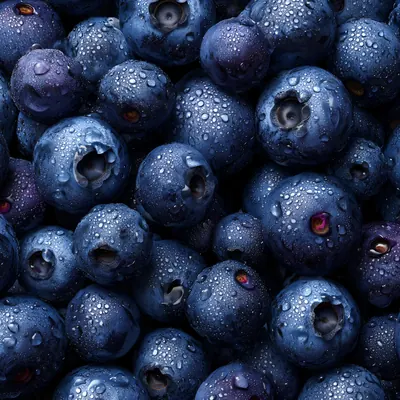
Blueberries
Berries providing anthocyanins, vitamin C and fibre
Substances: Cyanidin and Cyanidin-3-Glucoside (C3G), Delphinidin, Kaempferol, Malvidin, Manganese, Peonidin, Petunidin, Quercetin (and Isoquercetin), Vitamin C (Ascorbate)
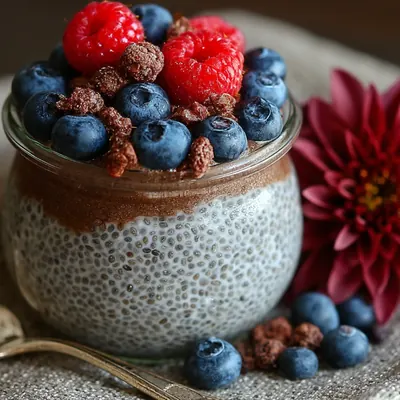
Chia Seeds
ALA omega-3, fiber, and minerals
Substances: ALA (Alpha-Linolenic Acid), Calcium, Linoleic Acid (LA, n-6), Magnesium, Manganese, Phosphorus (Phosphate)

Flax Seeds
ALA omega-3 and soluble fiber source
Substances: ALA (Alpha-Linolenic Acid), Linoleic Acid (LA, n-6), Magnesium, Manganese

Ginger
Gut-brain axis support and anti-inflammatory; prokinetic for SIBO

Greek Yogurt
Fermented dairy providing probiotics and complete protein

Pumpkin Seeds
High zinc, tryptophan, and magnesium for neurotransmitter support
Substances: Iron, Magnesium, Tryptophan, Tyrosine, Zinc

Walnuts
ALA omega-3, polyphenols, and ellagitannins for urolithin A production
Substances: ALA (Alpha-Linolenic Acid), Copper, Linoleic Acid (LA, n-6), Magnesium, Manganese, Phosphorus (Phosphate)