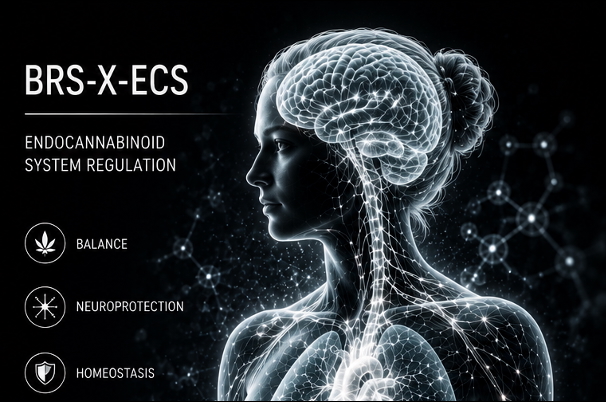
BRS-X(ECS) - Endocannabinoid System
(Lipid-Mediated Neuromodulation & Stress Buffering)
Ambition
Maintain balanced endocannabinoid signalling so the brain can regulate neural homeostasis, stress adaptation, appetite, and neuroimmune communication across changing physiological demands.
Dietary and Lifestyle Levers
Dietary patterns, food handling and behavioural levers shape how effectively this Biological Regulatory System can operate under daily demand.
Key Dietary Strategy & Targets: Prioritise phospholipid-rich whole foods — eggs, oily fish, soy, and nuts — alongside choline-containing foods that support endocannabinoid precursor biology. Include omega-3-rich seafoods and a diverse range of polyphenol-rich plants to support endogenous lipid mediator formation through food rather than pharmacological receptor targeting. Favour these whole-food fat patterns over ultra-processed, low-omega-3 dietary patterns.
- Blueberries
Polyphenol-rich fruit supporting FAAH-mediated endocannabinoid preservation and diet-sensitive modulation of stress-buffering capacity.
BRS-X(ECS-PM3) BRS-X(ECS-PM5) - Eggs
Phospholipid- and choline-rich whole food supporting NAPE → NAE biosynthesis and dietary entry into endocannabinoidome precursor pools.
BRS-X(ECS-PM1) BRS-X(ECS-PM4) BRS-X(ECS-PM5) - Fish Roe
Phospholipid-bound DHA source supporting NAPE biosynthesis, omega-3-derived endocannabinoidome signalling, and dopamine-linked neuromodulation.
BRS-X(ECS-PM1) BRS-X(ECS-PM2) BRS-X(ECS-PM4) - Oats
Whole-grain phospholipid and fibre matrix supporting NAPE precursor availability and endocannabinoid stress-buffering through regular meal-pattern intake.
BRS-X(ECS-PM1) BRS-X(ECS-PM5) - Salmon
Omega-3-rich oily fish supporting DHEA/EPEA-related endocannabinoidome signalling, dopamine neuromodulation, and stress-buffering lipid mediator context.
BRS-X(ECS-PM2) BRS-X(ECS-PM4) BRS-X(ECS-PM5) - Walnuts
Plant source of ALA and polyphenols supporting omega-3-derived endocannabinoidome signalling without reliance on pharmacological receptor targeting.
BRS-X(ECS-PM2)
Prioritise sleep regularity and stress recovery to support endocannabinoid tone, stress buffering, and healthier dopamine-related motivation context.
Supports: BRS-X(ECS-PM3) BRS-X(ECS-PM4) BRS-X(ECS-PM5)
Maintain regular meal timing to support steady dietary entry into endocannabinoid precursor pools across the day.
Supports: BRS-X(ECS-PM1) BRS-X(ECS-PM2)
Overview
The brain uses lipid-mediated signalling to modulate synaptic activity, stress responses, appetite, and neuroimmune communication beyond classical neurotransmitters alone. BRS-X(ECS) describes the integrated capacity that sustains endogenous endocannabinoidome tone rather than relying on pharmacological receptor activation. NAPE precursor biology, NAE biosynthesis, FAAH-mediated preservation, dopamine-linked neuromodulation, and stress-buffering pathways work together so lipid signalling remains proportionate and adaptive. Nutrition influences these capacities through phospholipid-rich meals, choline-containing foods, omega-3-supportive patterns, and polyphenol diversity that support endogenous lipid mediator formation.
Functional Mechanisms
Endocannabinoidome signalling integrates lipid-mediated neuromodulation — NAE biosynthesis, preservation, and stress-buffering — that modulates synaptic activity and neuroimmune communication. These mechanisms sustain proportionate endogenous tone rather than relying on pharmacological receptor activation alone.
- BRS-X(ECS-FM1) — Endocannabinoidome Signalling Capacity & Neuromodulatory RegulationOpen FM →
- BRS-X(ECS-PM1) — NAPE → NAE Biosynthesis Capacity
- BRS-X(ECS-PM2) — Omega-3-Derived Endocannabinoidome Signalling
- BRS-X(ECS-PM3) — FAAH-Mediated Endocannabinoid Preservation
- BRS-X(ECS-PM4) — Endocannabinoid–Dopamine Neuromodulation
- BRS-X(ECS-PM5) — Endocannabinoid Stress-Buffering Capacity
Maintains endocannabinoidome signalling capacity by coordinating precursor availability, N-acyl ethanolamine production, degradation balance, and neuromodulatory interactions.
FM page: BRS-X(ECS-FM1) — Endocannabinoidome Signalling Capacity & Neuromodulatory Regulation
Primary biological effects: ↑ endocannabinoidome precursor and NAE signalling capacity; ↑ FAAH-sensitive endogenous tone preservation; ↑ dopaminergic neuromodulatory coupling; ↑ stress-buffering and neuroinflammatory modulation context; ↓ diet-limited endocannabinoidome insufficiency
Modulation context: Intervention: Mixed Modulation · Timing-specific: Yes · Coverage: Daily
Key constraints:
Connected mechanisms:
- BRS1-FM3-PM6 — fM3-PM6 context relevant to this mechanism
- BRS1(FM1) — bRS1(FM1) context relevant to this mechanism
- BRS6(FM2) — bRS6(FM2) context relevant to this mechanism
Specific Mechanisms
Specific Mechanisms (SMs) are interpretation layers — context-specific readings of stable BRS-X(ECS) biology grounded in connected PMs, FMs, and KCs. They provide additional biological context for applying the BRAIN Framework. Current SM categories include SM-SNP (genetic variation), SM-CROSS (multi-BRS interpretive concepts), SM-Male and SM-Female (sex-specific biology), SM-Lifestage (e.g. childhood, pregnancy, older adulthood), and SM-Pattern (e.g. vegan, vegetarian, ketogenic). Functional phenotype interpretation is handled via the Phenome Registry rather than SM-PHEN pages. Individual SMs may be combined to create richer biological profiles and support future precision-nutrition applications.
- No published ECS-specific SM pages yet.