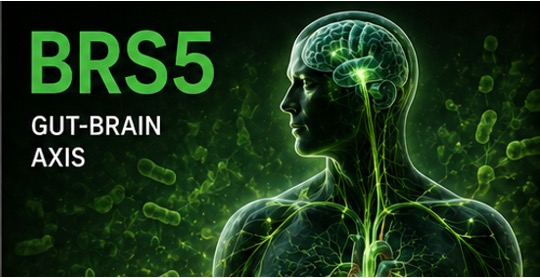
BRS5-FM3-PM7 - Vagal / ENS Signalling Modulation
(Gut Nerve Signals That Talk to the Brain)
1. Mission & Overview
Mission
Maintain gut-to-brain nerve signalling through the vagus nerve and enteric nervous system.
Overview
The gut communicates with the brain through the vagus nerve and the enteric nervous system (the gut's own nerve network). Microbial activity, fermentable fibres and gut-derived neuroactive cues can modulate these pathways — influencing stress responses, mood tone and autonomic balance. Regular meal patterns and fermented foods may support this signalling when tolerated.
- Modulates vagal and enteric nervous system signalling from the gut.
- Transduces microbial and gut-environment cues into brain-relevant neuromodulation.
- Highlights fermentable fibre, meal regularity and fermented foods as supporting dietary patterns.
2. Primary Biological Effects
↑ vagal tone signalling; ↑ gut-brain neuromodulatory input
3. Phenome Connections
These mappings are translational relationships, not single-mechanism outcome claims. Phenomes are emergent functional patterns supported by multiple interacting PMs across the BRAIN Framework. Biology → Phenome Confidence reflects how directly this mechanism's biology would be expected to affect the phenome within BRAIN architecture — not dietary treatment efficacy. Evidence Confidence (below Key References) reflects how convincing the attached evidence is for the Biology → Phenome relationship on that row.
These are three independent scores. They are not combined or averaged. A phenome can have Medium registry evidence while individual mechanism rows show different Biology → Phenome and Evidence scores.
1. Phenome Evidence Confidence (Phenome Registry only)
Question: How convincing is the foundational evidence that this phenome is a valid, well-defined functional construct — and that diet-relevant biology can plausibly connect to it?
Not a roll-up of Biology → Phenome Confidence or Evidence Confidence from Primary Mechanism page rows. Those are scored per mechanism; this score is assigned once per phenome at registry level.
Derived from foundational landmark evidence organised in up to three layers: construct validation, biology→phenome linkage, and nutrition→biology modulation. Each layer may include one or many landmark papers depending on registry review.
2. Biology → Phenome Confidence (Primary Mechanism page §3 rows)
Question: If this PM/FM biology were substantially impaired in isolation, how directly would that phenome be expected to suffer — within BRAIN architecture?
How it is derived: Reviewers read the PM/FM definition and biological function first — initially ignoring attached references and whether dietary intervention studies exist. References are reviewed only when scoring Evidence Confidence (below).
Score levels (the value shown on each row as Biology → Phenome Confidence):
- High — primary biological determinant (e.g. noradrenergic signalling → attention; GABA synthesis → calming tone)
- Medium — major contributory determinant, not the sole driver
- Low–Medium — established but indirect, modulatory, or one integrative step removed
- Low — distal, conditional, or weak biological coupling
“Not dietary treatment efficacy” means this score does not ask whether a diet or supplement treats the phenome. It asks whether the biology itself is architecturally relevant. Limited dietary RCT evidence belongs in Evidence Confidence, not here.
3. Evidence Confidence (Primary Mechanism page §3 rows)
Question: How convincing are the attached Key References on that specific row that this biology actually relates to this phenome?
How it is derived: Assigned after Biology → Phenome Confidence, by reviewing only the references on that PM/FM row. Judges whether refs support the relationship — not just mechanism or phenome in isolation.
- High — strong convergent human evidence directly linking mechanism biology to phenome variation
- Medium — multiple human lines supporting the relationship; may include one bridge study with an inferential step
- Low–Medium — convergent translational stack without direct mechanism↔phenome measurement on the row
- Low — mechanistic or preclinical only; mechanism and phenome supported separately but not bridged
Often equal to or lower than Biology → Phenome Confidence. Can occasionally be higher when outcome evidence is stronger than the mechanism's contributory role.
- Biology → Phenome Confidence: Low–Medium
- Rationale: Open-label Bifidobacterium bifidum supplementation associated with symptom change and altered gut microbiota in children with ADHD — vagal/ENS signalling is the proposed gut–brain conduit; early-life Lactobacillus exposure adds developmental modulation context.
- Key References:
- Evidence Confidence: Low–Medium
- Biology → Phenome Confidence: Low–Medium
- Rationale: Probiotic-associated symptom change in ADHD children and hypothesis-generating early-life microbial modulation windows support gut–vagal pathways intersecting affective regulation biology without definitive prevention claims.
- Key References:
- Evidence Confidence: Low–Medium
4. Levers
Intervention Profile
Intervention Dominance: Diet-Supported
- Fermented foods ← yogurt, kefir, fermented vegetables
- Fibre diversity ← varied plant foods
- Regular meals ← ENS rhythm support
- GABA-supportive cofactors
- Magnesium ← leafy greens, nuts, seeds
- polyphenols
-
Inulin/GOS ← onions, chicory, legumes
-
Pectin/soluble fibre ← oats, apples, flax seeds
-
Resistant starch ← cooled potatoes, cooled rice, green bananas
1. Food Preparation & Delivery ONLY
- Repeated daily patterning matters more than one-off vagal-support ideas.
- Meal regularity may be especially relevant where enteric rhythm is unstable.
- Prepare fermentable staples and include traditionally fermented foods where tolerated — see Lentils — Preparation.
- Soak overnight to reduce phytates and improve mineral bioavailability — see Oats — Preparation.
5. Mechanistic Basis
Summary
BRS5-FM3-PM7 links fermented foods, fibre-supported microbial activity, and rhythmic eating patterns to vagal and enteric neuromodulatory signalling [Bravo et al., 2011; Austelle et al., 2022].
(Vagal route of communication)
The vagus nerve and ENS provide a route by which gut state can influence central regulatory context without requiring direct neurotransmitter transfer across the blood-brain barrier.
(Dietary support context)
Fermented foods, fibre diversity, and ecological stability may influence the microbial and neuroactive signals entering this route, while meal regularity helps shape enteric rhythm context.
(Cross-system context)
Because neuromodulatory interpretation depends partly on membrane and glycaemic state, this PM links outward to BRS1 and BRS6 support layers.
5.1 Evidence Highlights
Introduction/Summary
Vagal and enteric nervous system signalling biology is well established. The studies below do not restate neural anatomy; they highlight microbiota–vagal pathway and neuromodulatory-route findings that refine how gut-to-brain signalling is interpreted in practice.
- Confidence: low-medium
- Evidence Level: mechanistic
- Rationale: Ingestion of a Lactobacillus strain altered central GABA receptor expression via vagal pathways in preclinical models — supporting fermented-food and microbial ecology as levers for enteric–vagal neuromodulatory signalling [Bravo et al., 2011].
- Key References:
- Confidence: low-medium
- Evidence Level: mechanistic
- Rationale: The vagus nerve transmits microbial and neurochemical cues from the gut to central regulatory circuits without requiring direct neurotransmitter transfer across the blood–brain barrier — as a principal gut–brain communication route [Austelle et al., 2022].
- Key References:
- Confidence: low-medium
- Evidence Level: mechanistic
- Rationale: Vagus nerve stimulation reviews summarise neuromodulatory pathways through which gut-derived signals may influence autonomic and regulatory tone — contextualising vagal/ENS signalling as an integrative interface rather than a single dietary effect [Austelle et al., 2022].
- Key References:
- Confidence: low-medium
- Evidence Level: mechanistic
- Rationale: Fermented foods, fibre-supported microbial activity, and rhythmic eating patterns may influence the microbial and neuroactive signals entering vagal routes — reinforcing repeated exposure over one-off interventions [Bravo et al., 2011].
- Key References:
6. BRS Pathways and Connections
6.1 BRS Pathways
- None listed
6.2 Cross-BRS Mechanism Relationships
Primary Mechanisms in other Biological Regulatory Systems that directly interact with, constrain or support this mechanism.
- BRS1-FM3-PM6 - Neuronal Membrane DHA Incorporation — biological connection relevant to this mechanism
- BRS6-FM1-PM2 - Glycaemic Variability Regulation — biological connection relevant to this mechanism
6.3 Local BRS Mechanism Relationships
Related Primary Mechanisms within the same Biological Regulatory System that collectively support the integrated biological function.
- BRS5-FM3-PM8 - Neurotransmitter Precursor Biotransformation & Availability
- BRS5-FM1-PM3 - Keystone Taxa Support
7. Scoreable Inputs & Modulation Signals
This PM is scoreable through fermented-food, fibre-diversity, and meal-rhythm signals.
| Input Category | Example Inputs | PM5 Relevance |
|---|---|---|
| Functional Property Potentials | fermented_food_pattern; fibre_diversity; meal_rhythm_support | May support vagal / ENS signalling modulation. |
| Realised Functional States | fermented_food_inclusion; regular_meal_pattern | Reflect practical gut-neuromodulation states. |
| Preparation Transformations | live_fermented_food_use; minimally_processed_matrix | May preserve neuroactive microbial context. |
8. References
- Bravo et al. (2011) — Ingestion of Lactobacillus Strain Regulates Emotional Behavior and Central GABA Receptor Expression
- Austelle et al. (2022) — A Comprehensive Review of Vagus Nerve Stimulation for Depression
- Wang et al. (2022) — Effect of Bifidobacterium Bifidum on Clinical Characteristics and Gut Microbiota in Attention-Deficit/Hyperactivity
- Pärtty et al. (2015) — A Randomized Trial