Oligofructose
Overview
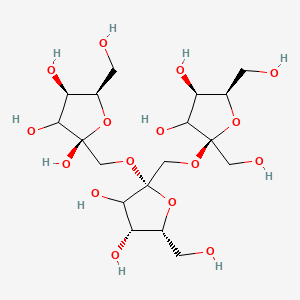
Oligofructose is a mixture of short-chain inulin-type fructans. The structure shown is one fructose trimer from that mixture, not every chain the name covers. Roberfroid places the mixture at a degree of polymerisation of about 2–8, average about 4, beside longer-chain inulin (about 10–60) and beside blends such as oligofructose-enriched inulin [1]. Niness describes the same short-chain subgroup with an upper bound of 10, so the bound is a convention rather than a second substance [2]. This page uses oligofructose for that short-chain inulin-type mixture.
FOS and fructooligosaccharides overlap with this name, and they also name sucrose-derived kestose, nystose and fructosyl-nystose [3]. Chicory, onion, garlic, leek and Jerusalem artichoke store mixed fructan lengths. That plant mix is not a standardised oligofructose ingredient, and no food page here has a measured amount. In adults with overweight, 21 g/day of oligofructose for 12 weeks lowered plasma lipopolysaccharide versus placebo. That is a small supplement result, not a vegetable effect [4].
Dietary Origin
Commercial oligofructose is usually the partial enzymatic hydrolysate of chicory inulin: a mixture of glucose-terminated and fructose-only chains in the short degree-of-polymerisation range [1,2]. That is a direct ingredient exposure. Sucrose-derived fructooligosaccharides are a different preparation, even when a label uses the same words [3].
Native plants contain inulin-type fructans across a range of chain lengths. A food that contains fructans does not, by that fact, contain this standardised mixture, and eating the food is not the 21 g/day supplement [1,4]. No food in this ontology yet has a chain-length measurement that would support a contains relationship, so none is linked.
Research Spotlights & Evidence Checks
Recipes
Foods
References
[1] Roberfroid (2007). Inulin-type fructans: functional food ingredients. Defines oligofructose as the short-chain inulin-type fraction (degree of polymerisation about 2–8), separate from longer-chain inulin and from oligofructose-enriched inulin.
[2] Niness (1999). Inulin and oligofructose: what are they?. Describes oligofructose as the short-chain subgroup of inulin, with an upper bound of 10 rather than 8, so the cutoff is a convention.
[3] Kelly (2008). Inulin-type prebiotics — a review: part 1. Records that fructooligosaccharides, oligofructose and inulin are used inconsistently, and that chicory extraction and sucrose synthesis do not yield the same chain mixture.
[4] Parnell et al. (2017). Oligofructose decreases serum lipopolysaccharide and plasminogen activator inhibitor-1 in adults with overweight/obesity. Supplemental 21 g/day result in a small overweight sample. It is not a food trial and not a finding about every fructan.