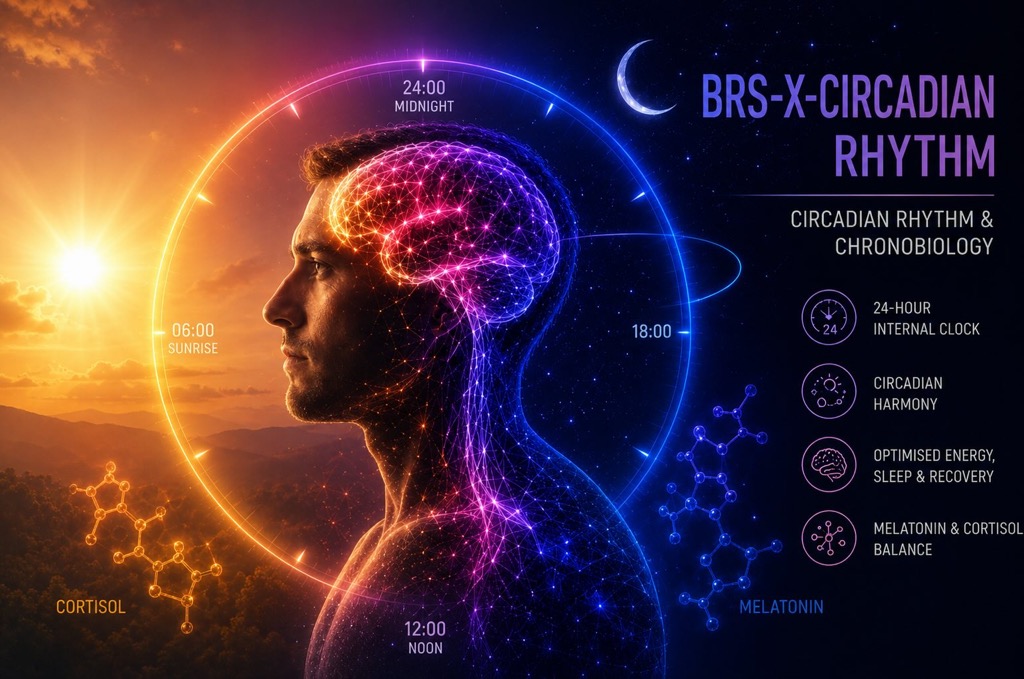
BRS-X(Circadian-FM1) - Light and Feeding Zeitgeber Entrainment
(Coordination through light–dark and feeding cues)
Primary Mechanisms
- BRS-X(Circadian-FM1-PM1) — Light–Dark Circadian Entrainment
- BRS-X(Circadian-FM1-PM2) — Feeding-Time Circadian Synchronisation
1. Mission & Overview
Mission: Coordinate light-linked central clock timing and feeding-linked peripheral metabolic rhythms across the daily cycle.
Overview
Circadian clocks organise when physiological processes occur. This FM concerns how light–dark and feeding cues, called zeitgebers, adjust that timing: light influences central circadian phase, while feeding can shift selected peripheral metabolic rhythms. Their coordinated operation offers a biological basis for aligning internal timing with the external day and feeding cycle. The evidence establishes these timing responses more clearly than it establishes an optimal schedule or combined health benefit. [4] [2]
Coverage includes these two entrainment routes. It does not encompass every sleep, hormonal or arousal process; cortisol output and histaminergic arousal retain their separate mechanisms.
2. Primary Biological Effects
Central circadian phase adjustment; light-dependent melatonin responses; feeding-dependent shifts in selected metabolic and peripheral clock rhythms. Direction and magnitude depend on cue timing, tissue and study conditions. [1] [4] [2]
4. Mechanistic Basis (Integrated FM Narrative)
4.1 Functional Rationale
Daily coordination depends on timing cues reaching both central and peripheral clocks. Light can reset human circadian phase, while feeding can shift selected metabolic rhythms without moving measured melatonin or cortisol rhythms. If these capacities operate adequately, they provide routes for coordinating internal timing with the external day and feeding cycle. This is a biological rationale; the separate studies do not demonstrate a combined health benefit or an optimal schedule. [2, 4]
4.2 Evidence Summary
Human experiments distinguish an immediate hormonal response from a clock-phase change: evening room light suppressed and shortened melatonin secretion, whereas timed bright light produced phase advances or delays depending on internal circadian timing. Evening light-emitting eReader exposure also delayed circadian timing and affected sleep onset and next-morning alertness under the tested conditions. [1, 4, 5]
Feeding provides a partly separate timing signal. In ten healthy men, a five-hour meal delay shifted glucose timing by 5.69 ± 1.29 hours and adipose PER2 by 0.97 ± 0.29 hours, without significant melatonin or cortisol phase shifts. Rodent experiments show that feeding can shift peripheral clocks while the central clock remains aligned to light; cell and mouse work identifies insulin/IGF-1–PERIOD signalling as a candidate link. These findings support differentiated central and peripheral timing control, not a uniform reset of every tissue. [2, 6, 7, 8]
Taken together, the evidence supports complementary entrainment routes that could coordinate daily physiology when both function appropriately. Mouse time-restricted-feeding protection adds metabolic context but does not establish human clock-mediated benefit. No cited experiment tests the combined operation of both child mechanisms or establishes that a phase shift necessarily improves health. [3]
4.3 Suboptimal Function & Its Effects
Mistimed light can shift the timing signal associated with the biological night. In the controlled eReader experiment, later circadian timing accompanied longer sleep onset and reduced next-morning alertness; this does not establish the effect of every screen or light exposure. [5]
Feeding at a different time can move selected peripheral rhythms without moving the measured central-clock proxies. Animal studies show that central and peripheral timing can become uncoupled, but the human meal-delay study does not establish clinical harm from that shift. Consequences depend on the tissue, exposure and endpoint; a changed rhythm alone is not evidence of dysfunction. [7] [2]
5. Connected Mechanisms
- BRS6-FM2-PM4 — Cortisol Rhythm Regulation — cortisol is a rhythmic endocrine output. Its measured phase did not shift in the meal-delay experiment, so that feeding result does not establish a change in cortisol regulation. [2]
- BRS5-FM2-PM4 — Microbial Substrate-Processing Selection & Adaptation — feeding changes the schedule of gut substrate exposure. A causal connection between its microbial adaptation and the clock responses assessed here remains unestablished.
- BRS1(SM-CROSS1) — Histaminergic Arousal Regulation & Neuroimmune Crosstalk — arousal regulation is distinct from circadian entrainment. The studies cited here do not establish histaminergic mediation of their timing effects.
7. Phenome Connections
These outcomes describe translational contexts for the FM as an integrated biological capacity. They are not single-mechanism treatment claims. FM confidence uplift: FM confidence may exceed that of any individual child PM only where multiple PMs converge on the same phenome and the integrated FM biology provides additional biological rationale (biological uplift) beyond the individual mechanisms.
Each Phenome relationship has two independent ratings. They are not combined or averaged.
Biology → Phenome Relationship Strength
How direct and important is this biological mechanism expected to be to the Phenome within the BRAIN model?
Evidence Confidence
How strongly does the adjudicated evidence support this particular biology → Phenome relationship?
No functional outcome context currently mapped.
8. References
- [1] Gooley et al. (2011) — Exposure to room light before bedtime suppresses melatonin onset and shortens melatonin duration in humans
- [2] Wehrens et al. (2017) — Meal Timing Regulates the Human Circadian System
- [3] Hatori et al. (2012) — Time-restricted feeding without reducing caloric intake prevents metabolic diseases in mice fed a high-fat diet
- [4] Khalsa et al. (2003) — A phase response curve to single bright light pulses in human subjects
- [5] Chang et al. (2015) — Evening use of light-emitting eReaders negatively affects sleep, circadian timing, and next-morning alertness
- [6] Stokkan et al. (2001) — Entrainment of the circadian clock in the liver by feeding
- [7] Damiola et al. (2000) — Restricted feeding uncouples circadian oscillators in peripheral tissues from the central pacemaker in the suprachiasmatic nucleus
- [8] Crosby et al. (2019) — Insulin/IGF-1 Drives PERIOD Synthesis to Entrain Circadian Rhythms with Feeding Time