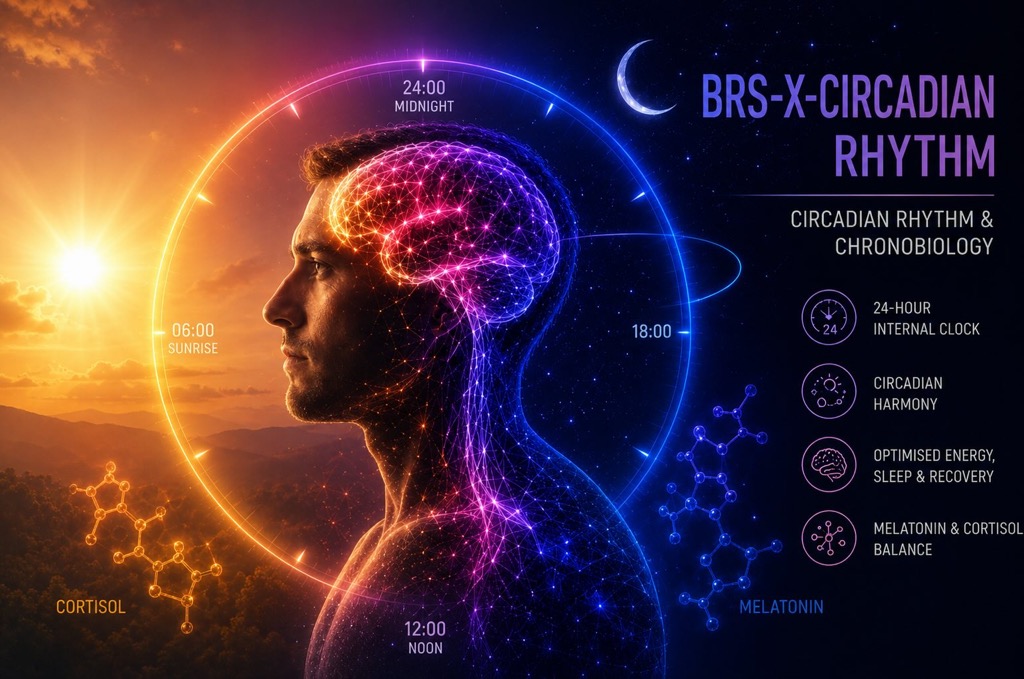
BRS-X(Circadian) - Circadian Rhythm Regulation
(Light–Dark Entrainment & Feeding-Time Synchronisation)
All Mechanisms of BRS-X-CIRCADIAN
- BRS-X(Circadian-FM1) — Light and Feeding Zeitgeber EntrainmentOpen FM →
- BRS-X(Circadian-FM1-PM1) — Light–Dark Circadian Entrainment
- BRS-X(Circadian-FM1-PM2) — Feeding-Time Circadian Synchronisation
Keeps the central clock in step with the light–dark cycle, and peripheral metabolic clocks in step with feeding time. The two cues are not interchangeable.
FM page: BRS-X(Circadian-FM1) — Light and Feeding Zeitgeber Entrainment
Primary biological effects: Evening room light suppressed and shortened melatonin secretion. A five-hour meal delay shifted glucose and adipose PER2 timing and did not shift melatonin or cortisol.
Modulation context: Intervention: Behavioural/Lifestyle Dominant · Timing-specific: Yes · Coverage: Daily
Connected mechanisms:
- BRS6-FM2-PM4 — Cortisol Rhythm Regulation — cortisol output is a different job; see PM4
- BRS5-FM2-PM4 — Microbial Substrate-Processing Selection & Adaptation — feeding schedules are an exposure context; those substrate studies do not establish clock synchronisation
- BRS1(SM-CROSS1) — Histaminergic Arousal Regulation & Neuroimmune Crosstalk — arousal signalling is a different job; see SM-CROSS1
Ambition
Keep retinal light and feeding time as separate timing cues, so the central clock and peripheral metabolic clocks can be described without treating cortisol output, sleep duration, or a metabolic benefit as the same result.
Rationale for inclusion as a distinct BRS-X
Circadian regulation belongs in the framework as a distinct cross-system because it coordinates when biological processes operate. The central clock in the suprachiasmatic nucleus (SCN) responds to retinal light, while feeding time can influence peripheral metabolic timing. In healthy adults, delaying meals shifted glucose and adipose clock-gene timing without shifting melatonin or cortisol. This makes timing a distinct regulatory job that connects nutrition, metabolism and sleep rather than belonging wholly to any one of them [Wehrens et al., 2017].
Food is therefore more than a source of nutrients: when we eat can influence how the body processes it. Supporting regulation is not simply a matter of increasing intake. Light exposure and meal timing provide different cues, so this BRS-X keeps their contributions separate [Gooley et al., 2011; Wehrens et al., 2017].
Therapeutic Area Research
ADHD is the first mapped therapeutic area in the BRAIN Framework. Circadian research adds a timing dimension: sleep timing, internal clock phase and ADHD symptoms are related endpoints, but are not interchangeable.
Introduction
Circadian regulation coordinates the timing of wakefulness, sleep and metabolic activity. In ADHD, this provides a useful framework for investigating delayed sleep timing and individual differences in daily function, while keeping light-driven entrainment separate from feeding-time synchronisation.
ADHD translational biological context
A placebo-controlled trial in 105 medication-free children with ADHD and chronic sleep-onset insomnia found that melatonin advanced sleep onset and the dim-light melatonin rhythm, and increased sleep duration. Behaviour, cognition and quality of life did not significantly improve. This supports a circadian/sleep relationship in that selected group, rather than a universal circadian explanation or treatment for ADHD [4].
An epigenome-wide study of saliva from 391 children with ADHD and 213 controls reported sex-dependent methylation differences at VIPR2, a gene encoding a receptor involved in circadian signalling: lower methylation in male cases and higher methylation in female cases. The diagnosis-associated findings were not genome-wide significant. Peripheral methylation does not measure brain receptor activity, clock phase or a diet-responsive mechanism [5].
Together, these findings justify assessing circadian timing in ADHD research. They do not establish that every person with ADHD has a delayed clock, that nutritional changes correct VIPR2 methylation, or that improving a sleep endpoint necessarily improves core ADHD symptoms.
ADHD evidence and connected circadian mechanisms
| Evidence | Citation | Connected mechanisms |
|---|---|---|
| Four-week randomized trial in 105 children with ADHD and chronic sleep-onset insomnia: melatonin advanced sleep onset and endogenous melatonin timing and increased total sleep; no significant behaviour, cognition or quality-of-life benefit. The tested intervention is melatonin, not proof of light or meal-timing efficacy. | Van der Heijden et al. (2007) [4] | Circadian-FM1 — Light and Feeding Zeitgeber Entrainment — central timing context; no automatic PM intervention admission. |
| Childhood ADHD saliva methylation study: sex-dependent VIPR2 association; no genome-wide significant diagnosis-associated sites. Association does not establish causal receptor dysfunction or nutritional reversibility. | Mooney et al. (2020) [5] | Circadian-FM1 — circadian signalling research context, beyond the two retained zeitgeber PMs. |
Current evidence limitations
| Question | Remaining gap |
|---|---|
| Do light or meal-timing changes improve ADHD through measured clock changes? | ADHD-specific studies measuring both timing and functional outcomes are needed; healthy-volunteer timing results cannot settle this. |
| Can diet modify the ADHD-associated VIPR2 signal? | No nutritional intervention or causal mediation is established by the cited methylation study. |
| Do exercise, fasting or nutrient combinations improve ADHD by circadian mediation? | Separate physiological effects from measured clock changes and from ADHD outcomes; the supplied manuscript summary does not establish that chain. |
Framework expansion
Sleep outcomes and VIPR2 signalling broaden the research context without creating new PMs or transferring phenome ratings. Feeding-time and light-driven mechanisms retain their distinct ownership. Maternal metabolic and environmental-exposure evidence requires separate routing and does not establish a VIPR2 dietary lever.
Dietary and Lifestyle Levers
Neither mechanism has an established nutrient requirement. The evidence is about when light and meals occur, not about a food constituent.
Key Dietary Strategy & Targets: No food, cofactor, or nutrient requirement is established for light–dark entrainment or for feeding-time synchronisation. A meal schedule is not a constituent of a food. A metabolic change after timed eating does not, by itself, show that a peripheral clock moved [2,3].
Evening room light versus dim light suppressed melatonin onset and shortened melatonin secretion in healthy young adults. That laboratory comparison is not a rule for every screen, and it is not a daylight prescription [1].
Supports: BRS-X(Circadian-FM1-PM1)
A five-hour meal delay shifted glucose timing and adipose PER2 timing, and did not shift melatonin or cortisol, in ten healthy men on a fixed routine. That protocol is not a universal eating window [2].
Supports: BRS-X(Circadian-FM1-PM2)
Caffeine timing: Evening caffeine can delay the internal clock. In a controlled study of five healthy adults, a double-espresso-equivalent dose three hours before habitual bedtime delayed melatonin phase by about 40 minutes. Avoiding late caffeine is a relevant timing consideration; this study does not establish a universal eight-hour cutoff or ADHD benefit [6].
Alcohol and sleep: Alcohol is not a reliable sleep aid. Its effects depend on dose, timing and prior wakefulness. A forced-desynchrony experiment found increased wakefulness under one circadian/homeostatic condition; it does not establish a uniform clock shift or an ADHD treatment effect [7].
Sugary and energy drinks: Short sleep and these beverages were associated in an adolescent survey. Direction of causation was not established, and caffeinated energy drinks cannot be treated as an isolated sugar exposure. This evidence does not show that evening sugar destabilises an insulin–melatonin cycle or causes ADHD-related sleep fragmentation [8].
Meal timing, exercise and nutrient synergy: Meal timing has measured peripheral effects in healthy adults [2]. The manuscript’s wider exercise, fasting and nutrient-synergy proposals remain candidates for separate assessment; they do not currently establish ADHD-specific circadian benefits or nutrient requirements.
Overview
Circadian timing is a cross-system job. Retinal light is the cue that keeps the central clock with the external day–night cycle. Feeding time can shift peripheral metabolic clocks without moving that central signal. The two routes share a coordinating system and do not share a result [1,2].
Evening room light suppressed and shortened melatonin secretion [1]. Delaying meals by five hours shifted glucose and adipose PER2 timing and left melatonin and cortisol unmoved [2]. Cortisol output remains with BRS6-FM2-PM4 — Cortisol Rhythm Regulation. A metabolic benefit from meal timing, including protection in mice when calories were not reduced, does not by itself establish clock synchronisation [3].
Functional Mechanisms
- BRS-X(Circadian-FM1) — Light and Feeding Zeitgeber EntrainmentOpen FM →
- BRS-X(Circadian-FM1-PM1) — Light–Dark Circadian Entrainment
- BRS-X(Circadian-FM1-PM2) — Feeding-Time Circadian Synchronisation
Keeps the central clock in step with the light–dark cycle, and peripheral metabolic clocks in step with feeding time.
FM page: BRS-X(Circadian-FM1) — Light and Feeding Zeitgeber Entrainment
Primary biological effects: Evening room light suppressed and shortened melatonin secretion [1]. A five-hour meal delay shifted glucose and adipose PER2 timing and did not shift melatonin or cortisol [2].
Modulation context: Intervention: Behavioural/Lifestyle Dominant · Timing-specific: Yes · Coverage: Daily
Connected mechanisms:
- BRS6-FM2-PM4 — Cortisol Rhythm Regulation — cortisol output is a different job; see PM4
References
[1] Gooley et al. (2011). Exposure to room light before bedtime suppresses melatonin onset and shortens melatonin duration in humans. Evening room light versus dim light in healthy young adults. Acute melatonin suppression is not a demonstrated phase reset.
[2] Wehrens et al. (2017). Meal Timing Regulates the Human Circadian System. Ten healthy men; a five-hour meal delay shifted glucose and adipose PER2 timing and did not shift melatonin or cortisol.
[3] Hatori et al. (2012). Time-restricted feeding without reducing caloric intake prevents metabolic diseases in mice fed a high-fat diet. Metabolic protection in mice. Not a human clock-phase measurement.
[4] Van der Heijden et al. (2007). Effect of melatonin on sleep, behavior, and cognition in ADHD and chronic sleep-onset insomnia.
[5] Mooney et al. (2020). Large epigenome-wide association study of childhood ADHD identifies peripheral DNA methylation associated with disease and polygenic risk burden.
[6] Burke et al. (2015). Effects of caffeine on the human circadian clock in vivo and in vitro.
[7] Van Reen et al. (2011). Does timing of alcohol administration affect sleep?.
[8] Sampasa-Kanyinga et al. (2018). Sleep duration and consumption of sugar-sweetened beverages and energy drinks among adolescents.