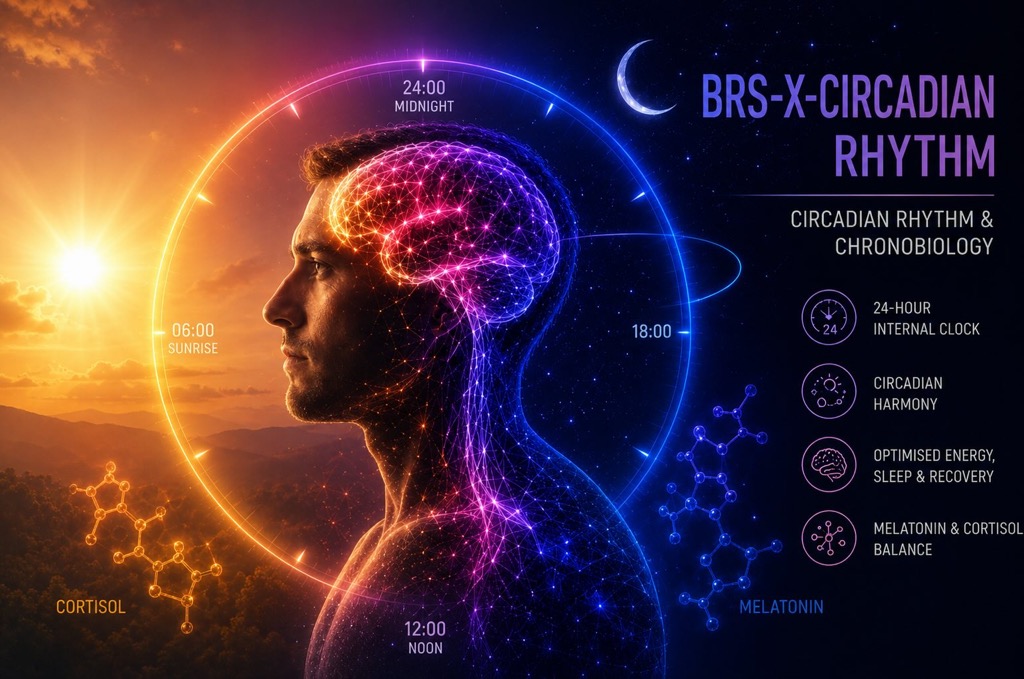
BRS-X(Circadian-FM1-PM1) - Light–Dark Circadian Entrainment
(Retinal Light and the Central Clock)
1. Mission & Overview
Mission
Synchronise the central circadian clock with the external light–dark cycle through retinal light signals.
Intervention Dominance: Lifestyle-Dominant — System Optimisation Practices
Light-driven phase resetting and acute suppression have different endpoints. Principal route selection identifies the mechanism-specific intervention class, not a universal optimal schedule or superiority across all health outcomes.
- Timed bright-light exposure
- Dim-light comparison before bedtime
- Printed-book comparison with evening eReader use
Overview
Light reaching the retina provides a timing signal that helps the central circadian clock track the day–night cycle. Timed light can shift circadian phase; light before bedtime can also suppress the nightly melatonin signal. These are different effects. Practical support therefore concerns the timing and characteristics of light exposure, with the direction of a phase shift depending on internal clock timing. Gooley et al. (2011) [1]; Khalsa et al. (2003) [2]
- Benefits: Avoiding the tested evening eReader exposure prevented its measured delay, longer sleep onset and reduced next-morning alertness relative to the printed-book condition. Chang et al. (2015) [3]
- Implementation Notes: Light timing is the practical lever. Direction depends on clock phase; use the disclosed exposure boundaries rather than one universal lux or clock-time target. Khalsa et al. (2003) [2]
- Biological Relevance: This PM concerns light-driven central timing; PM2 concerns feeding-driven peripheral timing. Khalsa et al. (2003) [2]
2. Primary Biological Effects
- Phase advances or delays following timed light. Khalsa et al. (2003) [2]
- Acute melatonin suppression and shorter secretion after room light. Gooley et al. (2011) [1]
- Delayed circadian timing, longer sleep onset and reduced next-morning alertness after the studied evening eReader exposure. Chang et al. (2015) [3]
3. Levers
No Direct or Derived Dietary Requirement is currently established for synchronising the central circadian clock with the day–night cycle.
No evidence-supported cofactors or substrates are currently established for this mechanism.
No mapping established.
No evidence-qualified lifestyle relationship is projected.
4. Mechanistic Basis
Summary
Retinal photoreception transmits the light cue. Timed light can reset central circadian phase, while evening exposure can acutely suppress the melatonin output. Khalsa et al. (2003) [2]; Berson et al. (2002) [4]
Mechanism boundary: Cortisol output remains with BRS6 PM4; feeding-driven peripheral timing remains with PM2. Melatonin supplementation and exercise are other timing cues, not retinal light mechanisms.
4.1 Scientific Findings
Summary
The evidence separates three links: retinal photoreception, phase resetting by timed light, and acute suppression of melatonin. Human phase measurements support the entrainment scope; the suppression comparison alone does not. Evening eReader exposure also affected sleep onset and next-morning alertness. Animal photopigment evidence identifies machinery without establishing an extra-intake benefit.
In a retrospective analysis of 116 healthy adults aged 18–30, room light before bedtime suppressed melatonin and shortened its duration by about 90 minutes relative to dim light.
What this means
The exposure changes a central-clock output. Acute suppression is not the same as resetting clock phase, and it is not a cortisol result.
Evidence confidence: Not yet scored
Finding ID: PM1-F1
Finding Statement: In a retrospective analysis of 116 healthy adults aged 18–30, room light before bedtime suppressed melatonin and shortened its duration by about 90 minutes relative to dim light.
Synthesised Evidence Confidence: Not yet scored
Synthesis: The room-light comparison establishes acute melatonin suppression and shorter secretion. It does not by itself establish a lasting shift of the pacemaker.
Synthesis Limitations: Indoor laboratory illumination is not identical to every screen or to daylight. Acute suppression does not establish a durable phase correction.
Evidence Considered:
- Study
- Retrospective analysis of two laboratory studies; room light below 200 lux versus dim light below 3 lux in the eight hours before bedtime.
- Population
- 116 healthy volunteers aged 18–30.
- Result
- Later melatonin onset in 99% of participants and approximately 90 minutes shorter secretion duration.
- Effect / Magnitude
- Approximately 90 minutes shorter melatonin duration; acute suppression is distinct from phase resetting.
- Evidence Summary
- Evening room light changed a central melatonin signal relative to dim light.
- Limitations
- The comparison is not every screen, not daylight, and not a cortisol measurement.
- Evidence Source
- Inherited repository evidence
- Reference
- [1]
Human light exposures can advance or delay circadian phase, depending on their timing.
What this means
Khalsa measured pre/post melatonin phase under constant routines, providing phase-resetting evidence distinct from suppression. Chang provides a separate evening device comparison with delayed circadian timing, sleep and next-morning alertness effects. Neither specifies one best schedule for everyone.
Evidence confidence: Not yet scored
Finding ID: PM1-F2
Finding Statement: Human light exposures can advance or delay circadian phase, depending on their timing.
Synthesised Evidence Confidence: Not yet scored
Synthesis: Khalsa measured pre/post melatonin phase under constant routines, providing phase-resetting evidence distinct from suppression. Chang provides a separate evening device comparison with delayed circadian timing, sleep and next-morning alertness effects. Neither specifies one best schedule for everyone.
Synthesis Limitations: Timing relative to internal phase, exposure duration, intensity and prior light history matter; laboratory bright-light and eReader protocols are not interchangeable.
Evidence Considered:
- Study
- 21 healthy adults; 6.7-hour bright-light pulse scheduled across circadian phases; pre/post dim-light constant routines.
- Population
- 21 healthy adults; 6.7-hour bright-light pulse scheduled across circadian phases; pre/post dim-light constant routines.
- Result
- The melatonin-midpoint phase-response curve had a 5.02-hour peak-to-trough amplitude, with advances and delays depending on exposure phase.
- Effect / Magnitude
- The melatonin-midpoint phase-response curve had a 5.02-hour peak-to-trough amplitude, with advances and delays depending on exposure phase.
- Evidence Summary
- The melatonin-midpoint phase-response curve had a 5.02-hour peak-to-trough amplitude, with advances and delays depending on exposure phase.
- Limitations
- A single long pulse establishes phase resetting, not a universal daily treatment schedule or durable health benefit.
- Evidence Source
- Bounded external search
- Reference
- [2]
- Study
- Controlled light-emitting eReader versus printed-book comparison before bedtime.
- Population
- Controlled light-emitting eReader versus printed-book comparison before bedtime.
- Result
- eReader exposure delayed measured circadian timing, reduced melatonin secretion, prolonged sleep onset and reduced next-morning alertness.
- Effect / Magnitude
- eReader exposure delayed measured circadian timing, reduced melatonin secretion, prolonged sleep onset and reduced next-morning alertness.
- Evidence Summary
- eReader exposure delayed measured circadian timing, reduced melatonin secretion, prolonged sleep onset and reduced next-morning alertness.
- Limitations
- Specific device/exposure conditions; does not establish that every screen or a shorter exposure produces the same effect.
- Evidence Source
- Bounded external search
- Reference
- [3]
Intrinsically photosensitive retinal ganglion cells provide a biological route for retinal light signals; melanopsin photosensitivity depends on a vitamin A-based chromophore.
What this means
Retinal recordings establish intrinsic phototransduction. Fu found reduced photosensitivity in Rpe65-deficient mice and rescue with a retinal analogue. This is biochemical resource evidence; retinal light dosing and dietary vitamin A applicability remain separate propositions.
Evidence confidence: Not yet scored
Finding ID: PM1-F3
Finding Statement: Intrinsically photosensitive retinal ganglion cells provide a biological route for retinal light signals; melanopsin photosensitivity depends on a vitamin A-based chromophore.
Synthesised Evidence Confidence: Not yet scored
Synthesis: Retinal recordings establish intrinsic phototransduction. Fu found reduced photosensitivity in Rpe65-deficient mice and rescue with a retinal analogue. This is biochemical resource evidence; retinal light dosing and dietary vitamin A applicability remain separate propositions.
Synthesis Limitations: Animal/cellular machinery and chromophore rescue do not quantify a dietary vitamin A requirement for adult human entrainment or prove benefit from additional intake.
Evidence Considered:
- Study
- Retinal ganglion-cell electrophysiology in mammalian preparations.
- Population
- Retinal ganglion-cell electrophysiology in mammalian preparations.
- Result
- Clock-projecting retinal ganglion cells were intrinsically photosensitive.
- Effect / Magnitude
- Clock-projecting retinal ganglion cells were intrinsically photosensitive.
- Evidence Summary
- Clock-projecting retinal ganglion cells were intrinsically photosensitive.
- Limitations
- Foundational pathway evidence, not a human dietary intervention.
- Evidence Source
- Bounded external search
- Reference
- [4]
- Study
- Rpe65-deficient and melanopsin-ablated mouse retinal preparations; retinal-analogue rescue.
- Population
- Rpe65-deficient and melanopsin-ablated mouse retinal preparations; retinal-analogue rescue.
- Result
- Rpe65-deficient cells were approximately 20–40-fold less photosensitive; exogenous 9-cis-retinal restored photosensitivity where melanopsin was present.
- Effect / Magnitude
- Rpe65-deficient cells were approximately 20–40-fold less photosensitive; exogenous 9-cis-retinal restored photosensitivity where melanopsin was present.
- Evidence Summary
- Rpe65-deficient cells were approximately 20–40-fold less photosensitive; exogenous 9-cis-retinal restored photosensitivity where melanopsin was present.
- Limitations
- 9-cis-retinal is an analogue; do not call it dietary retinol or infer supplementation benefit.
- Evidence Source
- Bounded external search
- Reference
- [5]
5. BRS Pathways and Connections
5.1 BRS Pathways
- None listed
5.2 Cross-BRS Mechanism Relationships
Primary Mechanisms in other Biological Regulatory Systems that directly interact with, constrain or support this mechanism.
- BRS6-FM2-PM4 — Cortisol Rhythm Regulation — this boundary separates hormonal output regulation from retinal light-driven timing; a cortisol intervention is not established by this PM’s light studies
- BRS1(SM-CROSS1) — Histaminergic Arousal Regulation & Neuroimmune Crosstalk — arousal signalling is a different job; see SM-CROSS1
5.3 Local BRS Mechanism Relationships
Related Primary Mechanisms within the same Biological Regulatory System that collectively support the integrated biological function.
- BRS-X(Circadian-FM1-PM2) — Feeding-Time Circadian Synchronisation — meal timing can shift peripheral clocks without moving this melatonin signal; see PM2
7. Phenome Connections
These mappings are translational relationships, not single-mechanism outcome claims. Phenomes are emergent functional patterns supported by multiple interacting PMs across the BRAIN Framework.
Each Phenome relationship has two independent ratings. They are not combined or averaged.
Biology → Phenome Relationship Strength
How direct and important is this biological mechanism expected to be to the Phenome within the BRAIN model?
Evidence Confidence
How strongly does the adjudicated evidence support this particular biology → Phenome relationship?
No direct functional outcome relationship currently mapped.
8. References
- [1] Gooley et al. (2011) — Exposure to room light before bedtime suppresses melatonin onset and shortens melatonin duration in humans
- [2] Khalsa et al. (2003) — A phase response curve to single bright light pulses in human subjects
- [3] Chang et al. (2015) — Evening use of light-emitting eReaders negatively affects sleep, circadian timing, and next-morning alertness
- [4] Berson et al. (2002) — Phototransduction by retinal ganglion cells that set the circadian clock
- [5] Fu et al. (2005) — Intrinsically photosensitive retinal ganglion cells detect light with a vitamin A-based photopigment, melanopsin