Pears
Overview
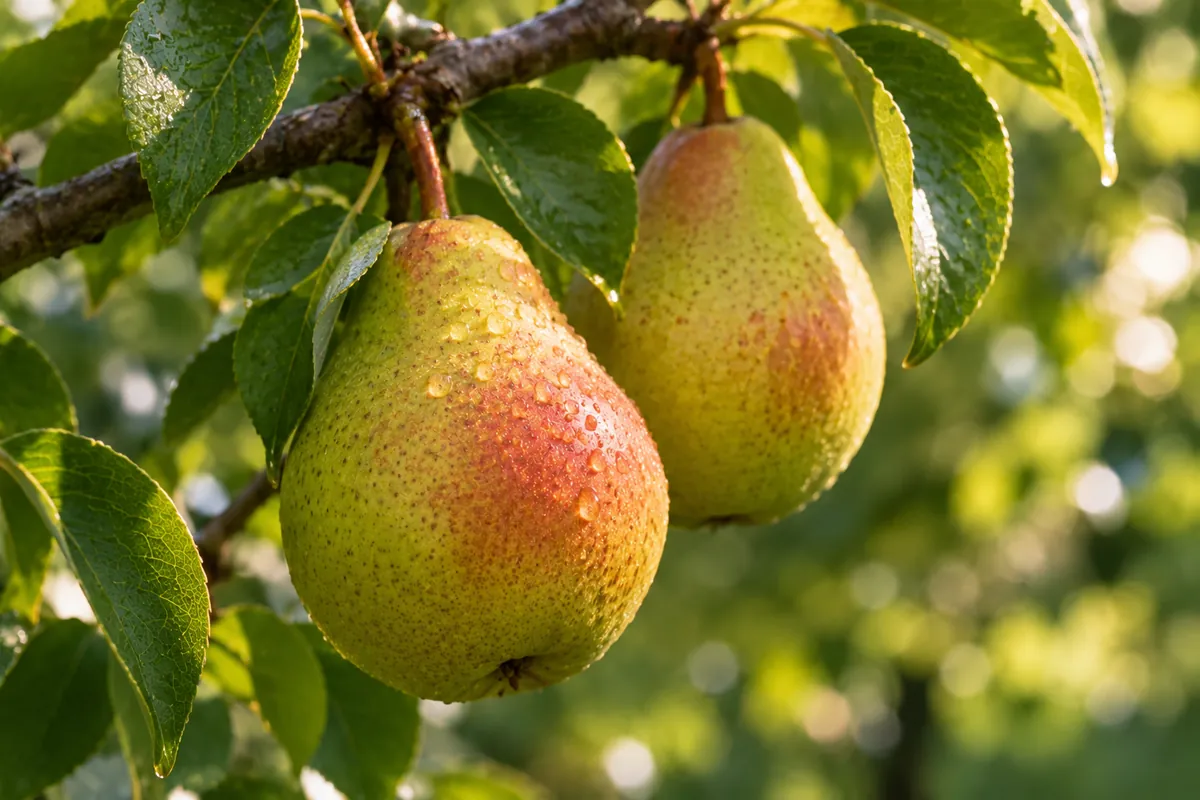
Pears are a whole fruit eaten fresh, poached or baked. The edible flesh provides fibre and natural sugars [1]. Bartlett pears contain pectin; the balance of pectic fractions changes as the fruit ripens, and this page does not give a per-100 g pectin amount [2].
Food Context
Preparation
- Eat ripe fruit fresh, or poach or bake it.
- Leave the skin on when tolerated.
Recipes
Nutrient Tables (per 100 g)
Selected food and preparation: Pears, raw. per 100 g edible portion.
Core nutrients
| Nutrient | Amount per 100 g | % reference intake per 100 g |
|---|---|---|
| Energy | 57 kcal | — |
| Protein | 0.4 g | — |
| Total fat | 0.1 g | — |
| Saturated fat | 0 g | — |
| Carbohydrates | 15.2 g | — |
| Sugars | 9.8 g | — |
| Fibre | 3.1 g | — |
Full vitamins and minerals
Amounts apply to the preparation named above. Only amounts meeting 10% of the adult reference intake are highlighted in the summary. A dash means no RI percentage is available.
| Nutrient | Amount per 100 g or stated basis | % reference intake |
|---|---|---|
| Iron | 0.2 mg | 1% |
| Zinc | 0.1 mg | 0.9% |
| Magnesium | 7 mg | 1.7% |
| Phosphorus | 12 mg | 1.7% |
| Manganese | 0.05 mg | 2.1% |
| Selenium | 0.1 µg | 0.2% |
| Calcium | 9 mg | 0.9% |
| Potassium | 116 mg | 3.4% |
| Copper | 0.1 mg | 9.1% |
| Sodium | 1 mg | — |
| Choline | 5.1 mg | 0.9% |
| Folate | 7 µg | 1.8% |
| Vitamin B6 | 0.03 mg | 2.2% |
| Vitamin B2 | 0.03 mg | 2% |
| Vitamin B1 | 0.01 mg | 1% |
| Vitamin B3 | 0.2 mg | 1% |
| Vitamin B5 | 0.05 mg | 1% |
| Vitamin C | 4.3 mg | 4.8% |
| Vitamin A | 1 µg | 0.1% |
| Vitamin E | 0.1 mg | 0.8% |
| Vitamin K | 4.4 µg | 3.7% |
Bioactive compounds
| Compound / class | Amount per 100 g | Notes |
|---|---|---|
| Pectin | Present — quantity not established | Bartlett pear pectic fractions change with maturity and after-ripening. Not a per-100 g amount for this page. |
- Pectin: Miura et al. 1963 supports this qualitative constituent record. See technical provenance for fruit and ripeness.
Technical provenance
Pectin: Miura, Haginuma and Mizuta (1963) measured water-soluble pectin, protopectin and other pectic fractions in Bartlett pears during maturation and after-ripening. The fractions changed with ripeness. USDA FoodData Central (Pears, raw; FDC 169118) reports total fibre 3.1 g/100 g and does not quantify pectin. Those fraction measurements are not converted into a per-100 g pectin number for this record.
Substances
1 substance in this food

Pectin
Miura et al. (1963) measured pectic fractions in Bartlett pears. USDA reports total fibre and does not give a per-100 g pectin amount. This is not a standardised pectin dose and is not the purified citrus pectin used in defined-community experiments.
References
[1] USDA Agricultural Research Service (2019). Pears, raw. FoodData Central SR Legacy record for raw pears, the per-100 g composition source for this page.
[2] Miura, Haginuma & Mizuta (1963). Quality of pectin in pears, with special reference to the changes during maturation and subsequent after-ripening in Bartlett pears. Measured water-soluble pectin, protopectin and other pectic fractions in Bartlett pears. The fractions changed with maturity and after-ripening and are not a per-100 g pectin amount for this page.
Food composition → admitted dietary relationships
These links join food composition to existing PM admissions. They do not establish that a portion reproduces an intervention, delivers an intact cofactor to tissue, or improves a clinical outcome. Derived supply retains its conversion and delivery limits.
- Citrus pectin → BRS5-FM2-PM4 · Type A / direct
Food form & relationship limits
Defined-community mouse experiments and glycan assays do not establish equivalence across all pectins, a human intake target or beneficial host outcomes. The studied citrus-pectin preparation is not whole orange or lemon, and it is not the apple-pectin record.
Bartlett pear fruit during maturation and after-ripening; raw. Qualitative presence in Bartlett pear fruit. No per-100 g pectin amount is established. Ripeness changes the balance of pectic fractions.
- Pectin → BRS5-FM2-PM5 · Type A / direct
Food form & relationship limits
Pectin structure, purified preparation, donor community and enriched culture medium affect interpretation. Pascale is secondary synthesis; Bang is bounded primary culture evidence. Whole apples are not equivalent to the tested citrus preparation; no human brain or clinical benefit is established.
Bartlett pear fruit during maturation and after-ripening; raw. Qualitative presence in Bartlett pear fruit. No per-100 g pectin amount is established. Ripeness changes the balance of pectic fractions.