Brazil Nuts
Overview
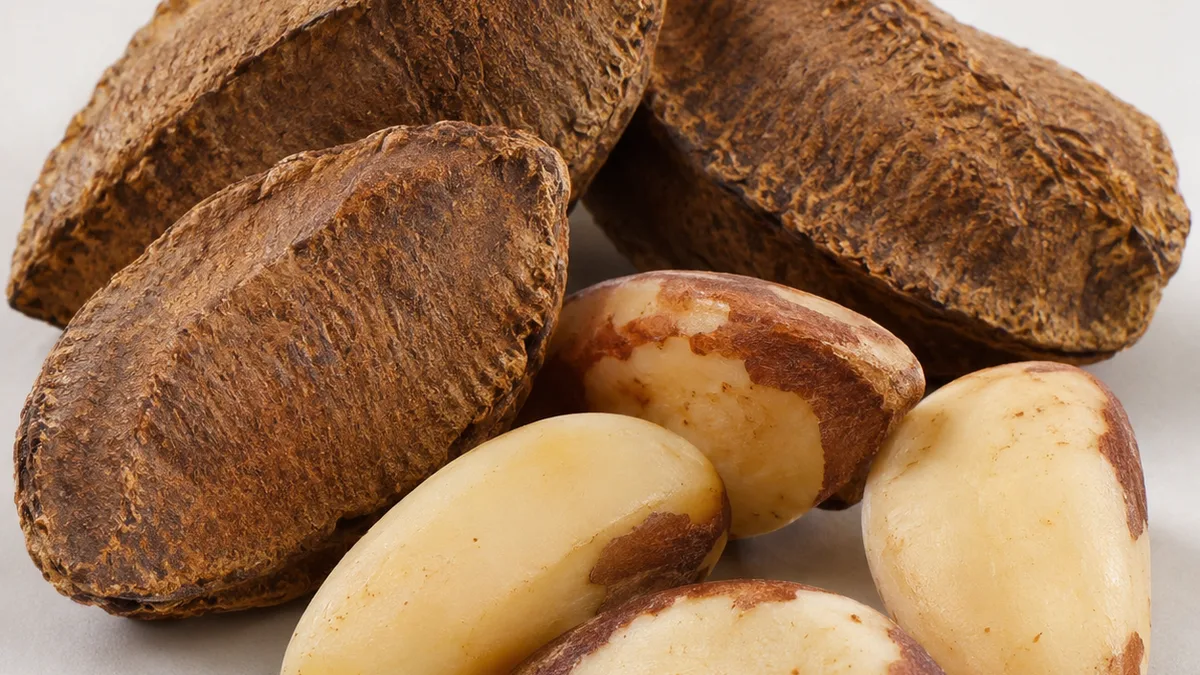
Brazil nuts are the seeds of Bertholletia excelsa. USDA SR Legacy records 1917 µg selenium per 100 g for dried, unblanched nuts, and 543 µg in the 1 oz (28.35 g) portion of that same record [1].
That ounce is a large selenium amount. The selenium guidance is to avoid frequent high-dose intake, because selenium has a narrower safety margin than many other minerals.
Other Nutritional Highlights
- Selenium 1917 µg per 100 g, and 543 µg per 1 oz (28.35 g), on the dried unblanched USDA record [1].
- The same record also reports magnesium 376 mg, phosphorus 725 mg and copper 1.743 mg per 100 g [1].
- A usual portion is a small number of nuts. The per-100 g figure is not a serving.
Food Context
Preparation
- Use dried nuts in small portions.
- This page records the dried, unblanched USDA food. It is not a butter, flour or extract.
Recipes
Nutrient Tables (per 100 g)
Selected food and preparation: Nuts, brazilnuts, dried, unblanched. per 100 g edible portion.
Core nutrients
| Nutrient | Amount per 100 g | % reference intake per 100 g |
|---|---|---|
| Energy | 659 kcal | — |
| Protein | 14.3 g | — |
| Total fat | 67.1 g | — |
| Saturated fat | 16.1 g | — |
| Carbohydrates | 11.7 g | — |
| Sugars | 2.3 g | — |
| Fibre | 7.5 g | — |
Key vitamins and minerals
Vitamins and minerals supplying at least 10% of an adult reference intake per 100 g, derived from the composition panel.
| Nutrient | Amount per 100 g | % reference intake per 100 g |
|---|---|---|
| Iron | 2.4 mg | 13.5% |
| Zinc | 4.1 mg | 36.9% |
| Magnesium | 376 mg | 89.5% |
| Phosphorus | 725 mg | 103.6% |
| Manganese | 1.2 mg | 53.2% |
| Selenium | 1917 µg | 3485.5% |
| Calcium | 160 mg | 16% |
| Potassium | 659 mg | 19.4% |
| Copper | 1.7 mg | 193.7% |
| Vitamin B1 | 0.6 mg | 51.4% |
| Vitamin E | 5.7 mg | 37.7% |
Substances
References
[1] USDA Agricultural Research Service (2019). Nuts, brazilnuts, dried, unblanched. FoodData Central SR Legacy record, FDC 170569. Selenium is 1917 µg per 100 g, and 543 µg in the 1 oz (28.35 g) portion.
Food composition → admitted dietary relationships
These links join food composition to existing PM admissions. They do not establish that a portion reproduces an intervention, delivers an intact cofactor to tissue, or improves a clinical outcome. Derived supply retains its conversion and delivery limits.
- Selenium → BRS3-FM2-PM4 · direct
Food form & relationship limits
In selenium-deficient adults, plasma glutathione peroxidase activity levelled off once intake reached about 35 micrograms a day. Intake above that plateau did not raise the enzyme further, and the study did not measure net oxidative pressure.
Nuts, brazilnuts, dried, unblanched; dried, unblanched.
- Selenium → BRS3-FM2-PM5 · Type A / direct
Food form & relationship limits
Mouse whole-organ enzyme assays do not identify mitochondrial isoforms, a human food dose or benefit above selenium adequacy. Repletion response depended on dose; antioxidant capacity does not establish clinical prevention.
Nuts, brazilnuts, dried, unblanched; dried, unblanched.
- Selenium → BRS3-FM2-PM6 · Type A / direct
Food form & relationship limits
Culture selenium exposure is not an oral food dose. This supports the thioredoxin arm, not selenium dependence of glutathione reductase, universal tissue recycling flux or benefit above adequacy.
Nuts, brazilnuts, dried, unblanched; dried, unblanched.