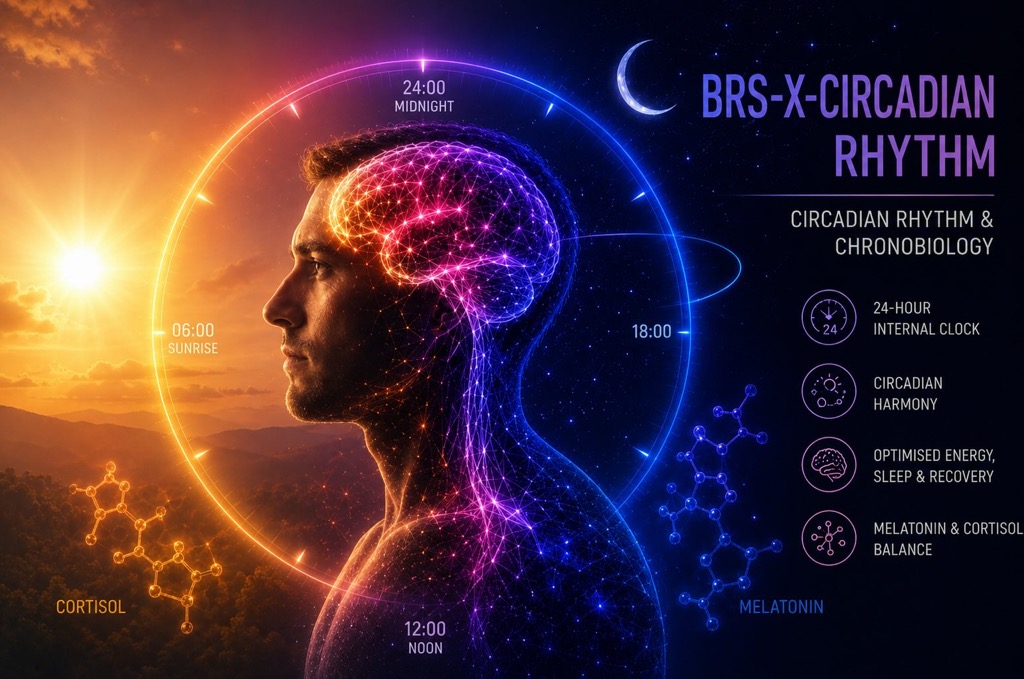
BRS-X-Circadian-1-1 - Light–Dark Circadian Entrainment
(Retinal Light and the Central Clock)
1. Mission & Overview
Mission
Synchronise the central circadian clock with the external light–dark cycle through retinal light signals.
Intervention Dominance: Lifestyle-Dominant — System Optimisation Practices
Light-driven phase resetting and acute suppression have different endpoints. Principal route selection identifies the mechanism-specific intervention class, not a universal optimal schedule or superiority across all health outcomes.
Caffeine timing — assessment pending: Limiting or timing exposure is a proposed practice to reduce disruption. The tested three-hour pre-bedtime exposure is not a validated avoidance cutoff. No caffeine-timing SOP is admitted. [9]
- Timed bright-light exposure
- Dim-light comparison before bedtime
- Printed-book comparison with evening eReader use
Overview
Light reaching the retina provides a timing signal that helps the central circadian clock track the day–night cycle. Timed light can shift circadian phase; light before bedtime can also suppress the nightly melatonin signal. These are different effects. Practical support therefore concerns the timing and characteristics of light exposure, with the direction of a phase shift depending on internal clock timing. Gooley et al. (2011) [1]; Khalsa et al. (2003) [2]
- Benefits: Avoiding the tested evening eReader exposure prevented its measured delay, longer sleep onset and reduced next-morning alertness relative to the printed-book condition. Chang et al. (2015) [3]
- Implementation Notes: Light timing is the practical lever. Direction depends on clock phase; use the disclosed exposure boundaries rather than one universal lux or clock-time target. Khalsa et al. (2003) [2]
- Biological Relevance: This PM concerns light-driven central timing; PM2 concerns feeding-driven peripheral timing. Khalsa et al. (2003) [2]
Scope qualification: The light–dark mission is unchanged. Evening caffeine is included only as demonstrated disruptive regulation of circadian phase; this does not establish a retinal mechanism or feeding-clock effect. [9]
2. Primary Biological Effects
- Phase advances or delays following timed light. Khalsa et al. (2003) [2]
- Acute melatonin suppression and shorter secretion after room light. Gooley et al. (2011) [1]
- Delayed circadian timing, longer sleep onset and reduced next-morning alertness after the studied evening eReader exposure. Chang et al. (2015) [3]
3. Levers
No supportive dietary input is currently admitted for this operation.
- Caffeine — potential disruption of circadian timing. Oral caffeine can alter circadian timing under the conditions examined in the cited study. In five healthy adults, 2.9 mg/kg taken as capsules three hours before habitual bedtime delayed subsequent dim-light melatonin onset by approximately 40 minutes relative to placebo. [9] Participants had abstained from caffeine for two weeks; only one dose and timing were tested. The measured phase delay does not establish reduced melatonin synthesis, effects from a particular coffee preparation, or a response in every individual. Adding caffeine to bright light did not significantly increase the delay beyond bright light alone. No universal avoidance cutoff, chronic-use response or clinical benefit was established.
No evidence-supported cofactors or substrates are currently established for this mechanism.
No mapping established.
Intervention = Uvex S1933X glasses blocking 99% below530nm, from three hours before bedtime and during nocturnal light exposure for two weeks; compare partial-blocking S1905 glasses.
Intervention type = Lifestyle Lever — Circadian regulation
Biological relationship = Mechanism of Action: Short-wavelength filtering reduces retinal light exposure; the measured onset under exposure cannot separate acute suppression relief from persistent clock phase shifting.
Evidence status: Proposed relationship; measured endpoint does not establish causal mediation
Measured Effect: Adjusted melatonin-onset difference28 minutes (95% CI5–51); bedtime, sleep onset and phase angles did not differ significantly.
PM Relevance: Light input and melatonin timing relate to entrainment; sustained phase shift and better sleep are not established.
Evidence source = [8]
Study context: Liset et al. (2022); nulliparous third-trimester women;60 analysed,47 usable onset estimates; home saliva sampling; baseline-adjusted ANCOVA.
Limitations
- missingness: Onset estimation excluded out-of-range samples; baseline and follow-up counts differ.
- population: Pregnancy-specific, not universal sleep treatment.
- safety: Transient malaise and other symptoms reported; one control participant withdrew for severe malaise.
- measurement: Not standard dim-light laboratory onset; comparator also filters blue light.
Intervention admitted = Yes — bounded, study-specific admission
No evidence-qualified lifestyle relationship is projected.
4. Mechanistic Basis + Scientific Findings (SFs 4)
Summary
Retinal photoreception transmits the light cue. Timed light can reset central circadian phase, while evening exposure can acutely suppress the melatonin output. Khalsa et al. (2003) [2]; Berson et al. (2002) [4]
Mechanism boundary: Cortisol output remains with BRS6 PM4; feeding-driven peripheral timing remains with PM2. Melatonin supplementation and exercise are other timing cues, not retinal light mechanisms.
Intervention-specific SEC assessments
PM1-LP-BLUE-BLOCKING-1 — Blue-blocking glasses · Assessment status: Provisionally assessed
Synthesised Evidence Confidence (SEC) assessment
Exact assessed proposition: Uvex S1933X glasses blocking 99% below530nm, from three hours before bedtime and during nocturnal light exposure for two weeks; compare partial-blocking S1905 glasses. Adjusted melatonin-onset difference28 minutes (95% CI5–51); bedtime, sleep onset and phase angles did not differ significantly.
Principal limitation: Onset estimation excluded out-of-range samples; baseline and follow-up counts differ.
Raw SEC 4/8; adjusted SEC 4/8. Assessment date: 2026-11-05. Record version 1.
Existing D/B/P/R sum and ceilings applied; no extra replication decrement.
- Directness — 2/2 · established
- Direct salivary threshold-onset outcome under exact tested conditions.
- Bias Protection — 1/2 · established
- Randomised masked glasses; home collection and selected measurable samples remain concerns.
- Precision — 1/2 · established
- CI spans5–51 minutes; no validated clinical adequacy threshold.
- Replication — 0/2 · established
- One pregnancy dataset; healthy-adult sleep studies test another endpoint.
Unknown is not zero. Inaccessible methods or uncertainty do not justify zero for Bias Protection or Precision; incomplete replication retrieval does not justify zero for Replication. Completed factor judgements are provisional anchor assessments, not measured quantities or human scientific review.
Supporting synthesis: liset_blue_blocking_2022 ·
Onset estimation excluded out-of-range samples; baseline and follow-up counts differ. Pregnancy-specific, not universal sleep treatment. Transient malaise and other symptoms reported; one control participant withdrew for severe malaise. Not standard dim-light laboratory onset; comparator also filters blue light.
- 10.1016/j.nbscr.2021.100074 · Exact intervention–outcome evidence · Primary full text retrieved via Scite; methods and results appraised in Batch 3. Liset et al. (2022); nulliparous third-trimester women;60 analysed,47 usable onset estimates; home saliva sampling; baseline-adjusted ANCOVA.
Contextual evidence:
- Pregnancy-specific, not universal sleep treatment.
- Transient malaise and other symptoms reported; one control participant withdrew for severe malaise.
- Not standard dim-light laboratory onset; comparator also filters blue light.
Assessment process: Independent Batch 3 intervention appraisal reused without rescoring. Author approved bounded admission; no Finding score inherited..
Methodology: Scientific Evidence Confidence: Directness + Bias Protection + Precision + Replication; version Existing D/B/P/R rubric with approved completeness extension. Source: system/reviews/sec-calibration/SEC-calibration-rubric-proposal.html
Completed appraisal of the exact bounded intervention proposition; admission does not establish clinical benefit.
- 2026-11-05: Author approved five eligible Batch 3 interventions; implement existing independent provisional appraisal and bounded six atoms.
Original discussion link: not recorded. Research dialogue is supporting history, not the authoritative assessment.
4.1 Scientific Findings (4)
Summary
The evidence separates three links: retinal photoreception, phase resetting by timed light, and acute suppression of melatonin. Human phase measurements support the entrainment scope; the suppression comparison alone does not. Evening eReader exposure also affected sleep onset and next-morning alertness. Animal photopigment evidence identifies machinery without establishing an extra-intake benefit.
Supports SOP: Dim-light comparison before bedtime
In a retrospective analysis of 116 healthy adults aged 18–30, room light before bedtime suppressed melatonin and shortened its duration by about 90 minutes relative to dim light.
What this means
The exposure changes a central-clock output. Acute suppression is not the same as resetting clock phase, and it is not a cortisol result.
Evidence confidence: Not yet scored
Canonical record ID: PM1-F1
Finding Statement: In a retrospective analysis of 116 healthy adults aged 18–30, room light before bedtime suppressed melatonin and shortened its duration by about 90 minutes relative to dim light.
Synthesised Evidence Confidence: Not yet scored
Synthesis: The room-light comparison establishes acute melatonin suppression and shorter secretion. It does not by itself establish a lasting shift of the pacemaker.
Synthesis Limitations: Indoor laboratory illumination is not identical to every screen or to daylight. Acute suppression does not establish a durable phase correction.
Evidence Considered:
- Study
- Retrospective analysis of two laboratory studies; room light below 200 lux versus dim light below 3 lux in the eight hours before bedtime.
- Population
- 116 healthy volunteers aged 18–30.
- Result
- Later melatonin onset in 99% of participants and approximately 90 minutes shorter secretion duration.
- Effect / Magnitude
- Approximately 90 minutes shorter melatonin duration; acute suppression is distinct from phase resetting.
- Evidence Summary
- Evening room light changed a central melatonin signal relative to dim light.
- Limitations
- The comparison is not every screen, not daylight, and not a cortisol measurement.
- Evidence Source
- Inherited repository evidence
- Reference
- [1]
Supports SOP: Timed bright-light exposure
Supports SOP: Printed-book comparison with evening eReader use
Human light exposures can advance or delay circadian phase, depending on their timing.
What this means
Khalsa measured pre/post melatonin phase under constant routines, providing phase-resetting evidence distinct from suppression. Chang provides a separate evening device comparison with delayed circadian timing, sleep and next-morning alertness effects. Neither specifies one best schedule for everyone.
Evidence confidence: Not yet scored
Canonical record ID: PM1-F2
Finding Statement: Human light exposures can advance or delay circadian phase, depending on their timing.
Synthesised Evidence Confidence: Not yet scored
Synthesis: Khalsa measured pre/post melatonin phase under constant routines, providing phase-resetting evidence distinct from suppression. Chang provides a separate evening device comparison with delayed circadian timing, sleep and next-morning alertness effects. Neither specifies one best schedule for everyone. Fargason provides a selected ADHD pilot with a measured phase advance, alongside correlated symptom change.
Synthesis Limitations: Timing relative to internal phase, exposure duration, intensity and prior light history matter; laboratory bright-light and eReader protocols are not interchangeable. The uncontrolled ADHD pilot combined morning light and evening restriction and cannot establish symptom mediation or a universal treatment effect.
Evidence Considered:
- Study
- 21 healthy adults; 6.7-hour bright-light pulse scheduled across circadian phases; pre/post dim-light constant routines.
- Population
- 21 healthy adults; 6.7-hour bright-light pulse scheduled across circadian phases; pre/post dim-light constant routines.
- Result
- The melatonin-midpoint phase-response curve had a 5.02-hour peak-to-trough amplitude, with advances and delays depending on exposure phase.
- Effect / Magnitude
- The melatonin-midpoint phase-response curve had a 5.02-hour peak-to-trough amplitude, with advances and delays depending on exposure phase.
- Evidence Summary
- The melatonin-midpoint phase-response curve had a 5.02-hour peak-to-trough amplitude, with advances and delays depending on exposure phase.
- Limitations
- A single long pulse establishes phase resetting, not a universal daily treatment schedule or durable health benefit.
- Evidence Source
- Bounded external search
- Reference
- [2]
- Study
- Controlled light-emitting eReader versus printed-book comparison before bedtime.
- Population
- Controlled light-emitting eReader versus printed-book comparison before bedtime.
- Result
- eReader exposure delayed measured circadian timing, reduced melatonin secretion, prolonged sleep onset and reduced next-morning alertness.
- Effect / Magnitude
- eReader exposure delayed measured circadian timing, reduced melatonin secretion, prolonged sleep onset and reduced next-morning alertness.
- Evidence Summary
- eReader exposure delayed measured circadian timing, reduced melatonin secretion, prolonged sleep onset and reduced next-morning alertness.
- Limitations
- Specific device/exposure conditions; does not establish that every screen or a shorter exposure produces the same effect.
- Evidence Source
- Bounded external search
- Reference
- [3]
- Study
- Uncontrolled two-week pilot added to standard care; morning bright light plus evening light restriction.
- Population
- Adults with ADHD; actigraphic sleep comparison reported in a subset of eight phase responders.
- Result
- Phase advances correlated with reduced ADHD symptom scores.
- Effect / Magnitude
- DLMO advance 31 minutes; mid-sleep advance 57 minutes.
- Evidence Summary
- Supports phase shifting in a selected ADHD sample.
- Limitations
- No control group; combined light changes; medication and expectancy confounding. Nonsignificant sleep changes do not establish sleep-independent mediation.
- Evidence Source
- Bounded external search
- Reference
- [6]
Intrinsically photosensitive retinal ganglion cells provide a biological route for retinal light signals; melanopsin photosensitivity depends on a vitamin A-based chromophore.
What this means
Retinal recordings establish intrinsic phototransduction. Fu found reduced photosensitivity in Rpe65-deficient mice and rescue with a retinal analogue. This is biochemical resource evidence; retinal light dosing and dietary vitamin A applicability remain separate propositions.
Evidence confidence: Not yet scored
Canonical record ID: PM1-F3
Finding Statement: Intrinsically photosensitive retinal ganglion cells provide a biological route for retinal light signals; melanopsin photosensitivity depends on a vitamin A-based chromophore.
Synthesised Evidence Confidence: Not yet scored
Synthesis: Retinal recordings establish intrinsic phototransduction. Fu found reduced photosensitivity in Rpe65-deficient mice and rescue with a retinal analogue. This is biochemical resource evidence; retinal light dosing and dietary vitamin A applicability remain separate propositions.
Synthesis Limitations: Animal/cellular machinery and chromophore rescue do not quantify a dietary vitamin A requirement for adult human entrainment or prove benefit from additional intake.
Evidence Considered:
- Study
- Retinal ganglion-cell electrophysiology in mammalian preparations.
- Population
- Retinal ganglion-cell electrophysiology in mammalian preparations.
- Result
- Clock-projecting retinal ganglion cells were intrinsically photosensitive.
- Effect / Magnitude
- Clock-projecting retinal ganglion cells were intrinsically photosensitive.
- Evidence Summary
- Clock-projecting retinal ganglion cells were intrinsically photosensitive.
- Limitations
- Foundational pathway evidence, not a human dietary intervention.
- Evidence Source
- Bounded external search
- Reference
- [4]
- Study
- Rpe65-deficient and melanopsin-ablated mouse retinal preparations; retinal-analogue rescue.
- Population
- Rpe65-deficient and melanopsin-ablated mouse retinal preparations; retinal-analogue rescue.
- Result
- Rpe65-deficient cells were approximately 20–40-fold less photosensitive; exogenous 9-cis-retinal restored photosensitivity where melanopsin was present.
- Effect / Magnitude
- Rpe65-deficient cells were approximately 20–40-fold less photosensitive; exogenous 9-cis-retinal restored photosensitivity where melanopsin was present.
- Evidence Summary
- Rpe65-deficient cells were approximately 20–40-fold less photosensitive; exogenous 9-cis-retinal restored photosensitivity where melanopsin was present.
- Limitations
- 9-cis-retinal is an analogue; do not call it dietary retinol or infer supplementation benefit.
- Evidence Source
- Bounded external search
- Reference
- [5]
- Study
- Ten-month vitamin-A-free diet with ocular retinal measurement and acute light-induced SCN gene expression.
- Population
- Retinol-binding-protein-mutant mice and controls.
- Result
- The acute SCN response persisted despite very low ocular retinal.
- Effect / Magnitude
- No estimate of long-term behavioural entrainment or human dietary response.
- Evidence Summary
- Qualifies simple dietary-depletion predictions; it does not overturn later direct melanopsin chromophore experiments.
- Limitations
- Residual chromophore, compensation and acute gene induction differ from full photoentrainment. The original non-opsin interpretation predates direct melanopsin evidence and is not adopted here.
- Evidence Source
- Bounded external search
- Reference
- [7]
Oral caffeine (2.9 mg/kg), three hours before habitual bedtime, delayed subsequent dim-light melatonin onset by approximately 40 minutes relative to dim-light placebo.
What this means
Negative/disruptive regulation relative to maintaining habitual circadian timing under the tested conditions; not a blanket judgement that caffeine is harmful. Dim-light melatonin onset is a circadian phase marker, not direct measurement of SCN activity or biosynthetic capacity.
Evidence confidence: Not yet scored
Canonical record ID: PM1-F4
Finding Statement: Oral caffeine (2.9 mg/kg), three hours before habitual bedtime, delayed subsequent dim-light melatonin onset by approximately 40 minutes relative to dim-light placebo.
Synthesised Evidence Confidence: Not yet scored
Synthesis: Oral caffeine (2.9 mg/kg), three hours before habitual bedtime, delayed subsequent dim-light melatonin onset by approximately 40 minutes relative to dim-light placebo.
Synthesis Limitations: Five healthy adults after two weeks of caffeine abstinence; one human dose and timing. Capsules, not a tested coffee preparation. Phase delay is not reduced melatonin synthesis, universal harm, improved sleep or ADHD efficacy. No validated avoidance cutoff, chronic-use response or human dose-response curve. Bright-light plus caffeine was not significantly different from bright-light placebo (p=0.26). Separate transformed human U2OS-cell experiments support an adenosine-A1/cAMP mechanism for period lengthening; this mechanism was not measured in the participants.
Evidence Considered:
- Study
- Randomised, double-blind caffeine/placebo, four-condition within-subject study over approximately 49 days. Caffeine/rice-flour capsules under dim light (~1.9 lux) or bright light (~3000 lux for three hours starting at bedtime). Pre/post constant routines measured salivary dim-light melatonin onset.
- Population
- Five healthy adults, three women; age 24.0 ± 2.8 years (mean ± SD). Two weeks caffeine abstinence.
- Result
- Oral caffeine (2.9 mg/kg), three hours before habitual bedtime, delayed subsequent dim-light melatonin onset by approximately 40 minutes relative to dim-light placebo. Caffeine versus dim-light placebo p=0.011, Cohen d=0.93. Bright-light placebo and bright-light caffeine delays were approximately 85 and 105 minutes relative to dim-light placebo; their difference was not significant.
- Effect / Magnitude
- Approximately 40-minute additional delay versus dim-light placebo, not an absolute delay in every participant.
- Evidence Summary
- Measured phase disruption under the tested evening exposure. Separate six-day transformed U2OS reporter experiments and ADORA1 knockdown support cellular A1/cAMP involvement, not confirmed human mediation.
- Limitations
- Five healthy adults after two weeks of caffeine abstinence; one human dose and timing. Capsules, not a tested coffee preparation. Phase delay is not reduced melatonin synthesis, universal harm, improved sleep or ADHD efficacy. No validated avoidance cutoff, chronic-use response or human dose-response curve. Bright-light plus caffeine was not significantly different from bright-light placebo (p=0.26).
- Evidence Source
- Bounded external search
- Reference
- [9]
5. BRS Pathways and Connections
5.1 BRS Pathways
- None listed
5.2 Cross-BRS Mechanism Relationships
Primary Mechanisms in other Biological Regulatory Systems that directly interact with, constrain or support this mechanism.
- BRS6-FM2-PM4 — Cortisol Rhythm Regulation — this boundary separates hormonal output regulation from retinal light-driven timing; a cortisol intervention is not established by this PM’s light studies
- BRS1(SM-CROSS1) — Histaminergic Arousal Regulation & Neuroimmune Crosstalk — arousal signalling is a different job; see SM-CROSS1
5.3 Local BRS Mechanism Relationships
Related Primary Mechanisms within the same Biological Regulatory System that collectively support the integrated biological function.
- BRS-X(Circadian-FM1-PM2) — Feeding-Time Circadian Synchronisation — meal timing can shift peripheral clocks without moving this melatonin signal; see PM2
- BRS-X(Circadian-FM1-PM3) — Melatonin Biosynthesis & Availability — serotonin to melatonin formation. Light-driven secretion stays on this PM.
7. Phenome Connections
These mappings are translational relationships, not single-mechanism outcome claims. Phenomes are emergent functional patterns supported by multiple interacting PMs across the BRAIN Framework.
Each Phenome relationship has two independent ratings. They are not combined or averaged.
Biology → Phenome Relationship Strength
How direct and important is this biological mechanism expected to be to the Phenome within the BRAIN model?
Evidence Confidence
How strongly does the adjudicated evidence support this particular biology → Phenome relationship?
No direct functional outcome relationship currently mapped.
8. References
- [1] Gooley et al. (2011) — Exposure to room light before bedtime suppresses melatonin onset and shortens melatonin duration in humans
- [2] Khalsa et al. (2003) — A phase response curve to single bright light pulses in human subjects
- [3] Chang et al. (2015) — Evening use of light-emitting eReaders negatively affects sleep, circadian timing, and next-morning alertness
- [4] Berson et al. (2002) — Phototransduction by retinal ganglion cells that set the circadian clock
- [5] Fu et al. (2005) — Intrinsically photosensitive retinal ganglion cells detect light with a vitamin A-based photopigment, melanopsin
- [6] Fargason et al. (2017) — Correcting delayed circadian phase with bright light therapy predicts improvement in ADHD symptoms: A pilot study
- [7] Thompson et al. (2001) — Vitamin A deprivation and acute SCN light signalling
- [8] Liset et al. (2022) — A randomized controlled trial on the effect of blue-blocking glasses compared to partial blue-blockers on melatonin profile among nulliparous women in third trimester of the pregnancy
- [9] Burke et al. (2015) — Effects of caffeine on the human circadian clock in vivo and in vitro