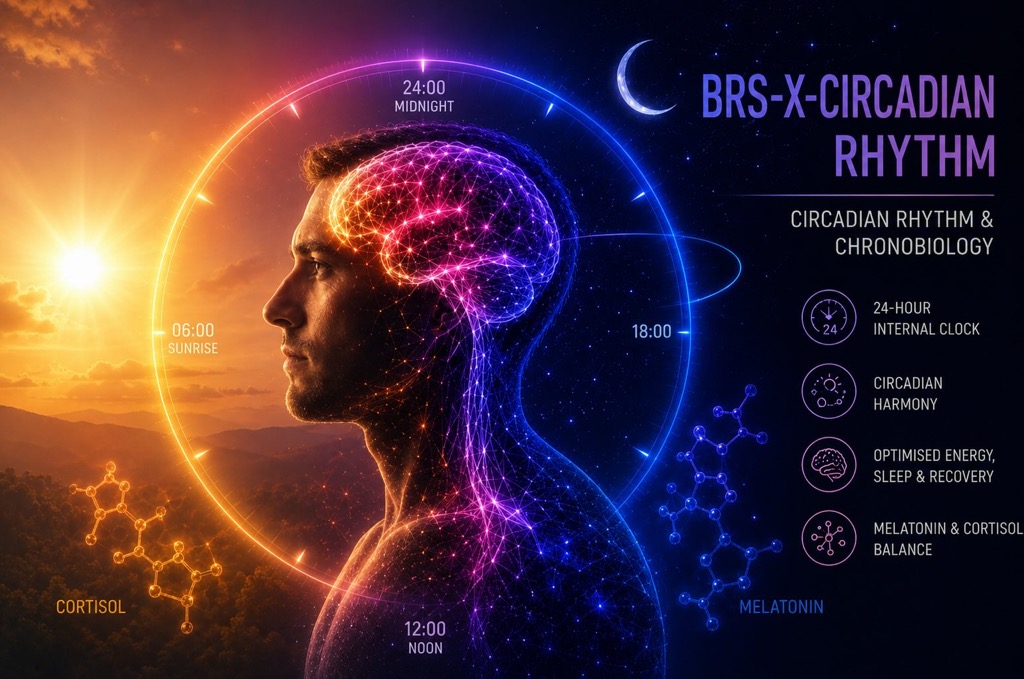
BRS-X-Circadian-1-3 - Melatonin Biosynthesis & Availability
1. Mission & Overview
Mission
Support the body's capacity to synthesise melatonin from serotonin through the availability of essential precursors and the activity of its biosynthetic enzymes.
Intervention Dominance: Diet-Supported — No principal intervention route established
Light entrainment and feeding time stay on PM1 and PM2.
Overview
Serotonin is acetylated to N-acetylserotonin by serotonin N-acetyltransferase (AANAT), using acetyl-CoA. N-acetylserotonin is methylated to melatonin by acetylserotonin O-methyltransferase (ASMT), using S-adenosylmethionine. Those reactions are the biochemical identity of this PM. [1]
In eight healthy volunteers, acute tryptophan depletion lowered nocturnal melatonin AUC compared with sham depletion. Free and total plasma tryptophan fell below 20% of baseline. That supports precursor availability as a constraint. It does not show that additional dietary tryptophan raises melatonin, improves sleep or changes ADHD outcomes. [2]
2. Primary Biological Effects
- AANAT acetylates serotonin to N-acetylserotonin. ASMT methylates N-acetylserotonin to melatonin. [1]
- Acute tryptophan depletion reduced nocturnal melatonin AUC in all eight volunteers. [2]
- The depletion result does not establish a benefit from extra tryptophan, better sleep or an ADHD outcome. [2]
3. Levers
- Tryptophan is a dietary precursor in the pathway leading to melatonin. Severe depletion lowered nocturnal melatonin, but benefit from additional intake is not established. A dietary recommendation for this mechanism has not been established; documented tryptophan in foods does not by itself establish a melatonin-raising effect.
- Acetyl-CoA — acetyl donor for AANAT. Not a dietary requirement.
- S-adenosylmethionine (SAM) — methyl donor for ASMT. Upstream biochemical dependency, with indirect dietary provision through established methylation pathways. Not a direct dietary requirement. Folate, vitamin B12, vitamin B6 and iron are not admitted here.
No mapping established.
No evidence-qualified system optimisation practice is projected. Meal timing stays on Circadian PM2.
No evidence-qualified lifestyle relationship is projected. Light entrainment stays on Circadian PM1.
4. Mechanistic Basis + Scientific Findings (SFs 2)
Summary
Melatonin formation from serotonin uses two enzyme steps. Acetyl-CoA and SAM are the biochemical donors. A human depletion experiment shows that driving tryptophan very low reduces nocturnal melatonin secretion. Ordinary food records for tryptophan are reused and are not a new intake target. [1] [2]
Mechanism boundary: Circadian PM1 owns light effects on the circulating melatonin signal. Circadian PM2 owns feeding time. BRS1 owns tryptophan-to-serotonin signalling. BRS2 owns SAM synthesis. Exogenous melatonin capsules are outside this PM.
The provisional Scientific Evidence Confidence for the depletion comparison is 4/8 (D2, B1, P1, R0). It is pinned to the depletion proposition only. It is not an intervention score and it is not copied onto the tryptophan relationship.
4.1 Scientific Findings (2)
Summary
The depletion study shows a constraint when tryptophan is driven very low. It does not show that eating more tryptophan raises melatonin, improves sleep or changes ADHD outcomes.
· Provisionally assessed · Evidence & Audit
In eight healthy volunteers, acute tryptophan depletion lowered nocturnal melatonin AUC compared with sham depletion.
What this means
The authors inferred a brain-serotonin step. Serotonin was not the reported endpoint. Sleep phase and ADHD outcomes were not reported in the retrieved abstract.
Evidence confidence: · Provisionally assessed · Evidence & Audit
Canonical record ID: PM3-F1
Finding Statement: In eight healthy volunteers, randomised double-blind acute tryptophan depletion lowered free and total plasma tryptophan below 20% of baseline and reduced nocturnal melatonin AUC compared with sham depletion in all eight. The result supports precursor availability as a biological constraint. It does not establish benefit from additional dietary tryptophan, improved sleep or ADHD outcomes.
Synthesised Evidence Confidence: · Provisionally assessed · Evidence & Audit
Synthesis: Severe acute tryptophan depletion reduced nocturnal melatonin secretion relative to sham.
Synthesis Limitations: Eight volunteers. The abstract does not give the AUC difference or a confidence interval. This is not a supplementation trial.
Evidence Considered:
- Study
- Randomised double-blind active versus sham acute tryptophan depletion.
- Population
- Eight healthy volunteers.
- Result
- Free and total plasma tryptophan fell below 20% of baseline. Nocturnal melatonin AUC was lower after active depletion than after sham in all eight.
- Effect / Magnitude
- Direction in all eight. No mean difference or interval was retrieved.
- Evidence Summary
- Precursor availability constrained nocturnal melatonin secretion under severe depletion.
- Limitations
- Not a test of extra dietary tryptophan, sleep benefit or ADHD outcome. Serotonin itself was not the reported endpoint.
- Evidence Source
- Bounded external search
- Reference
- [2]
A narrative review of dietary factors and melatonin names acetyl-CoA and S-adenosylmethionine on the serotonin-to-melatonin route.
What this means
The enzyme identities are the Scientific Principle. This Finding records the review's pathway statement only.
Evidence confidence: Not yet scored
Canonical record ID: PM3-F2
Finding Statement: Peuhkuri, Sihvola and Korpela (2012) describe pineal melatonin formation from serotonin, with AANAT as the main rate-limiting enzyme and S-adenosylmethionine named on the methylation step. This is a pathway review, not a new enzyme assay, and it does not show that extra intake of an upstream nutrient raises melatonin.
Synthesised Evidence Confidence: Not yet scored
Synthesis: The review places acetyl-CoA and S-adenosylmethionine on the route from serotonin to melatonin.
Synthesis Limitations: Narrative review. It does not admit folate, vitamin B12, vitamin B6, iron, zinc, magnesium or pantothenate, and it does not show a sleep or ADHD benefit.
Evidence Considered:
- Study
- Narrative review of dietary factors and melatonin.
- Population
- Not a new human cohort.
- Result
- The pathway figure and text place acetyl-CoA and S-adenosylmethionine on serotonin-to-melatonin formation.
- Effect / Magnitude
- No new effect size.
- Evidence Summary
- Pathway description, not a dietary-efficacy result.
- Limitations
- Not a new enzyme assay and not an intake trial.
- Evidence Source
- Bounded external search
- Reference
- [1]
5. BRS Pathways and Connections
5.1 BRS Pathways
- None listed
5.2 Cross-BRS Mechanism Relationships
Primary Mechanisms in other Biological Regulatory Systems that directly interact with, constrain or support this mechanism.
- BRS1-FM1-PM5 — Serotonergic Signalling Regulation — tryptophan to serotonin. That admission is not inherited here.
- BRS2-FM1-PM3 — SAMe Synthesis — indirect dietary provision of SAM. SAM is not a direct dietary requirement of this PM.
5.3 Local BRS Mechanism Relationships
Related Primary Mechanisms within the same Biological Regulatory System that collectively support the integrated biological function.
- BRS-X(Circadian-FM1-PM1) — Light–Dark Circadian Entrainment — light-driven secretion and phase. Not biosynthesis.
- BRS-X(Circadian-FM1-PM2) — Feeding-Time Circadian Synchronisation — meal timing. A meal delay that does not move melatonin stays on PM2.
7. Phenome Connections
These mappings are translational relationships, not single-mechanism outcome claims. Phenomes are emergent functional patterns supported by multiple interacting PMs across the BRAIN Framework.
Each Phenome relationship has two independent ratings. They are not combined or averaged.
Biology → Phenome Relationship Strength
How direct and important is this biological mechanism expected to be to the Phenome within the BRAIN model?
Evidence Confidence
How strongly does the adjudicated evidence support this particular biology → Phenome relationship?
No direct functional outcome relationship currently mapped.